
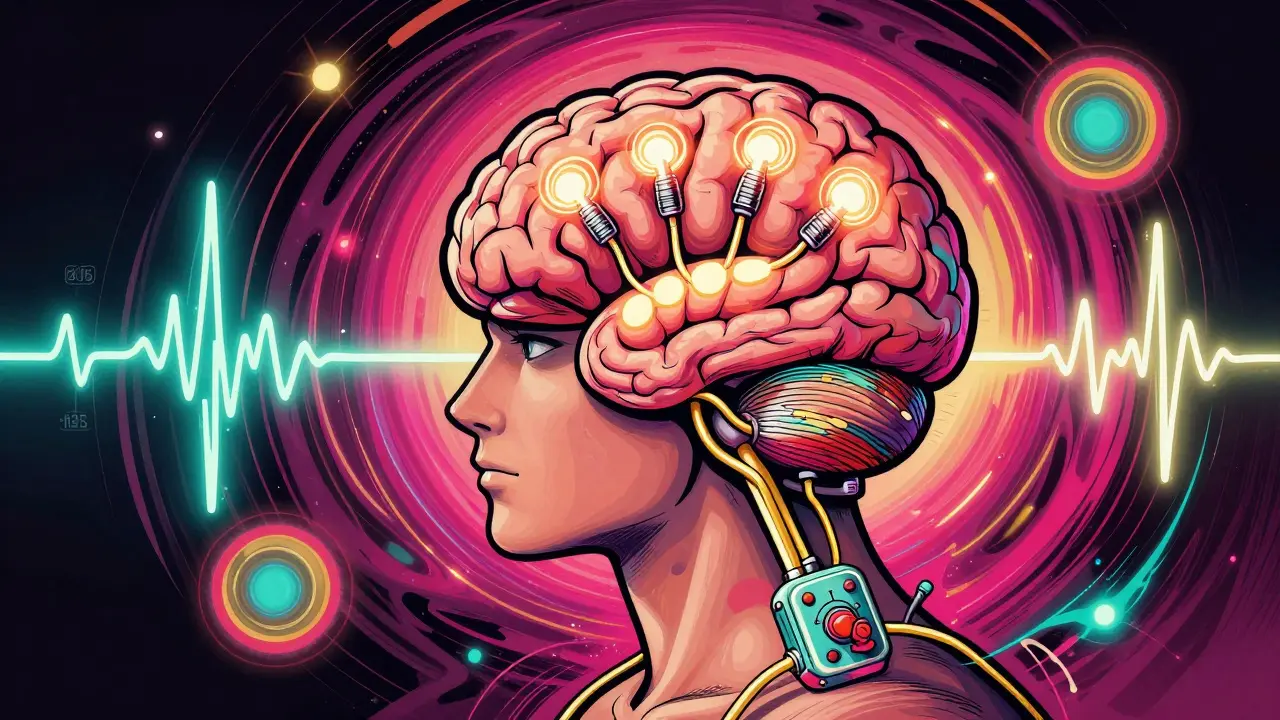
What Deep Brain Stimulation Actually Does for Parkinson’s
Deep Brain Stimulation, or DBS, isn’t a cure for Parkinson’s. It doesn’t stop the disease from progressing. But for many people, it changes everything. If you’ve been on levodopa for years and now your symptoms swing wildly between OFF times-when meds don’t work-and ON times with painful, uncontrollable movements (dyskinesias), DBS can bring back control. It doesn’t fix everything. But for the right person, it turns a life of unpredictability into one with more stability, more independence, and fewer pills.
The procedure implants thin wires (electrodes) into two small areas deep in the brain: either the subthalamic nucleus (STN) or the globus pallidus interna (GPi). These wires connect to a pacemaker-like device placed under the skin near your collarbone or belly. That device sends steady electrical pulses-usually between 60 and 185 times per second-to quiet down the overactive brain signals causing tremors, stiffness, and slowness. Modern systems like Medtronic’s Percept™ PC and Boston Scientific’s Vercise™ Genus™ can even sense brain activity and adjust stimulation automatically, a big leap from older models that just blasted the same signal all day.
Who Benefits Most from DBS?
Not everyone with Parkinson’s is a candidate. The best candidates have had the disease for at least five years and still respond well to levodopa. That’s the key. If your tremors or slowness improve dramatically after taking your morning pill, you’re likely a good fit. If your symptoms don’t budge with medication, DBS won’t help much. Studies show only 10% of people with atypical parkinsonism-like progressive supranuclear palsy or multiple system atrophy-see any benefit, compared to 60-70% of those with typical Parkinson’s.
Doctors use the Unified Parkinson’s Disease Rating Scale (UPDRS) to measure this. A 30% or better improvement in motor scores after taking levodopa is the minimum threshold. If you’re barely moving even after your meds, DBS won’t magically fix that. It only works on symptoms that respond to levodopa.
What They Test Before Surgery
Getting approved for DBS isn’t just about motor symptoms. It’s a full evaluation that takes months. First, a movement disorder neurologist confirms you have idiopathic Parkinson’s-not something else. Then comes neuropsychological testing: memory, attention, problem-solving, mood. If your MMSE score is below 24 or your MoCA is under 21, you’re usually not cleared. Cognitive decline can get worse after surgery, and no one wants to trade motor problems for memory loss.
You’ll also get a high-resolution 3T MRI to map your brain. Surgeons need to see the exact location of your STN or GPi. Some centers use microelectrode recording during surgery to listen to individual brain cells, ensuring the electrodes land within a millimeter of the target. This isn’t done everywhere, but in high-volume centers, it’s standard.
Then there’s the team meeting. Neurologist, neurosurgeon, neuropsychologist, and sometimes a speech therapist or social worker. They all weigh in. One person might say, “Her tremors are terrible, but her depression is severe.” Another might say, “He’s sharp, but his balance is failing-DBS won’t fix that.” Decisions aren’t made by one person. They’re made by consensus.
STN vs. GPi: Which Target Is Better?
There are two main targets for DBS electrodes: STN and GPi. Both work well for motor symptoms. But they have different trade-offs.
- STN lets you cut your levodopa dose by 30-50%. That’s huge. Less medication means fewer nausea episodes, less daytime sleepiness, and fewer dyskinesias. But STN has a higher risk of mood changes, word-finding trouble, and mild cognitive slowing.
- GPi reduces dyskinesias even more-up to 70%-and has fewer cognitive side effects. But it doesn’t let you reduce meds as much. You might still need the same dose, just with smoother effects.
Studies like the VA/NINDS CSP #468 trial found both targets improved motor function by about 49%. But GPi was better for dyskinesias and safer for thinking skills. So if you’re already struggling with memory or mood, GPi might be the safer pick. If you’re drowning in pills and want to cut back, STN could be worth the risk.
The Real-World Experience: Benefits and Downsides
People who get DBS often describe it as “getting their life back.” One user on the Parkinson’s Foundation Forum said his OFF time dropped from six hours a day to one. Another said his tremors vanished and he could hold a coffee cup again. In the EARLYSTIM trial, patients’ quality of life scores jumped by 23 points after DBS-nearly double the improvement from meds alone.
But it’s not perfect. About 10-15% of patients need hardware revisions-maybe because a wire moved, an infection popped up, or the battery died. Non-rechargeable batteries last 3-5 years. Rechargeable ones last 9-15, but you have to charge them every few days. Some people forget. Others find it annoying.
Cognitive changes are real. A Reddit user wrote, “My tremors are gone, but planning my day takes three times longer.” Word-finding issues, slower thinking, and emotional blunting happen in about 20-30% of cases. Speech therapy helps, but not always completely. And DBS doesn’t fix freezing, falls, or balance problems. Those axial symptoms only improve by 20-30%.
And then there’s the expectation gap. Some patients think DBS will stop the disease. It won’t. Others expect it to fix depression or sleep issues. It might help a little, but it’s not designed for that. Managing expectations is half the battle.
Why So Few People Get It
Here’s the shocking part: only 1-5% of people who qualify for DBS actually get it. Why? Many doctors don’t refer patients early enough. Some think it’s too risky. Others assume patients are too old. Insurance takes months to approve. Some centers don’t have the team or the tech.
And the cost? In the U.S., it’s $50,000 to $100,000. But Medicare and most private insurers cover it for Parkinson’s. The real barrier isn’t money-it’s awareness. The Parkinson’s Foundation calls DBS “markedly underutilized.” Too many people suffer for years, thinking there’s nothing else to try. Then, when they’re too far along, it’s too late.
What’s Next for DBS
The technology is getting smarter. The FDA approved Medtronic’s Percept™ PC in 2020-it’s the first “closed-loop” system that senses brain signals and adjusts stimulation on the fly. Early trials show 27% better symptom control than traditional DBS. Future versions might link to smartwatches, using tremor data to fine-tune settings remotely.
Researchers are also testing DBS earlier-maybe after just three years of Parkinson’s, not five. The EARLYSTIM-2 trial is looking at whether earlier intervention slows decline. And they’re exploring genetic markers. People with LRRK2 mutations respond 15% better to DBS, according to a 2023 Lancet Neurology study. That could mean personalized selection in the future: not just based on symptoms, but on your DNA.
What to Do If You’re Considering DBS
If you think you might be a candidate, talk to your neurologist. Ask: “Do I still respond well to levodopa?” “Have I been evaluated for cognitive issues?” “Is my team experienced with DBS?”
Look for a center that does at least 50 DBS surgeries a year. Higher volume means fewer complications. Ask if they use 3T MRI, microelectrode recording, and multidisciplinary team reviews. Don’t settle for a hospital that just refers you to a surgeon without a full neuropsych evaluation.
Keep a symptom diary. Note your ON/OFF times, dyskinesias, and medication doses. Bring it to every appointment. That data helps the team decide if you’re ready.
And don’t wait. The best results come when you get DBS before your body and brain are too worn down by years of uncontrolled symptoms.
Is DBS a cure for Parkinson’s?
No, DBS is not a cure. It doesn’t stop Parkinson’s from progressing. It only treats the motor symptoms that respond to levodopa-like tremors, stiffness, slowness, and dyskinesias. It won’t fix problems like balance issues, freezing, dementia, or depression, though some people see mild improvements in those areas.
How long does DBS last?
The electrodes implanted in the brain usually last a lifetime. The battery in the pulse generator lasts 3-5 years for non-rechargeable models and 9-15 years for rechargeable ones. When the battery dies, you need a minor surgery to replace it. Most people need one or two replacements over their lifetime. Studies show 85% of patients still benefit 10 years after surgery.
Can DBS make Parkinson’s worse?
It doesn’t make the disease worse, but it can cause new problems. About 10-15% of patients experience side effects like speech changes, balance issues, or cognitive slowing. These are often due to incorrect programming or electrode placement. In rare cases, infection or bleeding can occur. Most complications are fixable with adjustments or revision surgery.
What if I don’t respond to levodopa?
If your symptoms don’t improve after taking levodopa, DBS is unlikely to help. The procedure only works on symptoms that respond to medication. People with atypical parkinsonism-like PSP or MSA-usually get little to no benefit. Your neurologist will test your levodopa response before even considering DBS.
How long does recovery take after surgery?
Most people go home within 24-48 hours. You’ll need 4-6 weeks to heal from the surgery before programming starts. Programming itself takes 6-12 months. You’ll need monthly visits at first, then quarterly. It’s not a one-time fix-it’s a long process of fine-tuning. Patience is key.
Is DBS covered by insurance?
Yes, Medicare and most private insurers cover DBS for Parkinson’s disease when criteria are met. But getting approval can take 3-6 months. You’ll need documentation showing you’ve tried and optimized medications, and that you meet motor response and cognitive criteria. Your center’s DBS coordinator will help with this process.
Can I have an MRI after DBS?
Yes, but only under strict conditions. Modern DBS systems (like Medtronic Percept™ and Boston Scientific Vercise™) are MRI-conditional. You can have a 3T MRI, but only if the device is turned off and specific safety protocols are followed. Always inform your radiology team you have a DBS device before any scan.
Aayush Khandelwal
December 30, 2025 AT 22:46Man, DBS is like hitting the reset button on your nervous system-except the reset button is surgically implanted in your skull and programmed by a neuroengineer who probably drinks too much coffee. STN vs GPi? It’s not just a choice-it’s a trade-off between freedom from pills and freedom from brain fog. I’ve seen folks go from crawling to coffee runs post-surgery, but also watch others lose their train of thought mid-sentence. The tech’s wild now-closed-loop systems that *listen* to your brain like a therapist with a neural stethoscope. Mind-blowing. But yeah, if you’re still on the fence, ask yourself: do I want to live with less levodopa or less mental clarity? There’s no right answer, just different flavors of compromise.
Colin L
December 31, 2025 AT 15:20Okay so I just spent 47 minutes reading this and I have to say-I’m genuinely moved. I mean, I have a cousin in Manchester who’s been on levodopa since 2012 and her tremors are so bad she can’t hold a teacup without spilling it all over her lap, and she’s been told she’s not a candidate because her MMSE is 23.9 and apparently that’s one point too low? That’s insane. Like, what’s the point of medicine if it’s just about ticking boxes? I get that cognitive decline is a risk, but if you’re already living in a body that won’t obey you, isn’t risking a little brain fog better than never holding your grandchild’s hand again? And why is it that only 5% of people who qualify get it? Is it because doctors are scared of liability or because they just don’t care enough to push? I’m not mad, I’m just… disappointed. And also, can someone explain to me why the battery has to be replaced? Why can’t we just have a wireless, self-charging, AI-powered brain pacemaker? We’re in 2025. We have smart fridges that order milk. Why can’t we have a brain device that recharges itself from body heat? I’m just saying.
Hayley Ash
January 2, 2026 AT 07:23srishti Jain
January 3, 2026 AT 18:16Cheyenne Sims
January 4, 2026 AT 16:24It is imperative to underscore that Deep Brain Stimulation is not a panacea, nor is it a cure. The medical literature is unequivocal on this point. Any assertion suggesting otherwise constitutes a dangerous misrepresentation of clinical reality. Furthermore, the notion that patients should be encouraged to undergo this procedure without exhaustive neuropsychological screening is not only irresponsible-it is ethically indefensible. The United States healthcare system must prioritize evidence-based decision-making over anecdotal testimonials from online forums. Quality of life improvements are statistically significant, yes, but they do not override the imperative of patient safety. I urge all clinicians to adhere strictly to established guidelines and refrain from succumbing to the allure of technological novelty.
Shae Chapman
January 5, 2026 AT 13:56Okay I just cried reading this 😭 I have my dad’s symptom diary from the last 8 years and seeing how he went from ‘I can still walk the dog’ to ‘I need help standing up’… and now after DBS he held my hand for 10 minutes without shaking? 🥹 I know it’s not perfect, I know he forgets words now and sometimes looks tired, but he laughed today. Real laugh. Not the fake one he’s been forcing since 2019. I’m so grateful. If you’re on the fence? Please, just talk to someone who’s been through it. It’s not magic. But it’s hope. And hope is worth fighting for 💪❤️
Nadia Spira
January 7, 2026 AT 05:37Let’s be brutally honest: this whole DBS industry is a $100K placebo with electrodes. The ‘closed-loop’ systems? Marketing jargon dressed up as innovation. The VA/NINDS trial? Underpowered. The ‘23-point QoL improvement’? Measured with a scale designed by engineers who’ve never held a shaking coffee cup. And don’t get me started on the ‘10-15% revision rate’-that’s not a complication, that’s a feature of a system that’s fundamentally unstable. You’re replacing one chronic condition with another: now you’re a human with a pacemaker that needs charging, programming, and occasional surgery. Meanwhile, the real issue-neurodegeneration-is ignored. They’re treating symptoms like a broken faucet while the whole house is on fire. Wake up. This isn’t progress. It’s expensive damage control.
Henry Ward
January 7, 2026 AT 06:24People act like DBS is some miracle cure but let’s be real-you’re trading one set of problems for another. Tremors gone? Great. Now your speech is slurred and you can’t remember your kid’s birthday. And who’s paying for all these battery replacements? Insurance? Yeah, right. Then you get stuck with a $20k out-of-pocket bill because your ‘coverage’ has a loophole. And don’t even get me started on the ‘team meeting’-five people sitting around deciding if your life is worth saving based on a 24 on the MMSE? That’s not medicine, that’s eugenics with a stethoscope. If your brain’s not perfect, you’re not eligible. Who made them the gatekeepers of humanity? I’ve seen patients die waiting for approval. This system isn’t broken-it was designed this way.
kelly tracy
January 7, 2026 AT 16:18So let me get this straight-you’re telling me that after spending 18 months on a waiting list, getting cleared by 7 specialists, surviving brain surgery, and then enduring 10 months of programming sessions… you still can’t walk without freezing? And the battery dies every 5 years? And you have to charge it like your phone? And if you forget? You’re back to being a puppet with cut strings? And this is the best we’ve got? I’m not even mad. I’m just… exhausted. This isn’t progress. It’s a very expensive, very invasive band-aid on a bullet wound.
henry mateo
January 7, 2026 AT 20:11just read this whole thing and wow. i had no idea dbs could adjust on its own now. my uncle got it in 2018 and his battery died last year and he had to get a new one. he said the new one feels way smoother. i think he said something about it learning his brain patterns? i’m not sure i got all the tech stuff but he’s holding his coffee again so i’m happy. also he still forgets words sometimes but he laughs more. that’s the win right? ty for writing this.
Kunal Karakoti
January 7, 2026 AT 20:48DBS is a fascinating intersection of neurobiology, engineering, and existential negotiation. The brain, once considered a black box, is now being modulated like a dial on a radio-fine-tuned, calibrated, optimized. But what does it mean to ‘improve’ a person’s life when the self is inherently entangled with the malfunctioning system? If your tremors vanish but your emotional resonance dulls, are you still you? Or are you a more stable, less human version? The technology doesn’t ask these questions. It just delivers. And perhaps that’s the tragedy-not that it fails, but that it succeeds too well, leaving us to wonder what we sacrificed for silence.
Kelly Gerrard
January 9, 2026 AT 06:17DBS is a life-changing medical breakthrough that must be made accessible to all qualified patients without delay. The data is clear. The outcomes are proven. The barriers are bureaucratic and outdated. We must expand center capacity, reduce approval timelines, and eliminate stigma around neurological interventions. Every day of delay is a day lost to dignity. This is not optional. This is essential care. Act now.