
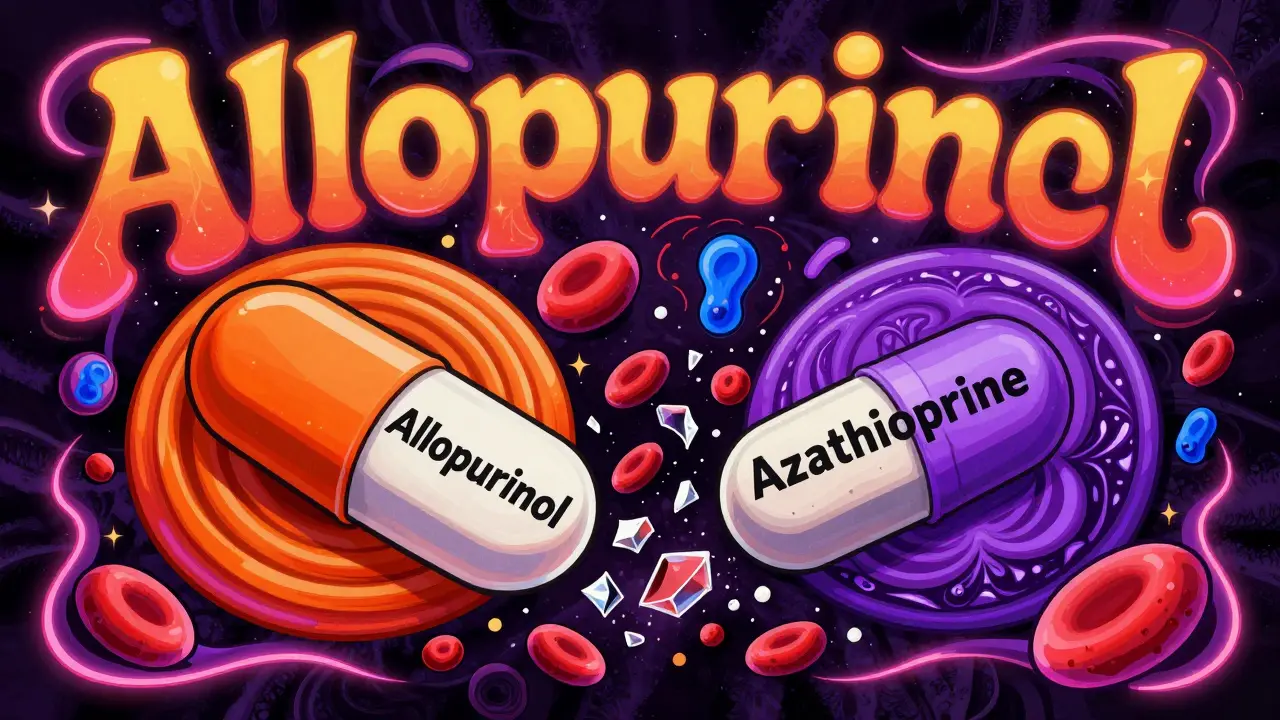
Drug Interaction Risk Checker
Allopurinol & Azathioprine Interaction Risk Assessment
This tool helps determine the risk level of combining allopurinol (gout medication) and azathioprine (immune suppressant) based on medical guidelines.
Risk Assessment:
Combining allopurinol and azathioprine can be deadly. It’s not a rare mistake-it’s a well-documented, life-threatening interaction that has sent patients to the ICU, cost thousands in hospital bills, and even led to death when overlooked. If you’re taking azathioprine for Crohn’s disease, ulcerative colitis, rheumatoid arthritis, or after an organ transplant, and your doctor prescribes allopurinol for gout, you need to know what’s at stake.
Why This Interaction Is So Dangerous
Allopurinol lowers uric acid to prevent gout flares. Azathioprine suppresses the immune system to treat autoimmune diseases and prevent organ rejection. On the surface, they seem unrelated. But inside your body, they collide in a way that can shut down your bone marrow. The problem lies in how your body breaks down azathioprine. It turns into 6-mercaptopurine (6-MP), which then gets processed by three enzymes. One of them-xanthine oxidase-is blocked by allopurinol. When that happens, 6-MP can’t be safely broken down. Instead, it builds up and gets turned into toxic compounds that attack your blood cells. Studies show this can increase 6-MP levels by up to four times. That means your body is flooded with a drug meant to be carefully dosed. The result? White blood cells, platelets, and red blood cells crash. One case from 1996 described a patient with white blood cell counts as low as 1,100/mm³ (normal is 4,000-11,000). His platelets dropped below 20,000/mm³ (normal is 150,000-450,000). He needed blood transfusions and intensive care.The Clinical Consequences: What Happens When It Goes Wrong
This isn’t theoretical. It’s happened in real people-often because the connection wasn’t made. - Pancytopenia: All three types of blood cells drop dangerously low. This leaves you vulnerable to infections, bleeding, and extreme fatigue. - Neutropenia: Absolute neutrophil counts can fall below 0.5 × 10³/mm³. Without enough neutrophils, even a minor cold can turn septic. - Thrombocytopenia: Platelets under 20,000/mm³ mean you can bleed from a bump or bruise that shouldn’t hurt. - Anemia: Hemoglobin can plummet to 3.7 g/dL (normal is 12-16 g/dL). You’ll feel like you’re running on empty, even when you’re sitting still. The 1996 case that first brought this to light cost over $25,000 in today’s money. More recent cases have exceeded $50,000 in hospital bills. And those are just the financial costs. The physical toll-weeks in the hospital, repeated blood tests, fear of infection, lost work, missed family events-is harder to measure.When Doctors Might Still Use Them Together (And How)
You might hear that some doctors still prescribe both drugs together. That’s true-but only in very specific cases, and only under strict supervision. About 25-30% of people with inflammatory bowel disease (IBD) are "thiopurine shunters." Their bodies turn azathioprine into a liver-toxic metabolite (6-MMP) instead of the therapeutic one (6-TGN). This means they get side effects without the benefit. In these rare cases, adding a low dose of allopurinol can redirect metabolism toward 6-TGN and away from 6-MMP. A 2018 trial showed that when used this way-with azathioprine reduced to 25% of the normal dose-53% of patients achieved steroid-free remission. That’s life-changing for someone who’s been dependent on steroids for years. But here’s the catch: this is not a DIY fix. It requires:- Baseline blood tests (CBC, liver enzymes)
- Thiopurine metabolite testing (6-TGN and 6-MMP levels)
- Azathioprine dose cut to 0.5-0.75 mg/kg/day (not the standard 2-2.5 mg/kg)
- Weekly blood counts for the first three months
- Expert oversight from a gastroenterologist or specialized pharmacist
What You Should Do If You’re Taking Azathioprine
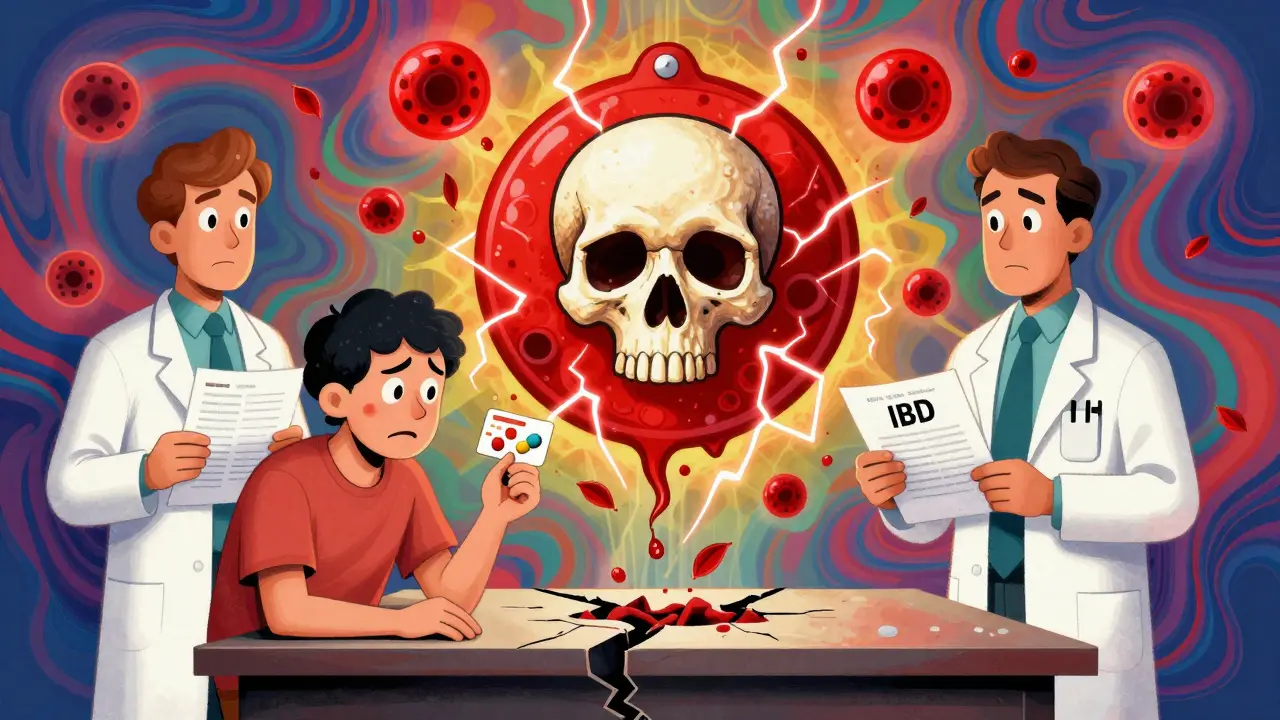
If you’re on azathioprine, here’s what you need to do right now:- Check your medication list. Do you have allopurinol? If so, don’t stop it-but don’t take it either until you talk to your doctor.
- Ask your doctor: "Am I on azathioprine? Is allopurinol safe with it?" If they say yes without mentioning dose reduction or monitoring, get a second opinion.
- Know your alternatives for gout. Febuxostat is a xanthine oxidase inhibitor like allopurinol-but it doesn’t block the same enzyme pathway. It’s often a safer choice for people on azathioprine. Colchicine can treat flares. Pegloticase is an option for severe, refractory gout.
- Carry a medication card. Write down all your drugs and show it to every new provider. Many cases happen because a new doctor doesn’t know your full history.
What Doctors Should Be Doing
Prescribers need to treat this interaction like a landmine. The FDA’s black box warning on azathioprine exists for a reason. Here’s what should happen every time azathioprine is prescribed:- Screen for allopurinol use before starting.
- Ask about gout, kidney stones, or recent joint pain.
- Document the conversation: "Patient informed of interaction risk. Alternative gout treatment discussed."
- Never start both drugs together unless under specialist care with metabolite monitoring.

The Bigger Picture: Why This Keeps Happening
This interaction keeps causing harm because medicine is fragmented. A rheumatologist treats your arthritis with azathioprine. A primary care doctor treats your gout with allopurinol. Neither talks to the other. You’re the one stuck in the middle. Also, many patients don’t know the names of their drugs. They just know "the pill for my joints" and "the pill for my gout." If they don’t know what they’re taking, they can’t ask the right questions. And even when doctors know, they sometimes assume the patient is being monitored. But in community clinics, that monitoring often doesn’t happen.What’s Changing Now
The good news? Awareness is growing. The 2022 American College of Gastroenterology guidelines now include a conditional recommendation for the combination in thiopurine shunters. That’s progress. New tools are emerging too:- TPMT genetic testing can identify people with low enzyme activity, who are at higher risk.
- Thiopurine metabolite testing (6-TGN and 6-MMP) is becoming more accessible.
- Alternative drugs like methotrexate, ustekinumab, and vedolizumab are replacing azathioprine in many cases.
Cecelia Alta
January 11, 2026 AT 21:26Okay so I just got back from my rheum appointment and my doc just slapped allopurinol on my script like it was Advil. I’m on azathioprine for Crohn’s. I almost walked out. Like… are you kidding me? I Googled it on the car ride home and nearly had a heart attack. This post is terrifyingly accurate. I’m calling my doctor tomorrow to demand a second opinion. I don’t care if he’s ‘busy’-I’m not dying because someone didn’t connect two dots.
Also, why is this not a mandatory pop-up in every EHR? Like, if you type in azathioprine and then allopurinol, shouldn’t the system scream at you? Someone’s getting paid to design these things and they let this slide? I’m furious.
Also also-my pharmacist didn’t flag it either. What even is the point of having pharmacists if they’re just glorified pill dispensers now?
I’m sending this to my entire family group chat. Everyone needs to know this. I’m not the only one on this combo. I swear I’ve seen it before.
Why is this not in every med school lecture? Why is it still happening? This isn’t rare. It’s negligence dressed up as ‘clinical discretion.’
laura manning
January 13, 2026 AT 19:11It is imperative to underscore that the pharmacokinetic interaction between allopurinol and azathioprine is not merely a theoretical concern but a well-documented, clinically significant, and potentially lethal metabolic inhibition. Xanthine oxidase, encoded by the XO gene, is the principal enzyme responsible for the catabolism of 6-mercaptopurine, the active metabolite of azathioprine. Allopurinol, a structural analog of hypoxanthine, acts as a potent, irreversible inhibitor of this enzyme, thereby causing a 300–400% increase in 6-MP plasma concentrations. This results in profound myelosuppression, as evidenced by multiple case reports in the Journal of Clinical Oncology and the New England Journal of Medicine. The FDA’s black box warning, issued in 2005, remains underutilized in primary care settings. Furthermore, the absence of mandatory thiopurine metabolite monitoring (6-TGN/6-MMP) in non-specialist environments constitutes a systemic failure in pharmacovigilance. This is not an oversight-it is a preventable catastrophe.
Jay Powers
January 14, 2026 AT 09:04I get why this is scary but I also know people who’ve been on both meds for years and are fine. The key is the dose. Like, if your doc cuts your azathioprine way down and checks your blood every week, it can actually help. My cousin’s GI doc did this for her after years of steroid dependence. She’s been in remission for 3 years now. It’s not magic, it’s not for everyone, but it’s not always a death sentence either.
Don’t panic. But do ask. And if your doctor says ‘it’s fine’ without mentioning metabolites or dose reduction, walk out. Find someone who knows what they’re doing. This stuff matters. But fear shouldn’t stop you from getting better-it should just make you smarter about who you trust.
Lawrence Jung
January 15, 2026 AT 17:24Medicine is just another religion now. We worship the pill, the lab, the algorithm. We forget that the body is not a machine. Allopurinol and azathioprine? Two symbols of our arrogance. We think we can control metabolism like we control a thermostat. But the body remembers. It holds the memory of every drug, every dose, every ignored warning. This interaction isn’t a mistake-it’s a message. The body is saying: you are not the master. You are the student. And if you keep treating biology like a spreadsheet, you will keep losing.
Maybe the real problem isn’t the drugs. Maybe it’s the belief that we can fix everything with more tests, more pills, more protocols. What if the answer is stillness? Listening? Letting go?
Just saying.
beth cordell
January 16, 2026 AT 15:38OMG I JUST GOT THIS PRESCRIPTION TODAY 😱 I thought allopurinol was just for gout 😭 I’m on azathioprine for my lupus and I was like ‘cool, another pill’ but now I’m shaking. Thank you for posting this. I’m literally deleting the app right now and calling my rheum. 🙏❤️
Also-can someone recommend a good gout med that doesn’t kill you? Febuxostat? Is that a thing? 😅
Rinky Tandon
January 17, 2026 AT 01:24Let me be blunt-this is a catastrophic failure of clinical pharmacology in the U.S. healthcare system. The 6-MP metabolic shunt is a well-characterized pathway since the 1970s, yet primary care providers continue to prescribe allopurinol without screening for thiopurine use. This is not ignorance-it’s institutional negligence. The TPMT genotype is available for under $150 via 23andMe. The 6-TGN/6-MMP metabolite assay is covered by Medicare. Yet, in 2024, patients are still being exposed to life-threatening myelosuppression because no one is doing their job.
Furthermore, the lack of interoperability between rheumatology, gastroenterology, and PCP EHRs is a structural flaw that must be addressed at the policy level. This is not a patient education issue. It’s a systemic failure of care coordination. The ACG guidelines are a start, but without enforcement, they are meaningless. We need mandatory CPOE alerts. We need pharmacy-level flags. We need consequences for prescribers who ignore black box warnings. This isn’t ‘bad luck.’ It’s malpractice waiting to happen.
Ben Kono
January 18, 2026 AT 15:16Wait so I’ve been on both for 2 years? My doc said it was fine. I’ve been fine. No blood transfusions. No ICU. I’ve had my blood drawn every 3 months. So what’s the big deal? Maybe you’re just scared of pills. I’ve got friends who’ve been on this combo since 2015. They’re alive. Maybe the real risk is fear-mongering?
Also, why are you all acting like this is new? It’s been in the textbooks since the 90s. If you’re not checking your labs, that’s your fault. Not the doctor’s. Not the drug’s.
Cassie Widders
January 20, 2026 AT 10:44My mum was on azathioprine for RA. Got allopurinol for gout. She had a scary week with low platelets. They caught it fast because her pharmacist called the clinic. She’s fine now. Just switched to febuxostat. The scary part? The GP didn’t know about the interaction. The pharmacist did. Why do we still rely on pharmacists to catch what doctors miss?
jordan shiyangeni
January 20, 2026 AT 16:53It’s not just the drugs. It’s the culture. You think this is an accident? It’s not. It’s the result of 30 years of corporate medicine prioritizing efficiency over safety. Doctors see 25 patients an hour. They don’t have time to check interactions. They rely on software that doesn’t warn them because the EHR vendor didn’t pay for the upgrade. Meanwhile, the pharmaceutical companies make billions off these prescriptions because they know the system is broken. And you, the patient, are the collateral damage.
You think you’re being ‘informed’ because you read a Reddit post? You’re still a cog. The system wants you to be scared, but not empowered. It wants you to trust the doctor, but not question the protocol. It wants you to pay for the mistake, not the provider.
This isn’t about allopurinol and azathioprine. It’s about a healthcare system that treats human life like a line item on a spreadsheet. And until you stop accepting that, you’ll keep getting poisoned by convenience.
Abner San Diego
January 22, 2026 AT 16:27Y’all are acting like this is some secret. It’s in the damn FDA warning. If you’re dumb enough to take both without knowing, you deserve what you get. This isn’t a medical mystery. It’s a basic pharmacology 101 thing. We’ve had computers for 30 years. Why are we still having this conversation? I’m from the Midwest. We don’t have time for this. If you’re on azathioprine, you should know what it does. Don’t blame the doctor. Blame yourself for not reading the damn pamphlet.
Also, febuxostat is expensive. So what? If you can’t afford it, get on Medicaid. Don’t risk your life for a $5 pill.
Eileen Reilly
January 23, 2026 AT 16:46ok so i just got my lab results and my wbc was 2.1 and my platelets were 18k and my doc said ‘oh weird’ and didn’t mention allopurinol. i’ve been on it for 6 months. i’m 28. i just got diagnosed with gout last month. i’m terrified. i’m going to the er tomorrow. i’m gonna print this out and hand it to them. please tell me i’m not the only one who got this wrong.
also can someone explain what 6-MMP even means? i googled it and my brain hurt.