

For years, treating type 2 diabetes meant one thing: lower blood sugar. But since 2015, everything has changed. A new class of pills - SGLT2 inhibitors - proved they don’t just manage glucose. They save hearts. They protect kidneys. And for many patients, they’re becoming the most important drug in their regimen.
What SGLT2 Inhibitors Actually Do
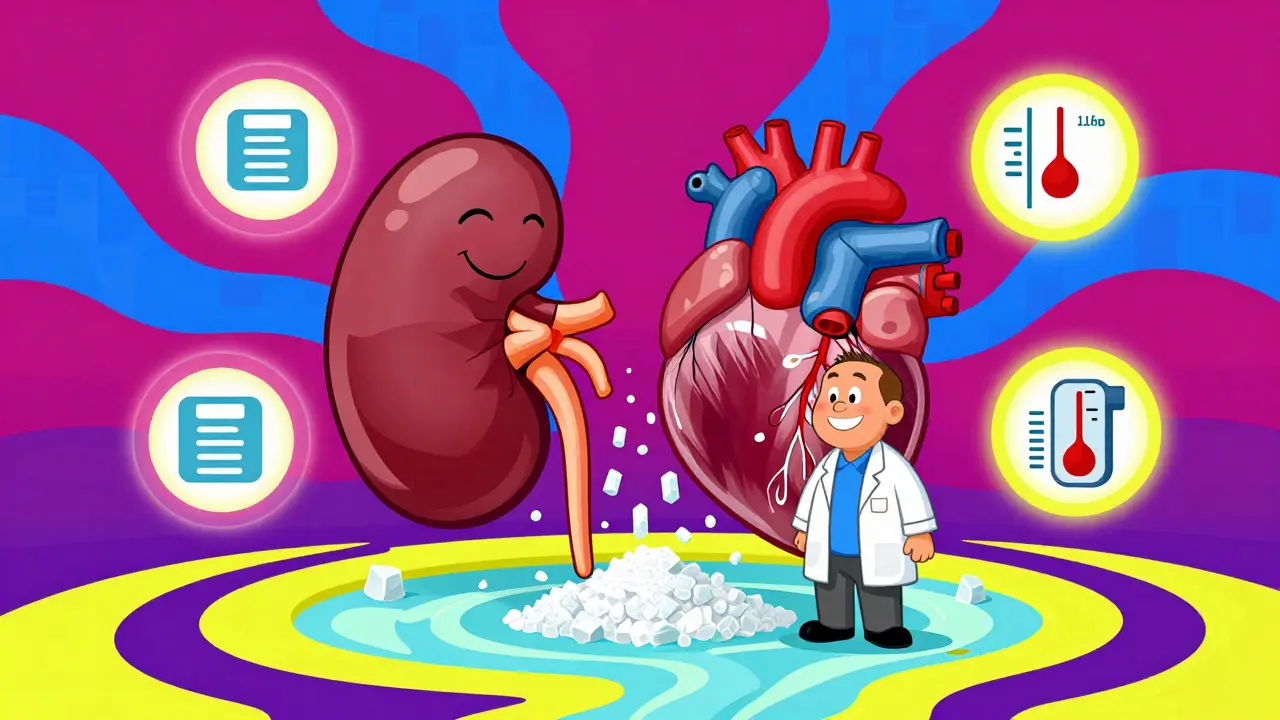
SGLT2 inhibitors - like Jardiance, Farxiga, and Invokana - work in the kidneys, not the pancreas. While most diabetes drugs force the body to make more insulin or make cells more sensitive to it, these drugs let the body do something natural: pee out extra sugar.
Normally, your kidneys reabsorb almost all the glucose filtered from your blood. But in type 2 diabetes, the kidneys get greedy. They reabsorb even more, keeping blood sugar high. SGLT2 inhibitors block that process. They stop a protein called SGLT2 from grabbing glucose back into the bloodstream. Instead, about 60 to 80 grams of sugar leave the body each day in urine.
This isn’t just a trick to lower HbA1c. It’s a system-wide reset. You lose weight - typically 2 to 3 kg over a few months. Your blood pressure drops by 3 to 5 mmHg. Your body starts burning fat for fuel more efficiently. And crucially, your kidneys and heart feel less strain.
The Heart Protection That Changed Everything
The EMPA-REG OUTCOME trial in 2015 was the turning point. Researchers gave empagliflozin to over 7,000 people with type 2 diabetes and known heart disease. After three years, those on the drug had a 38% lower risk of dying from heart problems. That’s not a small benefit. That’s a breakthrough.
Follow-up studies confirmed it. Canagliflozin cut major heart events by 14%. Dapagliflozin reduced hospital stays for heart failure by 27%. Even people without diabetes but with heart failure saw benefits. In the DAPA-HF and EMPEROR-Reduced trials, SGLT2 inhibitors improved survival and reduced hospitalizations in heart failure patients - whether they had diabetes or not.
Doctors now treat heart failure differently because of these drugs. The European Society of Cardiology and the American Heart Association both recommend SGLT2 inhibitors as first-line treatment for heart failure with reduced ejection fraction. That’s rare. Most drugs only treat symptoms. These fix the underlying problem.
Kidney Protection: Slowing Down the Slow Crash
Diabetic kidney disease is one of the leading causes of dialysis. For decades, ACE inhibitors and ARBs were the only tools to slow it down. Then came CREDENCE.
This trial tested canagliflozin in over 4,400 patients with type 2 diabetes and advanced kidney disease. After 2.6 years, those on the drug had a 30% lower risk of kidney failure, doubling of creatinine, or kidney-related death. That’s not just a trend. It’s a halt.
The EMPA-KIDNEY trial in 2023 took it further. Empagliflozin reduced major kidney events by 28% - even in people without diabetes. That means these drugs may soon be used for chronic kidney disease regardless of blood sugar levels.
How? It’s not just about sugar. SGLT2 inhibitors reduce pressure inside the kidney’s filtering units (glomeruli). This lowers inflammation and scarring. The initial dip in eGFR you might see? That’s not damage. It’s the kidneys relaxing. After 2-3 months, kidney function stabilizes - and often improves.
How They Compare to Other Diabetes Drugs
Metformin is still the first pill most doctors prescribe. It’s cheap, safe, and helps with weight. But it doesn’t reduce heart attacks or kidney failure the way SGLT2 inhibitors do.
Sulfonylureas like glimepiride? They lower blood sugar, but they cause low blood sugar episodes and weight gain. No heart or kidney protection.
DPP-4 inhibitors? They’re neutral - no weight gain, no hypoglycemia, but no real organ protection either.
GLP-1 agonists like semaglutide (Wegovy, Ozempic) are powerful too. They help with weight, heart, and kidneys. But they’re injections. SGLT2 inhibitors are pills. And they’re cheaper - even with insurance, metformin costs $4 a month. SGLT2 inhibitors run $500-600 a month, but many insurers cover them now for high-risk patients.
For someone with diabetes, heart disease, or early kidney damage, SGLT2 inhibitors aren’t just an option. They’re often the best choice.
Real People, Real Results
On patient forums, stories are mixed but telling.
One man on Reddit said he lost 12 pounds in three months on Jardiance. “I didn’t even try,” he wrote. “I just peed out the extra sugar.”
Another, with heart failure, saw her ejection fraction jump from 25% to 35% after adding Farxiga. Her cardiologist called it “remarkable.”
But there are downsides. Genital yeast infections happen in about 4-5% of users - mostly women. Urinating more often is common, especially at first. Some report fatigue or dizziness when starting, usually because of mild dehydration.
The biggest concern? Diabetic ketoacidosis. It’s rare - about 1 in 1,000 users - but it can happen even when blood sugar isn’t very high. That’s called euglycemic DKA. It’s dangerous. If you’re sick, fasting, or having surgery, your doctor may tell you to pause the drug temporarily.
Who Should Take Them - and Who Shouldn’t
If you have type 2 diabetes and any of these, SGLT2 inhibitors are likely a strong fit:
- Heart failure (even without diabetes)
- Chronic kidney disease (eGFR ≥30)
- History of heart attack or stroke
- High blood pressure and obesity
They’re not for everyone:
- Type 1 diabetes - risk of DKA is too high
- eGFR below 30 - kidneys can’t process them
- Severe dehydration or low blood pressure
- History of amputation - canagliflozin has a small increased risk
Doctors now screen for these before prescribing. It’s not just about glucose anymore. It’s about your whole body.
What’s Next for These Drugs?
The FDA approved dapagliflozin for chronic kidney disease without diabetes in early 2021. That was huge. Now, the EMPA-KIDNEY data suggests it might soon be approved for all forms of kidney disease - even if you don’t have diabetes.
Trials are also testing them in prediabetes, metabolic syndrome, and even non-alcoholic fatty liver disease. Early results are promising.
By 2027, the global market for these drugs could hit $18.5 billion. But generics are coming. Patents expire between 2025 and 2028. When that happens, prices could drop 60-70%.
For patients, that means better access. For doctors, it means fewer excuses not to prescribe.
Final Takeaway
SGLT2 inhibitors aren’t just another diabetes pill. They’re a new kind of medicine - one that treats the whole person, not just one number on a lab report. If you have type 2 diabetes and heart or kidney issues, ask your doctor if one of these drugs is right for you. The evidence isn’t just strong. It’s life-changing.
Arlene Mathison
January 21, 2026 AT 08:25This is wild. I didn’t know peeing out sugar could save your heart. My uncle’s on Farxiga now and he’s got more energy than me. No more 3 p.m. crashes. I swear, it’s like his body finally got the memo to stop being lazy.
pragya mishra
January 22, 2026 AT 12:36Why are you all so excited? Big Pharma pushed this because they can charge $600/month. In India, we can’t even get metformin reliably. This is just another profit scheme disguised as medicine.
Manoj Kumar Billigunta
January 22, 2026 AT 16:18Pragya, I get your point. But in my clinic, I’ve seen patients on these drugs avoid dialysis. It’s not about profit-it’s about survival. If you can’t afford it, talk to your doctor about patient assistance programs. There are options.
clifford hoang
January 24, 2026 AT 13:22They’re not really peeing out sugar… they’re just letting the government’s secret kidney surveillance drones drain your glucose to track your health metrics. 🤫👁️🗨️
They’re also using the sugar to power AI drones that fly over your house. That’s why your pee smells weird now. #SGLT2IsTheNewNSA
Also, why do all the trials have ‘Outcome’ in the name? Coincidence? I think not. 😈
Emily Leigh
January 25, 2026 AT 20:51Ugh. Another ‘miracle drug’ that’s basically just a fancy diuretic. I’m tired of being sold hope wrapped in clinical trial jargon. Also, ‘euglycemic DKA’? That’s just a fancy way of saying ‘your body’s on fire but your glucose monitor is lying.’
Courtney Carra
January 26, 2026 AT 05:03It’s fascinating how we’ve gone from ‘insulin is king’ to ‘let the kidneys handle it.’ We’re not treating disease anymore-we’re outsourcing biology. Is this progress… or just surrender? 🤔
thomas wall
January 27, 2026 AT 04:22Let us be clear: this is not medicine. This is a moral failure of the healthcare system. Why are we allowing patients to rely on pills that make them urinate more, rather than addressing the root cause: poor diet, sedentary lifestyles, and corporate greed? Shame on us.
Carolyn Rose Meszaros
January 27, 2026 AT 07:10I’ve been on Jardiance for 8 months. Lost 10 lbs. No yeast infections. Just… lighter. Like my body finally stopped fighting itself. 😊
Andy Thompson
January 29, 2026 AT 03:21Who funded these trials? WHO IS PAYING FOR THIS? 🤔
Big Pharma + the WHO + the CDC = one big sugar-free agenda.
Next they’ll say coffee causes diabetes. Mark my words.
Greg Robertson
January 29, 2026 AT 14:19Just wanted to say thanks for writing this. My mom’s on Invokana and she’s finally sleeping through the night. No more foot numbness. It’s not magic, but it’s close.
Paul Barnes
January 30, 2026 AT 06:23The CREDENCE trial reported a 30% reduction in kidney failure risk, not 30 percentage points. Please don’t misrepresent statistics. Also, ‘doubling of creatinine’ is not the same as ‘kidney failure.’ Precision matters.
sagar sanadi
January 31, 2026 AT 08:30So let me get this straight… we’re giving people pills to pee out sugar… but we still let them eat pizza? 😂
That’s like giving someone a leaky bucket and saying ‘good job, you’re not full.’
Nadia Watson
February 2, 2026 AT 05:42Thank you for this thoughtful, well-researched piece. I am a nurse in a rural clinic, and I’ve seen firsthand how these medications change lives-especially when patients have no access to specialists. The cost is a barrier, yes, but the alternatives are worse. Let’s push for generics, not reject the science. 🙏