
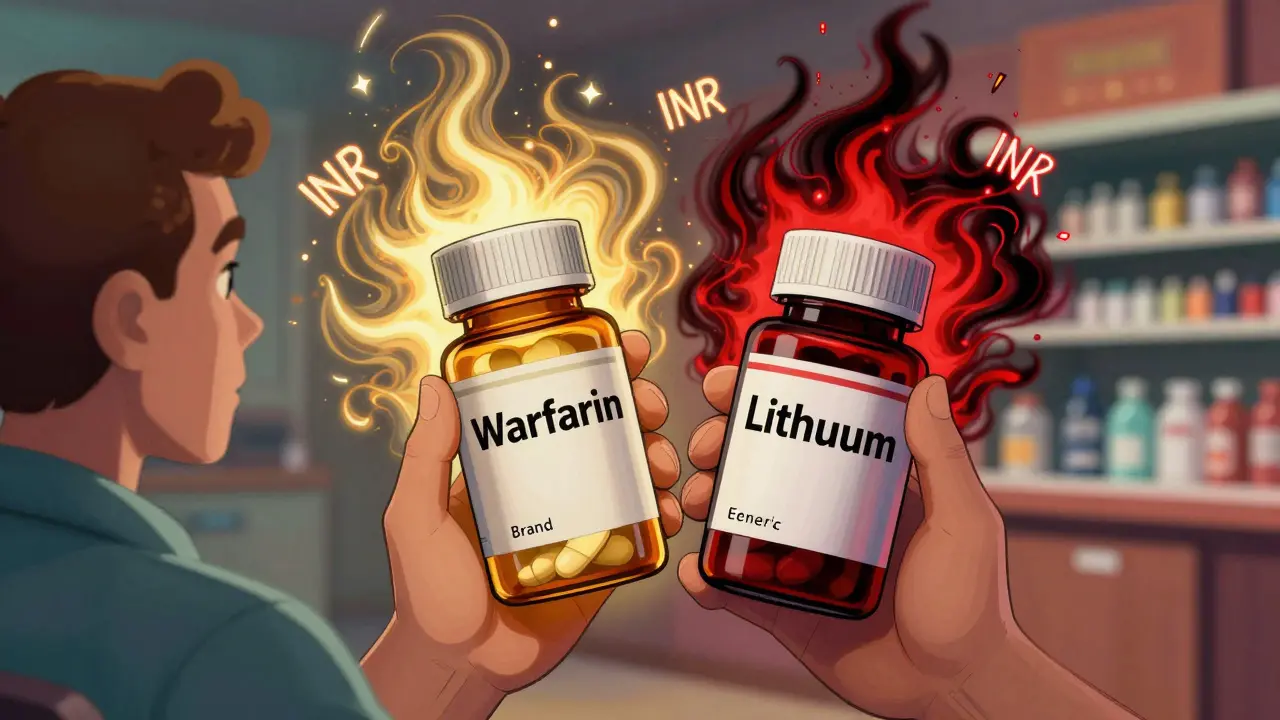
When you’re on a combination of NTI drugs, even a small change in dosage can be dangerous. These are medications where the difference between a therapeutic dose and a toxic one is razor-thin. Think warfarin, lithium, or levothyroxine. Now imagine taking two of them together - and your pharmacy swaps one or both for a generic version. That’s not a hypothetical. It’s happening. And the risks? They don’t just add up. They multiply.
What Makes NTI Drugs So Risky?
NTI stands for Narrow Therapeutic Index. It means the drug works only within a very tight range in your bloodstream. Too little, and it doesn’t work. Too much, and you could have a stroke, organ failure, or even die. The FDA says these drugs have five key traits: minimal room for error, high risk of serious side effects, need for constant blood monitoring, low variability within the same person, and frequent small dose tweaks.
Examples? Warfarin (blood thinner), levothyroxine (thyroid hormone), lithium (mood stabilizer), digoxin (heart medication), phenytoin (seizure control). Each of these has been used for decades. But when you combine two - say, warfarin and amiodarone, both NTI drugs - the margin for error shrinks even further. A 5% change in one drug’s absorption? Maybe manageable. A 5% change in two? That’s a 10% total shift in your system. And that’s enough to send your INR through the roof.
Why Generic Substitution Is a Minefield
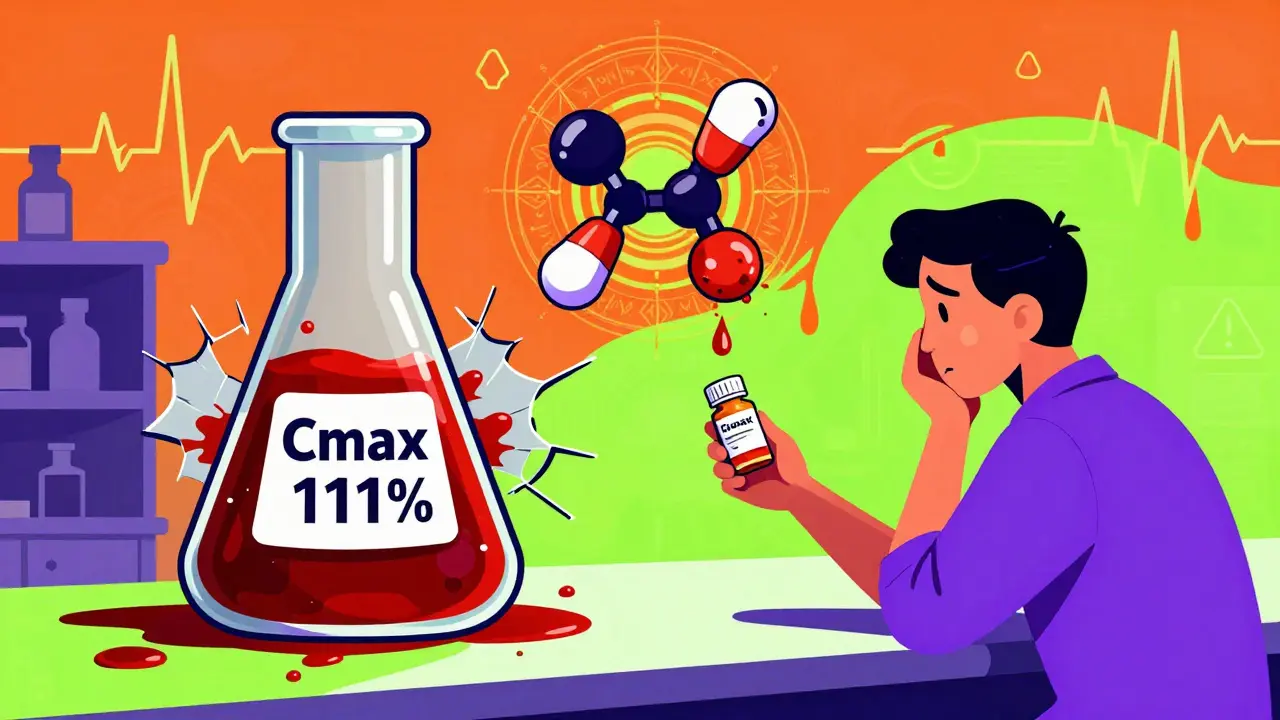
For most drugs, generics are safe, effective, and save patients billions. But for NTI drugs, the rules change. The FDA tightened bioequivalence standards in 2014 and again in 2022. For regular drugs, generics must match the brand within 80-125% of the active ingredient’s absorption. For NTI drugs? That window tightens to 90-111% for peak levels (Cmax) and 90-112% for total exposure (AUC). It’s stricter. But even that’s not enough when you combine two NTI drugs.
There are no FDA-approved fixed-dose combinations of two NTI drugs on the U.S. market. Not one. Why? Because proving bioequivalence becomes nearly impossible. If Drug A and Drug B are both NTI, and you mix them into one pill, how do you know the generic version delivers both components at the exact same rate as the brand? One might absorb faster. The other slower. The math doesn’t add up.
Meanwhile, patients are getting switched. Community pharmacies often substitute generics automatically unless the prescriber writes "Do Not Substitute." A 2023 ASHP survey found 78.3% of pharmacists had seen therapeutic failure after switching a patient on a combination that included at least one NTI drug. Over 40% reported serious adverse events - hospitalizations, bleeding, seizures.
The Real-World Cost of Substitution
It’s not just about clinical outcomes. It’s about money - and stress.
A 2022 Drugs.com survey of 1,247 patients on combination NTI therapy showed 63.4% experienced adverse effects after switching to generics. Compare that to 18.2% on brand-name combinations. One patient on Reddit described his INR jumping from 2.5 to 6.8 after a pharmacy switch - a level that can cause internal bleeding. He ended up in the ER. His story isn’t rare.
Doctors and pharmacists spend way more time managing these patients. It takes 6 to 8 weeks to stabilize someone on a combination NTI regimen. They need 3-4 dose adjustments on average, compared to just 2 for non-NTI drugs. Blood tests? They’re not optional. Patients on combination NTI therapy pay $1,200-$2,500 a year just for monitoring. That’s triple the cost of standard combination therapy.
And it’s not just the patient. Pharmacies don’t have enough trained staff. Only 12 of 50 major academic medical centers in the U.S. have specialized clinics for NTI combination therapy. Most community pharmacists get less than 20 hours of training on NTI drugs. The system isn’t built for this.
Why Aren’t More Generics Available?
Manufacturers could make them. Companies like Teva and Sandoz have the technology. Europe has approved a few generic combinations - like levothyroxine plus selenium - with low adverse event rates. But the U.S. regulatory path is a wall.
The FDA’s 2023 draft guidance proposes even tighter standards for combination NTI products: 90-107.69% for Cmax and 90-110% for AUC. That’s a huge leap. No company has yet met it. The approval timeline for these drugs is 4.7 years on average - more than double that of non-NTI combinations.
There’s also a lack of incentive. The NTI drug market is worth $48.7 billion globally, but combination NTI products make up less than 0.3% of it. Why invest millions in a product that might take five years to approve, and still face pushback from clinicians?
Where the System Is Failing
There’s a gap between what’s possible and what’s allowed. We have the science to monitor these drugs closely. We have the technology to produce precise doses. But the regulatory framework hasn’t caught up.
Experts like Dr. Donald Berry argue that even the current 90-111% window is too loose for combinations. Two drugs, each with up to 11% variation? That’s a 22% total potential swing - enough to cause harm. And there’s no validated way to test for bioequivalence in combination products that accounts for drug interactions.
Meanwhile, patients are caught in the middle. They want affordable meds. But they also don’t want to risk their lives. Many are forced to pay hundreds more per month for brand-name combinations just to avoid the uncertainty.
What’s Next?
The FDA is piloting a 2024 program using pharmacometric modeling - computer simulations that predict how drugs behave in the body - to assess bioequivalence in combination NTI products. That’s promising. It could reduce the need for endless clinical trials.
But until then, the status quo is dangerous. Some hospitals have created their own rules: no automatic substitution. Prescribers must write "dispense as written" on every NTI combination prescription. Pharmacists must verify each switch with the prescriber. That’s not scalable. It’s a band-aid on a broken system.
The truth? We can’t keep pretending combination NTI drugs are the same as other generics. The risks are too high. The science is too complex. The data is too clear. If we want affordable access to these life-saving regimens, we need better standards, better testing, and better training - not just more generics.
What Patients and Providers Can Do Today
- Ask your doctor: "Is this a combination of NTI drugs?" If yes, request "dispense as written" on the prescription.
- Never switch pharmacies without telling your prescriber. Different pharmacies may source different generics.
- Get regular blood tests - don’t skip them. Monitoring is non-negotiable.
- If you feel off after a switch - dizziness, bruising, fatigue, irregular heartbeat - get tested immediately. Don’t wait.
- Speak up. Contact your state pharmacy board if you’ve had a bad experience with a generic NTI switch.
There’s no easy fix. But ignoring the problem isn’t an option. Thousands of people are managing these drugs every day. They deserve safer, more predictable access - not guesswork.
What are NTI drugs?
NTI drugs, or Narrow Therapeutic Index drugs, are medications where the difference between an effective dose and a toxic dose is very small. Even minor changes in blood levels can cause treatment failure or serious side effects. Examples include warfarin, lithium, levothyroxine, digoxin, and phenytoin.
Why are generic combination NTI drugs so rare in the U.S.?
Combining two NTI drugs makes bioequivalence testing extremely difficult. The FDA requires tighter standards (90-111% for Cmax, 90-112% for AUC) than for regular drugs. When two NTI components are in one pill, even small differences in how each is absorbed can lead to dangerous variations. No manufacturer has yet met the required standards, so no fixed-dose combination NTI generics are approved in the U.S.
Can I safely switch to a generic if I’m on a combination NTI drug?
It’s risky. Studies show patients on combination NTI therapy have 27% higher rates of adverse events after switching to generics compared to non-NTI combinations. One study found 18.7% of patients on warfarin had unstable INR levels after a generic switch. If you’re on a combination, ask your doctor to write "dispense as written" on your prescription and avoid automatic substitution.
How often do I need blood tests if I’m on combination NTI drugs?
You’ll need frequent monitoring - typically every 1-4 weeks when starting or changing doses, and then every 2-3 months once stable. Patients on combination NTI therapy often require 3-4 dose adjustments in the first few months, compared to just 1-2 for non-NTI drugs. Annual monitoring costs can range from $1,200 to $2,500.
Are there any combination NTI generics approved anywhere?
Yes, but only in limited cases. The European Medicines Agency has approved a few, like levothyroxine plus selenium, with low adverse event rates. However, these are exceptions. No fixed-dose combinations of two NTI drugs - like warfarin plus amiodarone - are approved in the U.S. or most other countries due to unresolved bioequivalence challenges.
What’s being done to improve this situation?
The FDA is developing a pilot program for 2024 using pharmacometric modeling - computer simulations that predict how drugs behave in the body - to assess bioequivalence without relying solely on clinical trials. This could speed up approval. But until then, the regulatory and scientific barriers remain high, and no major breakthroughs are expected before 2026.
Final Thoughts
The gap between the promise of generics and the reality of NTI combination therapy isn’t just a policy issue - it’s a patient safety crisis. We can’t afford to treat these drugs like ordinary medications. The science says they’re different. The data says they’re dangerous to switch. The people taking them deserve better.
Stephen Craig
January 3, 2026 AT 23:29This isn't just about generics. It's about how we treat human biology like a spreadsheet.
Connor Hale
January 5, 2026 AT 21:09I've seen patients crash after a pharmacy switch. No one talks about the emotional toll-constant fear, missed work, the guilt of feeling like you're a burden.
Roshan Aryal
January 6, 2026 AT 06:16USA still clinging to 1980s pharma logic while India and Europe are moving forward. Our FDA is a glorified paper-pushing office with zero courage. We pay for mediocrity and call it freedom.
Jack Wernet
January 6, 2026 AT 08:56The clinical evidence is unequivocal. The regulatory inertia is indefensible. We have the tools to solve this problem-what we lack is the collective will to prioritize patient safety over cost arbitrage.
Charlotte N
January 6, 2026 AT 16:45my doctor said "dispense as written" but my insurance won't cover it... so i pay 300 a month extra... and still get calls from the pharmacy asking if i "really need the brand"
Catherine HARDY
January 7, 2026 AT 15:31They're not just swapping generics-they're running an uncontrolled experiment on millions. Big Pharma and the FDA are in cahoots. The monitoring costs? That's the real profit center. They want you dependent on blood tests, not safe meds.
bob bob
January 9, 2026 AT 02:24Bro, I got switched to generic levothyroxine + warfarin last year. Felt like a zombie for 6 weeks. Got my doctor to fight it. Now I'm back on brand. Worth every penny. Don't let them play Russian roulette with your thyroid and your blood.
Uzoamaka Nwankpa
January 9, 2026 AT 17:22You think this is bad? In Nigeria we don't even have generics. We have fake pills sold in markets. At least here you get a chance to die slowly with paperwork.
Vikram Sujay
January 10, 2026 AT 11:03The fundamental flaw lies in the reductionist paradigm of bioequivalence, which assumes pharmacokinetic parameters can be independently evaluated in isolation. When two NTI agents interact, the system becomes nonlinear, rendering conventional AUC and Cmax thresholds statistically and clinically inadequate. A systems-based pharmacometric approach is not merely preferable-it is ethically imperative.
Clint Moser
January 10, 2026 AT 12:11the FDA's 90-111% window is a joke. they're using 20th century PK models on 21st century polypharmacy. we need bayesian adaptive modeling, not batch testing. and why no real-time pharmacovigilance integration with EHRs? they're all asleep at the wheel.
Rory Corrigan
January 11, 2026 AT 15:27life is a gamble anyway. if you're on NTI drugs, you're already playing with fire. maybe the generics are the universe's way of saying "stop being so fragile." 😏
Oluwapelumi Yakubu
January 13, 2026 AT 08:45My brother in Lagos took a generic that looked like the real thing-same color, same logo. Turned out it was chalk and sugar. He ended up in ICU. So yeah, I get why you want brand. But here? We don't even get that luxury. You want safety? Pay for it. Or pray.
Terri Gladden
January 13, 2026 AT 12:44my pharmacist called me a "high-maintenance patient" because i asked for the brand. then she said "you're lucky you're not on insulin" like that makes it better?? i cried in the parking lot. i just want to not die.
Jennifer Glass
January 15, 2026 AT 07:31It's wild how we accept this. We'll fight for a new iPhone every year but let our lives be at the mercy of a pharmacy's inventory. If this were cars, we'd sue the whole industry. Why is medicine different?
Joseph Snow
January 16, 2026 AT 13:30Let's be honest: this entire system is designed to keep patients docile. The FDA, the insurers, the pharmacies-they all benefit from the illusion of choice. You think you're saving money? You're paying in hospital bills, lost wages, and trauma. This isn't capitalism. It's predation dressed in white coats.