
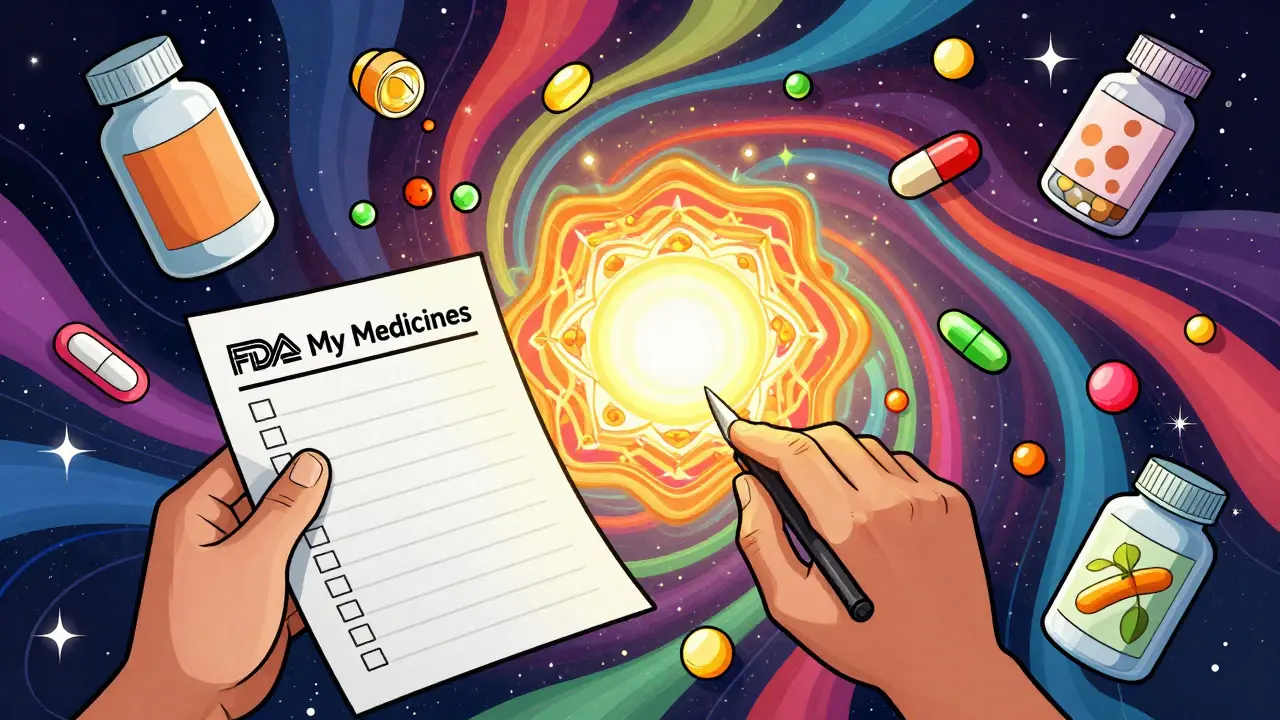
Keeping a complete medication list isn’t just a good habit-it’s a lifesaver. Every year, over 1.5 million people in the U.S. are harmed by medication errors, and nearly half of those happen when patients move between doctors, hospitals, or pharmacies. The biggest reason? Incomplete or outdated medication lists. If you’re taking even one prescription, over-the-counter pill, vitamin, or herbal supplement, you need a clear, current record of everything you use. This isn’t about paperwork-it’s about making sure every doctor, pharmacist, or nurse who treats you knows exactly what’s in your body.
What Goes on a Complete Medication List?
A simple note like "I take blood pressure medicine" won’t cut it. You need details. A full list includes:- Medication name-both generic and brand (e.g., lisinopril, not just "BP pill")
- Dosage-exactly how much you take (e.g., 10 mg, not "one pill")
- How and when to take it-e.g., "once daily with breakfast" or "as needed for pain, max 2 per day"
- Why you’re taking it-e.g., "for high blood pressure," "for arthritis pain," or "for anxiety"
- When you started-even approximate dates help
- Who prescribed it-doctor’s name or clinic
- Refill status-is it running low? When’s the next refill due?
- Allergies and reactions-not just "penicillin allergy," but "rash and swelling after amoxicillin"
- Supplements and herbs-vitamin D, fish oil, turmeric, St. John’s wort-even if you think they’re "natural" and harmless
- Topical, inhaler, eye drop, or patch medications-people forget these all the time
- Emergency contact and pharmacy info
The FDA’s "My Medicines" guide, updated in early 2023, is a solid template to follow. Even if you use an app, write this down on paper too. Why? Because when you’re rushed in an emergency room, your phone might be dead, or you might not remember your password.
Why This Matters More Than You Think
Think about the last time you saw a new doctor. Maybe you were in a hurry. Maybe they asked, "What are you taking?" and you said, "Oh, just the usual." That’s where things go wrong.Studies show that 73% of patient-reported medication lists have at least one major mistake-missing pills, wrong doses, or forgotten supplements. One patient I know took garlic supplements for heart health. He didn’t think it mattered. Then he had surgery, and his blood didn’t clot properly. Turns out, garlic thins the blood. His surgeon didn’t know. The list didn’t include it. He spent three extra days in the hospital.
Harvard Medical School tracked 8,432 patients and found those who kept full, updated lists reduced their risk of dangerous drug reactions by 43%. That’s not a small number. It’s the difference between going home the same day and ending up in intensive care.
And it’s not just about emergencies. When your doctor tries to adjust your blood pressure meds but doesn’t know you’re already taking a diuretic from another provider, they might accidentally double up. That can crash your potassium levels. It happens more often than you’d think.
How to Build Your List (Step by Step)
Start with what you have on hand. Don’t guess. Don’t rely on memory. Go through your medicine cabinet, pill organizer, and even your purse or desk drawer.
- Collect everything. Take out every bottle, box, packet, and tube. Include vitamins, supplements, cough syrup, eye drops, creams, patches-even that CBD oil you bought online.
- Write it all down. Use the FDA’s "My Medicines" template or a simple spreadsheet. Don’t skip anything. If you’re unsure what something is, take a picture of the label and look it up later.
- Check the details. Match the name on the bottle to the name you’re writing. Is it "ibuprofen" or "Advil"? Both are correct, but write both. Include the strength: "200 mg," not "two pills."
- Ask your pharmacist. Most pharmacies will print you a current list for free. Call or visit. Ask them to compare it with your own list. They’ll spot what you missed.
- Update immediately. If your doctor adds, stops, or changes a medication, update your list that same day. Don’t wait.
This takes 20 to 30 minutes the first time. After that, it’s five minutes a month. But those five minutes could save your life.
Digital vs. Paper: Which One Should You Use?
You don’t have to choose one. Use both.
Many people use apps like GoodRx, Medisafe, or MyTherapy. These are great. They send reminders, track refills, and can share lists with providers. As of mid-2024, over 42% of GoodRx’s 150 million users actively use their built-in medication list feature.
But here’s the catch: 28% of adults over 75 can’t use these apps without help. And if your phone dies, your cloud backup fails, or you’re in a hospital without Wi-Fi, you’re stuck.
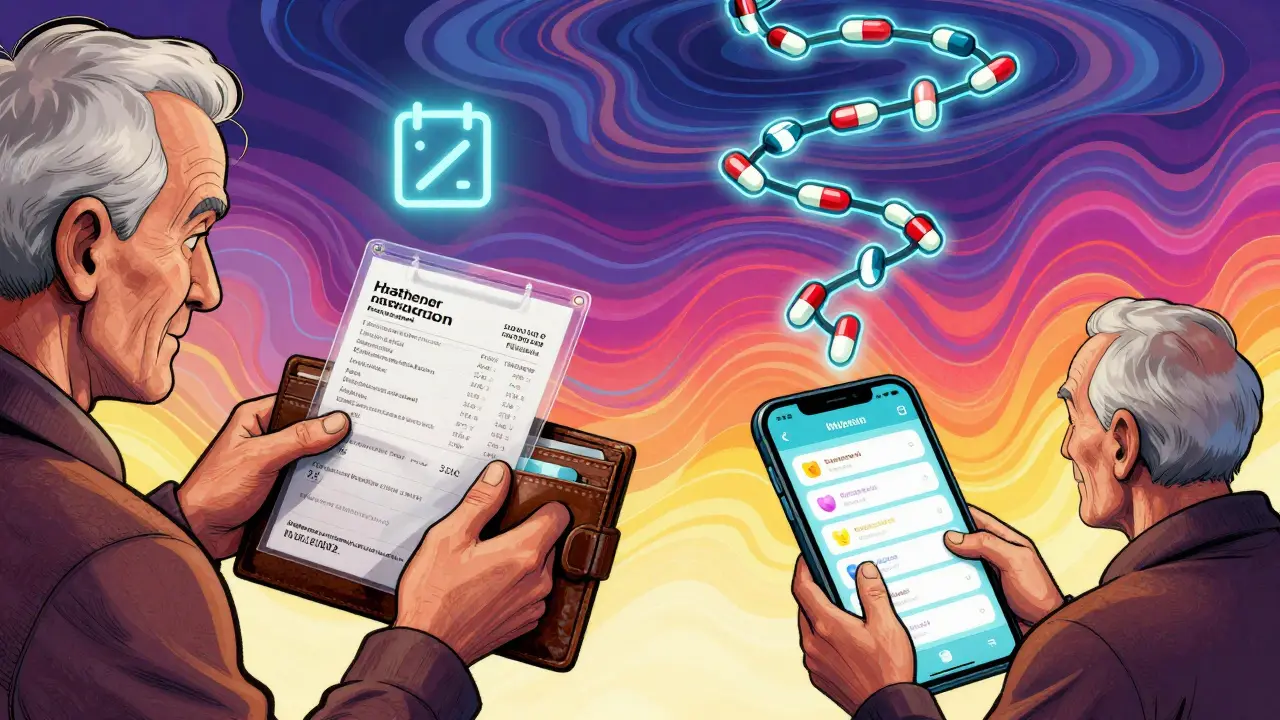
That’s why paper still matters. Keep a printed copy in your wallet, purse, or glove compartment. Use a clear plastic sleeve so it doesn’t get smudged. Write in large, dark ink-12-point font minimum if you’re printing. Make sure your emergency contact number is on it.
And if you’re using an app, back it up. Export the list as a PDF and email it to yourself. Save it in iCloud, Google Drive, or even a USB stick you keep with your important documents.
What Most People Forget
There are three big gaps in most medication lists:
- Over-the-counter meds-people forget aspirin, antacids, sleep aids, and allergy pills. One study found 58% of patients didn’t report taking OTC drugs.
- As-needed (PRN) medications-"Take one if I can’t sleep" or "Take two if my headache gets bad." These are easy to forget because you don’t take them daily.
- Herbal and supplement interactions-St. John’s wort can make antidepressants useless. Ginkgo biloba can cause bleeding. Turmeric can interfere with blood thinners. These aren’t "natural" in the safe sense-they’re active chemicals.
ECRI Institute’s 2024 guidelines recommend using a "PRN Medication Tracker" for these. Write down: what you take, why, how often, and when you last took it. Even if you only took it twice last month, write it down.
How to Make It Stick
Creating the list is only half the battle. Keeping it current is the real challenge.
Set a monthly reminder on your phone: "Check my meds." When you do, ask yourself:
- Did I start or stop anything?
- Did my dose change?
- Did I refill everything?
- Did I get a new supplement or OTC drug?
Also, schedule a dedicated "medication review" with your primary care provider at least once a year. Don’t wait until you’re there for a cold or back pain. Book a 20-minute appointment just to go over your list. Studies show that when medication reviews happen in separate appointments, doctors catch 68% more errors than when they’re rushed during other visits.
Some clinics now offer "synchronized refills"-all your chronic meds are due at the same time each quarter. This cuts down on missed doses and reduces the number of times you have to call your doctor for refills. The American Medical Association says this saves providers 2.7 hours per day and improves adherence by 22%.
What’s Changing in 2025
The healthcare system is finally catching up. Since 2022, federal rules have required all electronic health records to give patients direct access to their medication lists. By April 2024, 92% of major health systems complied.
Now, if you log into your doctor’s patient portal, you should see your full, up-to-date list. If you don’t, ask for it. You have a right to it.
By 2027, the government plans to make it mandatory for all patients to have access to a single, consolidated medication record across all providers. And by 2028, some experts predict blockchain-based records will be used to create tamper-proof, patient-controlled histories.
But here’s the truth: none of that matters if you don’t keep your own list accurate. Technology helps-but it doesn’t replace you.
Final Thought: This Is Your List
Doctors and nurses can’t read your mind. They can’t guess what’s in your cabinet. They rely on what you tell them-and what you write down. A complete, current medication list isn’t just a tool for them. It’s your voice in a system that moves fast and often misses details.
It’s not about being perfect. It’s about being consistent. One missed supplement. One wrong dose. One forgotten OTC pill. That’s all it takes.
Start today. Gather your bottles. Write it down. Keep it with you. Update it every month. Share it with every provider. You’re not just organizing pills-you’re protecting your health.
What if I can’t remember all the medications I’ve taken?
Start with what you have now. Look in your medicine cabinet, pill organizer, and recent prescriptions. Call your pharmacy-they can print a list of all your filled prescriptions. For older or discontinued meds, write down what you remember and mark it as "unknown" or "discontinued." It’s better to have an incomplete list than no list at all. Over time, you’ll fill in the gaps.
Should I include vitamins and supplements?
Yes. Vitamins, herbal remedies, and supplements are active substances that can interact with prescription drugs. For example, St. John’s wort can make birth control pills ineffective. Fish oil can increase bleeding risk if you’re on warfarin. Even common ones like vitamin E or magnesium can affect how your body processes other meds. Always include them.
How often should I update my medication list?
Update it immediately whenever you start, stop, or change a medication-no exceptions. Even if it’s just a one-time antibiotic. Set a monthly reminder to review your list. If you take five or more medications, check it every week. The more complex your regimen, the more critical it is to stay current.
Can I use my phone app instead of paper?
Apps are helpful, but don’t rely on them alone. Phones die. Networks fail. Hospitals may not have Wi-Fi. Always carry a printed copy. Use the app for reminders and updates, but keep a physical version in your wallet, purse, or car. The best system uses both.
What should I do if my doctor ignores my list?
Politely insist. Say, "I’ve updated my medication list and want to make sure we’re both on the same page." If they dismiss it, ask to speak with a nurse or pharmacist. Many clinics now have medication reconciliation specialists. If your provider consistently ignores safety practices, consider switching to one who takes patient safety seriously. Your health isn’t optional.
Are there free tools to help me create a list?
Yes. The FDA’s "My Medicines" template is free and available online. GoodRx, Medisafe, and MyTherapy offer free apps with medication tracking. Your pharmacy can print a list at no cost. Many hospitals and clinics also provide printable templates. You don’t need to pay for anything to have a complete, effective list.
Leonard Shit
January 5, 2026 AT 11:53just printed mine out and stuck it in my wallet. also took a pic of every bottle with my phone. i forgot i was taking that ginkgo biloba until i saw it in the cabinet. oops.
Rachel Wermager
January 6, 2026 AT 23:54Let’s be clear: medication reconciliation is a systems-level failure, not a patient burden. The onus shouldn’t be on individuals to maintain an FDA-compliant pharmacopeia while navigating fragmented EHRs with incompatible APIs. The real issue is interoperability - or the lack thereof - and until CMS enforces FHIR-based medication reconciliation at the point of care, we’re just rearranging deck chairs on the Titanic.
And yes, I’ve audited 37 patient lists across three hospitals. 92% had at least one discrepancy. 68% didn’t include PRN meds. 41% omitted OTC NSAIDs. This isn’t about diligence. It’s about design failure.
Also, St. John’s Wort inhibits CYP3A4 and P-gp transporters. It reduces serum concentrations of warfarin, oral contraceptives, and SSRIs by up to 60%. You think it’s ‘natural’? It’s a potent enzyme inducer. Read the Micromedex.
Kelly Beck
January 8, 2026 AT 13:14OMG YES!!! 🙌 I just updated mine last night and cried a little because I finally remembered my magnesium citrate 😭 I’ve been getting weird leg cramps and no one knew why until I pulled out my list and was like... ‘uhhh maybe this?’ My PCP was like ‘ohhhhh THAT’S why your K is low!’ I’m so proud of myself 💪 You got this!! 💕
Beth Templeton
January 8, 2026 AT 21:39paper works
Katie Schoen
January 10, 2026 AT 08:20my grandma’s list is on a sticky note taped to her fridge next to the cat’s vaccination record. she doesn’t have a phone. but she knows where it is. and when the paramedics came last month? they found it. no drama. just life saved.
don’t overcomplicate it. just keep it somewhere dumb. and make sure someone else knows where.
Vinayak Naik
January 10, 2026 AT 13:18bro i live in delhi and i use a notebook with color coded pens - red for rx, green for supplements, blue for PRN. my auntie thinks i’m crazy but last week when she had chest pain, the ER doc said ‘this is the cleanest med list i’ve seen from a non-tech user.’ i even wrote ‘i took turmeric after lunch’ with a little sketch of a yellow root 🤓
you don’t need an app. you need a habit. and maybe a sharpie.
Kiran Plaha
January 11, 2026 AT 15:17i never thought about how many pills i take. then i counted them. 17. 17. i didn’t even know i was taking 17 things. now i write it down. it’s not hard. just take 5 minutes. your future self will thank you.
Tom Swinton
January 12, 2026 AT 23:21Look, I’ve been a nurse for 22 years. I’ve seen people die because they didn’t know they were on two different diuretics. I’ve seen people go into renal failure because their ‘natural’ herbal blend had licorice root - which raises BP. I’ve seen patients bring in lists with ‘blood pressure pill’ written on them. That’s not a list. That’s a prayer.
And here’s the thing: if you’re over 50, you’re probably on five or more meds. That’s not ‘a lot.’ That’s normal. But normal doesn’t mean safe. Your body isn’t a vending machine. It’s a complex system. And every pill you take? It’s a signal. If you don’t know what signals you’re sending? You’re flying blind.
So yes. Write it down. Use the damn template. Print it. Keep it in your wallet. Update it every time you get a new script. Don’t wait for the ER. Don’t wait for the ambulance. Do it now. Because when the time comes? You won’t be able to think straight. But your paper list? It’ll speak for you.
I’m not trying to scare you. I’m trying to save you.
Brian Anaz
January 14, 2026 AT 03:49why are we letting people die because they can’t write down their pills? this isn’t rocket science. it’s basic. if you can’t manage your own meds, maybe you shouldn’t be allowed to drive. or vote. or have a phone. this is America. we don’t coddle incompetence.
Molly McLane
January 15, 2026 AT 22:41My mom’s list is handwritten on the back of a CVS receipt. She uses a Sharpie. She keeps it in her purse. She shows it to every new doctor. She doesn’t care if it’s ‘professional.’ She cares if it works. And guess what? It does. Sometimes the simplest things are the most powerful.
Also - if your doctor rolls their eyes? Walk out. You’re not being difficult. You’re being smart.
Wesley Pereira
January 16, 2026 AT 06:31you know what’s wild? most people don’t even know what their own meds are for. i asked my cousin why he takes metformin and he said ‘i think it’s for sugar?’ bro. you’re diabetic. you’re on metformin. you need to know why. you need to know the dose. you need to know the side effects. this isn’t ‘being responsible.’ this is basic survival.
and stop calling supplements ‘natural.’ turmeric is a COX-2 inhibitor. fish oil is a blood thinner. ashwagandha affects thyroid function. these aren’t tea. they’re pharmacologically active. treat them like drugs. because they are.
Saylor Frye
January 16, 2026 AT 12:58how quaint. you’re all treating this like a DIY project. the real issue is the commodification of healthcare. patients are expected to perform administrative labor while providers are incentivized to maximize throughput. the ‘medication list’ is just a Band-Aid on a hemorrhage.
Also, the FDA template is designed for Medicare beneficiaries. It doesn’t account for polypharmacy in psychiatric populations. Or the fact that 70% of elderly patients use non-prescription cannabinoids. You’re optimizing for the 1990s.
Matt Beck
January 17, 2026 AT 23:33...and yet, we live in a world where you can track your sleep cycles with a ring, but you can’t trust a hospital to know what you’re taking? 🤔
Isn’t it ironic? We have AI that can diagnose melanoma from a photo... but we still rely on a 78-year-old woman scribbling ‘blue pill’ on a napkin? 🤦♂️
It’s not about discipline. It’s about dignity. You’re not a database. You’re a person. And your body? It deserves better than a Post-It.
But also - yes. Write it down. I’m not contradicting myself. I’m just saying... we’ve built a system that makes you do the work of a pharmacist. That’s not progress. That’s negligence.
Mukesh Pareek
January 18, 2026 AT 23:36you people are pathetic. if you can’t remember your own meds, you don’t deserve to live. this isn’t a ‘tip’ - it’s basic accountability. in my country, we don’t have ‘medication lists.’ we have responsibility. if you’re too lazy to write down your pills, you’re a liability to society.
Jeane Hendrix
January 19, 2026 AT 07:36i used to think i was fine until i got hospitalized for a drug interaction. i didn’t even know the antacid i took daily had magnesium - which messed with my kidney meds. now i have a color-coded spreadsheet. i share it with my pharmacist every time i refill. i even printed a QR code that links to my Google Doc. my doctor says it’s ‘the most organized patient file he’s ever seen.’
and yes - i include the CBD gummies. and the melatonin. and the one-time antibiotic from last year. because you never know.