
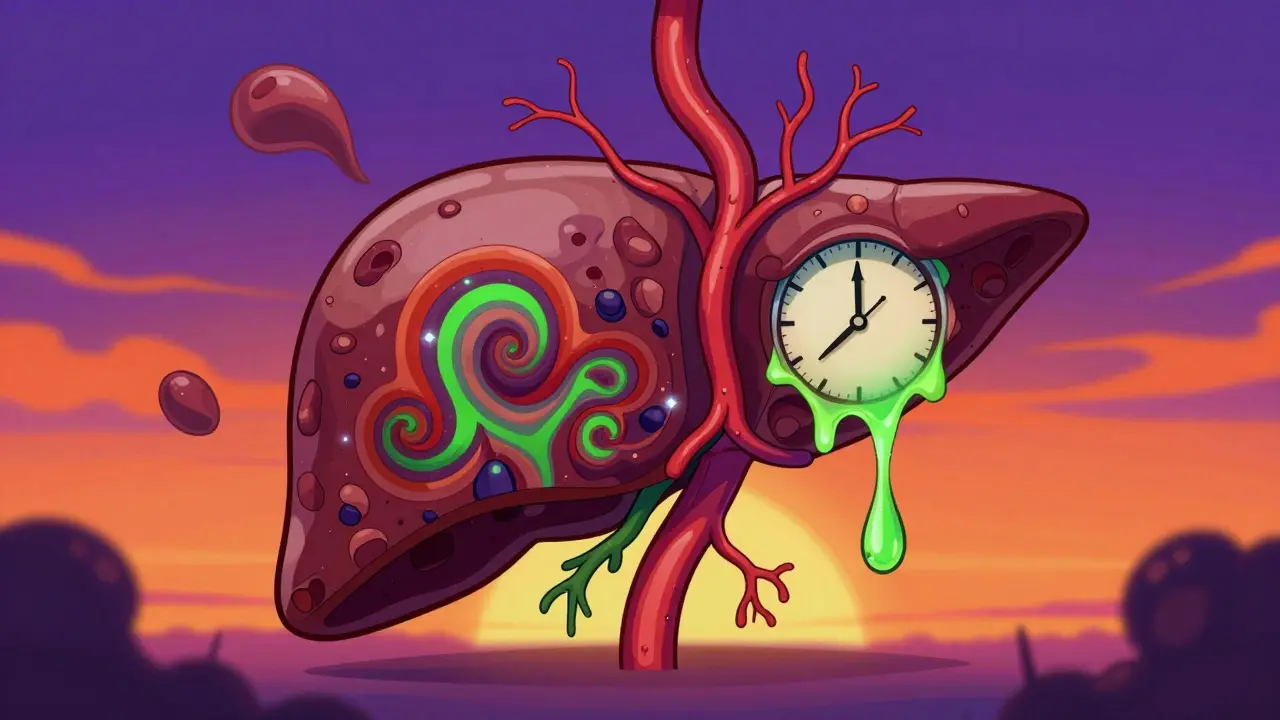
When your liver gets damaged over years-whether from alcohol, fatty liver disease, or hepatitis-it doesn’t just heal. It scars. That scarring is called cirrhosis, and it’s not reversible. Once it sets in, the liver’s structure changes, blood flow gets blocked, and its ability to clean your blood, make proteins, or store energy starts to fail. This isn’t just a slow decline-it’s a ticking clock for serious, sometimes deadly, complications.
What Happens When the Liver Starts to Fail?
Cirrhosis doesn’t always show symptoms at first. Many people feel fine for years. That’s called compensated cirrhosis. But when the liver can’t keep up anymore, things fall apart quickly. This is decompensated cirrhosis, and it brings on a chain reaction of problems.One of the first signs is fatigue-so bad it makes daily tasks impossible. About 72% of people with cirrhosis report this. Weight loss follows, often without trying. Bruising easily? That’s because the liver stops making clotting factors. Swelling in the legs? That’s edema. But the real red flags come later.
Jaundice-the yellowing of skin and eyes-means bilirubin is building up because the liver can’t process it. Ascites, or fluid buildup in the belly, affects half of people within 10 years of diagnosis. It’s not just uncomfortable; it can become infected. That’s spontaneous bacterial peritonitis (SBP), and it kills 20-40% of those who get it.
Portal Hypertension: The Root of Most Problems
All these complications tie back to one thing: portal hypertension. That’s when pressure builds in the vein that carries blood from your intestines to your liver. Scar tissue blocks the flow, so blood finds other paths-through veins in your esophagus and stomach. These veins swell up, becoming varices.One in three people with cirrhosis will bleed from these varices. And when they do, up to 20% won’t survive the episode. That’s why doctors check for them early. If you have cirrhosis, you need an upper endoscopy to look for these enlarged veins. If they’re found, you’re put on beta-blockers like propranolol or nadolol. These drugs lower pressure in the portal system and cut bleeding risk by nearly half.
Carvedilol, another beta-blocker, works even better at reducing pressure. But it’s not for everyone-people with asthma or very low blood pressure can’t take it. The goal isn’t just to prevent bleeding-it’s to keep you out of the hospital.
Ascites and the Battle Against Fluid
Ascites isn’t just a symptom-it’s a medical emergency waiting to happen. When fluid builds up, it puts pressure on your lungs, makes eating hard, and increases infection risk. The first step is simple: cut salt to less than 2 grams a day. That’s harder than it sounds. A single slice of bread can have 200mg. Processed food is the enemy.Diuretics come next. Spironolactone is the first-line drug. It’s often paired with furosemide. Most people respond well. But about 10% develop refractory ascites-fluid that won’t budge. That’s when doctors drain it directly from the belly using a needle. This is called large-volume paracentesis. It’s quick, but it can crash your circulation. That’s why albumin is given during the procedure. It keeps your blood pressure stable and cuts complications from 37% down to 10%.
But draining fluid doesn’t fix the problem. You’ll need to do it again. Some people go to the hospital every few weeks. One patient on Reddit said he missed 12 family events this year because he was too sick or recovering from the procedure. The emotional toll is as real as the physical one.
Hepatic Encephalopathy: The Brain Fog No One Talks About
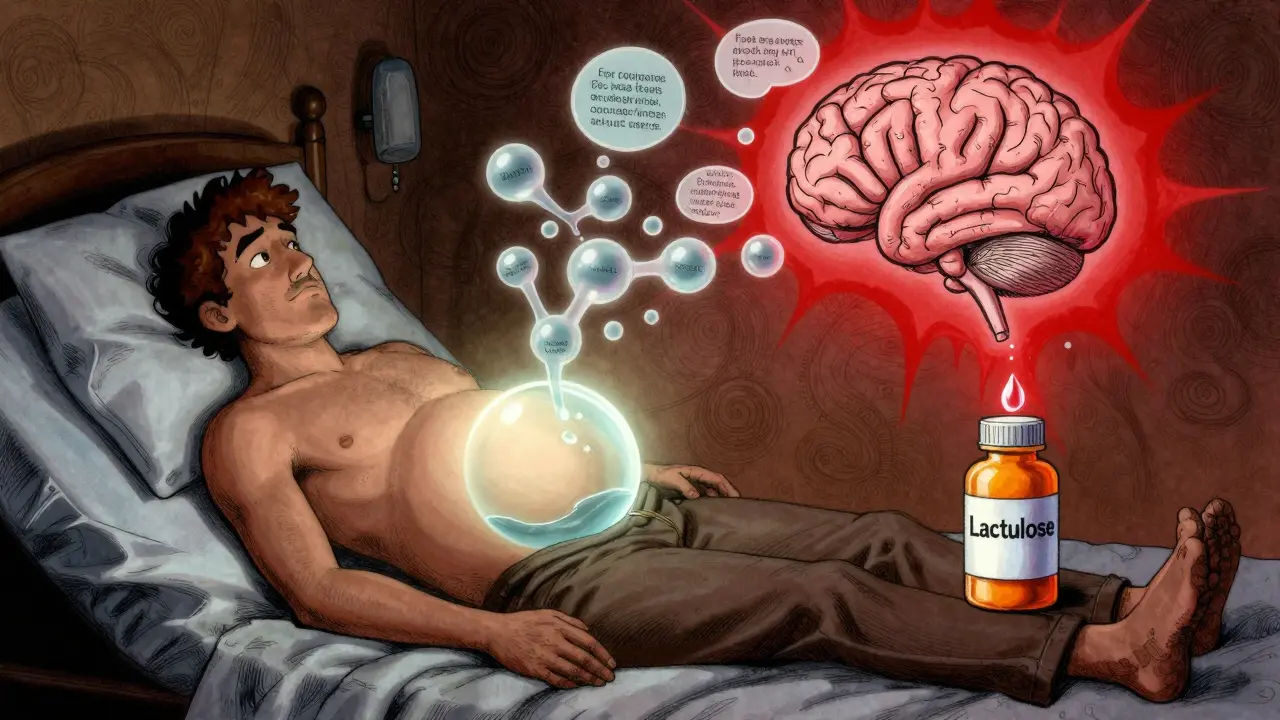
Your liver filters toxins. When it fails, ammonia and other chemicals build up and reach your brain. That’s hepatic encephalopathy. It starts with mild confusion, forgetfulness, or trouble concentrating. People call it “brain fog.” It gets worse-slurred speech, personality changes, even coma.It affects 30-45% of those with decompensated cirrhosis. The go-to treatment is lactulose. It’s a syrup you take three times a day. It pulls ammonia out of your gut through diarrhea. Sounds simple. But the side effects? Constant, painful diarrhea. One patient wrote: “I’ve missed 12 family events this year.”
There’s a better option now: rifaximin. It’s an antibiotic that doesn’t get absorbed into your bloodstream. It works in the gut to reduce ammonia-producing bacteria. Studies show it cuts hospital visits by 58% compared to placebo. But it costs $1,200 a month without insurance. Many patients can’t afford it.
Cancer Risk: The Silent Threat
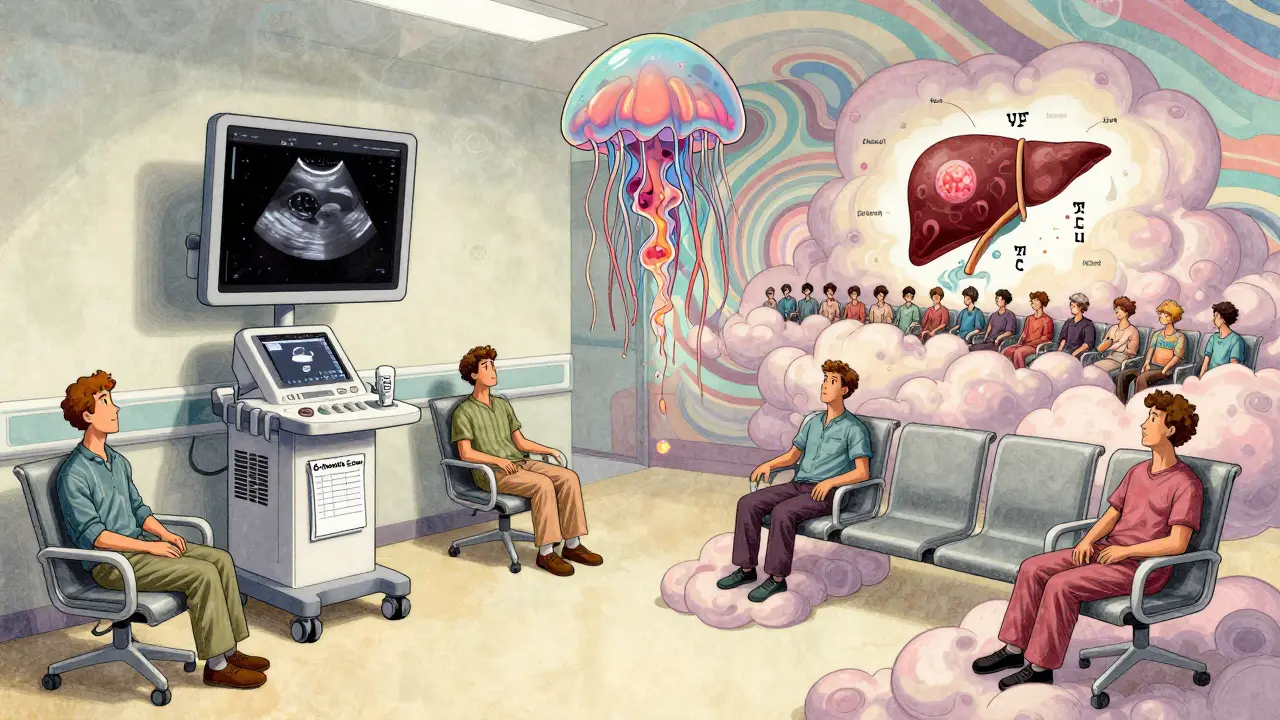
Cirrhosis doesn’t just damage the liver-it makes it more likely to turn cancerous. Hepatocellular carcinoma (HCC) develops in 2-8% of cirrhotic patients every year. That’s why everyone with cirrhosis gets screened every six months with an ultrasound. It’s not perfect-it misses some tumors-but it catches 70% of them early, when they’re still treatable.Without screening, tumors are often found too late. With it, patients can be treated with surgery, ablation, or even transplanted before the cancer spreads. The key is consistency. Skip a scan, and you’re gambling with your life.
How Management Has Changed-And What’s Coming
Ten years ago, cirrhosis management was mostly about treating symptoms. Now, it’s about stopping the cycle. For hepatitis C, direct-acting antivirals cure the infection in 95% of cases-even in cirrhosis. That halts further damage. For fatty liver disease (now called MASH), the FDA approved resmetirom in March 2024. In trials, it reduced liver scarring in over 20% of patients after one year.AI is also stepping in. A new algorithm called CirrhoPredict uses routine lab tests to forecast who’s likely to decompensate in the next 90 days. That means doctors can intervene before someone ends up in the ER. It’s not standard yet-but it’s coming fast.
Transplant remains the only cure. But there aren’t enough livers. In 2022, over 11,000 people were on the waiting list. Only 8,391 got transplants. Twelve percent died while waiting. That’s why the organ system changed in February 2024. Now, quality of life matters as much as MELD scores. Someone with terrible brain fog but a lower score can now move up the list.
What You Can Do Right Now
If you have cirrhosis, here’s what works:- See your hepatologist every month if you’re decompensated. Quarterly if you’re stable.
- Get screened for varices and HCC every six months.
- Take your beta-blockers and lactulose or rifaximin as prescribed-even if you hate the side effects.
- Absolutely stop alcohol. No exceptions.
- Track your weight daily. A 2-pound gain in a day could mean fluid is building up.
- Work with a dietitian. A 2g sodium diet is non-negotiable.
- Get vaccinated for hepatitis A, hepatitis B, pneumonia, and the flu.
Structured care programs that include nurses, social workers, and dietitians cut hospital visits by 40%. That’s huge. Don’t go it alone.
When to Call for Help
Don’t wait. If you have cirrhosis and notice:- Sudden swelling in your belly or legs
- Fever or abdominal pain
- Confusion, drowsiness, or slurred speech
- Vomiting blood or black, tarry stools
Go to the ER immediately. These are not “wait and see” symptoms. They’re life-threatening.
Can cirrhosis be reversed?
Cirrhosis itself is irreversible-once scar tissue forms, it doesn’t go away. But the progression can be stopped. If the cause is treated-like curing hepatitis C, quitting alcohol, or losing weight with MASH-the liver can stabilize. In some cases, early scarring may improve slightly, but advanced cirrhosis won’t heal. The goal is to prevent complications and avoid transplant.
How long can someone live with cirrhosis?
It depends on whether it’s compensated or decompensated. People with compensated cirrhosis can live 10+ years, especially if they avoid alcohol and get treated. Once decompensation happens-like with ascites, bleeding, or encephalopathy-the average survival drops to 1-3 years without transplant. The Child-Pugh and MELD scores give more precise predictions. A MELD score above 15 means high risk. Above 20, transplant should be discussed immediately.
Is liver transplant the only cure?
Yes, transplant is the only cure for end-stage cirrhosis. It replaces the damaged liver with a healthy one. Survival rates are strong-about 80% at 5 years. But the wait is long, and not everyone qualifies. You must be sober for at least 6 months if alcohol caused your cirrhosis (though some centers are moving to 30-day rules). You also need to be healthy enough for major surgery. Many die waiting.
Why is salt so dangerous with cirrhosis?
The liver can’t regulate fluids properly when it’s scarred. Salt pulls water into your tissues, making ascites and swelling worse. Your kidneys also hold onto sodium when the liver fails. Even small amounts-like a teaspoon of soy sauce-can cause fluid buildup overnight. That’s why doctors insist on under 2 grams a day. That’s less than what’s in one bag of chips.
Can I still work with cirrhosis?
Many people can, especially in the early stages. But fatigue and brain fog make it hard. Some switch to part-time roles or remote work. Others need disability. If you’re on diuretics or lactulose, you may need to plan bathroom breaks. Employers don’t always understand liver disease. Document your condition with your doctor. You may qualify for protections under the ADA.
What’s the best diet for cirrhosis?
Focus on high-protein foods (lean meats, eggs, legumes), low sodium, and no alcohol. Avoid raw shellfish-it can cause deadly infections. Eat small, frequent meals if you’re losing weight. A dietitian can help you plan meals that meet your needs. Some patients need protein supplements if they’re losing muscle. Don’t take vitamin A or iron supplements unless prescribed-they can harm your liver.
How do I know if my treatment is working?
Track your weight daily-stable weight means fluid isn’t building up. Watch for less confusion or clearer thinking-that’s encephalopathy improving. No new bruises or bleeding means your clotting is better. Your doctor will check your MELD score every few months. A dropping score means you’re stable. Rising score? That’s a warning. Also, if you’re not going to the ER or hospital as often, your treatment is working.
Are there new drugs coming for cirrhosis?
Yes. Resmetirom (Rezdiffra) is the first FDA-approved drug for MASH-related cirrhosis. It reduces liver scarring. Galectin-3 inhibitors are in phase 2 trials and may reverse fibrosis in up to 40% of patients by 2030. New antifibrotics and gene therapies are being tested. The goal isn’t just to manage symptoms-it’s to heal the liver. That’s the future.
rajaneesh s rajan
January 29, 2026 AT 09:49Frank Declemij
January 30, 2026 AT 20:33Sheryl Dhlamini
January 31, 2026 AT 08:11Doug Gray
February 1, 2026 AT 04:17LOUIS YOUANES
February 2, 2026 AT 12:37Pawan Kumar
February 3, 2026 AT 03:49DHARMAN CHELLANI
February 4, 2026 AT 02:32kabir das
February 4, 2026 AT 12:39Keith Oliver
February 4, 2026 AT 19:49ryan Sifontes
February 5, 2026 AT 07:17Jasneet Minhas
February 5, 2026 AT 19:05Eli In
February 7, 2026 AT 04:20Megan Brooks
February 8, 2026 AT 02:20Ryan Pagan
February 9, 2026 AT 13:00Paul Adler
February 10, 2026 AT 19:45