

When you're pregnant, every decision feels bigger. That’s why questions about vaccines come up so often. Is it safe? Will it help my baby? When’s the best time? These aren’t just theoretical concerns-they’re real, daily questions for expectant parents. The good news? Science has clear answers. And the data is overwhelming: getting the right vaccines during pregnancy protects both you and your newborn in ways no other intervention can.
Why Vaccines Matter During Pregnancy
Your immune system changes during pregnancy. It doesn’t shut down, but it does shift. That makes you more vulnerable to infections like the flu, whooping cough, and COVID-19. These aren’t just uncomfortable-they can lead to premature birth, hospitalization, or even death in rare cases. But here’s the powerful part: when you get vaccinated, your body doesn’t just protect you. It passes protection to your baby.
Antibodies from vaccines cross the placenta. Studies show that for pertussis (whooping cough), babies born to vaccinated mothers have up to 1.4 times more protective antibodies in their cord blood than their moms had in theirs. That means your newborn walks into the world with built-in defense during the first two months of life-before they can get their own shots. For flu and COVID-19, that protection cuts the risk of infection by more than half in infants under six months.
This isn’t theoretical. In the 2020-21 flu season, 43.2% of pregnant people in England got the flu shot. Those who did reduced their baby’s risk of hospitalization from flu by 72%. And during the peak of the pandemic, 96% of pregnant women hospitalized with severe COVID-19 were unvaccinated. The numbers don’t lie.
Which Vaccines Are Safe and Recommended?
Not all vaccines are created equal-especially during pregnancy. The rule is simple: inactivated and mRNA vaccines are safe. Live attenuated vaccines are not.
Here’s what you should get during every pregnancy:
- Influenza (flu) vaccine: Given anytime during pregnancy, but best between September and October. It’s an inactivated shot, not the nasal spray. The CDC recommends it every year, even if you got it last season. Protection lasts through the winter months when flu hits hardest.
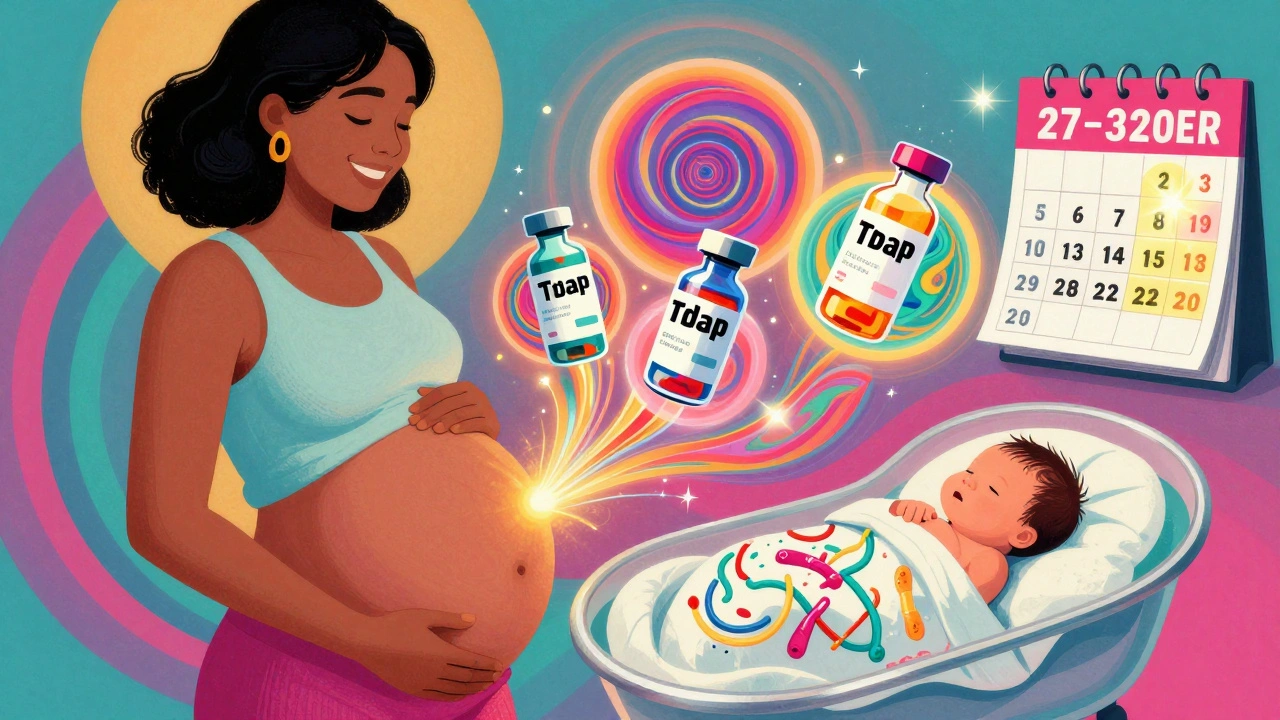
- Tdap (tetanus, diphtheria, pertussis): Given between 27 and 36 weeks. The sweet spot? 27-30 weeks. This timing ensures your baby gets the highest possible antibody levels. Even if you got Tdap five years ago, you still need it again. Pertussis immunity fades, and newborns are most at risk in the first two months.
- COVID-19 vaccine: mRNA vaccines (Pfizer-BioNTech, Moderna) are safe and strongly recommended. Updated monovalent boosters are available as they’re approved. Data from over 139,000 pregnant people in the CDC’s v-safe registry showed no increased risk of miscarriage, preterm birth, or birth defects. Vaccine effectiveness against infection was 89.2%; against hospitalization, it was 96.3%.
- RSV vaccine (Abrysvo): Approved in May 2023 and recommended between 32 and 36 weeks, during September through January. It cuts the risk of severe RSV lung infections by 81.8% in the first 90 days of life. That’s a game-changer-RSV is the leading cause of infant hospitalization in the U.S.
These four vaccines are backed by data from over 2.3 million pregnancies reviewed by the World Health Organization. No safety signals have been found in large studies of Tdap, flu, or COVID-19 vaccines in pregnant people. The risk of harm from the diseases? Far greater.
What Vaccines Should You Avoid?
Live vaccines are off-limits during pregnancy. These include:
- MMR (measles, mumps, rubella)
- Varicella (chickenpox)
- Nasal flu vaccine (LAIV)
- Yellow fever (unless travel to high-risk area and risk outweighs benefit)
If you need any of these, get them at least 28 days before you try to conceive. If you find out you’re pregnant and recently got one, don’t panic. There’s no evidence these vaccines cause harm if given unknowingly during early pregnancy. But they’re not recommended intentionally.
Timing Matters-Here’s the Ideal Schedule
It’s not enough to just get the shots. When you get them makes a difference.
- Flu shot: Get it as soon as it’s available-usually July or August. Don’t wait. Flu season can start early, and protection lasts through spring.
- Tdap: Between 27 and 36 weeks. Ideally, 27-30 weeks. Getting it earlier than 20 weeks means your baby gets 37% fewer antibodies. That’s a big gap.
- RSV vaccine: Between 32 and 36 weeks, and only during September through January. Outside that window, it’s not recommended because RSV season hasn’t started or is ending.
- COVID-19 vaccine: Get the latest booster as soon as it’s available, regardless of trimester. No need to wait. Protection is immediate and lasts through delivery.
Some providers give all three (flu, Tdap, RSV) at one visit. That’s fine. You can get them together. No increased side effects. Just make sure the dates fall within the right window for each.
Side Effects and Safety: What to Expect
Most people feel nothing unusual. The most common side effect? A sore arm. That’s it.
On Reddit’s r/ObGyn, 87% of respondents said they got Tdap during pregnancy. Of those, 68% said the only side effect was mild arm soreness. The CDC’s v-safe pregnancy registry tracked 139,897 people who got COVID-19 vaccines. 84.6% had no pregnancy complications. The most common reaction? Injection site pain (69.8%), followed by headache and fatigue-both mild and short-lived.
Severe reactions are extremely rare. For every 10,000 doses of Tdap given during pregnancy, fewer than one person reports a serious adverse event. For flu, it’s about 1.2 per 10,000. Anaphylaxis (severe allergic reaction) happens in about 1 in a million doses-and is treatable if caught within minutes. That’s why providers ask you to wait 15 minutes after any shot.
Concerns about ingredients like aluminum or thimerosal? They’ve been studied for decades. No link to autism, birth defects, or developmental delays. Thimerosal isn’t even in most flu shots anymore. The amount of aluminum in a single vaccine is less than what’s in a bottle of infant formula.
What If I’m Breastfeeding?
Good news: all the vaccines recommended during pregnancy are also safe while breastfeeding. In fact, you can get them right after delivery-even if you missed them during pregnancy.
While breastfeeding doesn’t transfer the same level of antibodies as placental transfer, it still helps. Your milk contains immune factors that support your baby’s developing defenses. Getting your flu shot or Tdap while nursing won’t hurt-it helps protect your baby from exposure.
And if you didn’t get the RSV vaccine during pregnancy, your baby can get a monoclonal antibody shot (Nirsevimab) after birth. It’s not a vaccine, but it gives immediate protection. Still, getting the vaccine during pregnancy is better-it’s longer-lasting and more effective.

Why Some People Still Hesitate
Despite the data, vaccine hesitancy persists. A March of Dimes survey found that 41.2% of hesitant pregnant people worried about effects on their baby. That fear isn’t irrational-it’s rooted in misinformation and old myths.
Dr. Laura E. Riley from Weill Cornell says it plainly: “Substantial evidence demonstrates the safety of currently recommended vaccines during pregnancy.” She’s citing data from over 1.5 million flu vaccinations and 1.2 million Tdap doses given to pregnant people between 2010 and 2022. No red flags. No patterns of harm.
And it’s not just U.S. data. The WHO reviewed 147 studies involving 2.3 million pregnancies and concluded: the benefits always outweigh the risks. Even Dr. Paul Offit, a well-known vaccine expert, says in his book that “theoretical concerns have been largely alleviated by robust post-marketing surveillance.”
The real barrier isn’t science-it’s access and communication. A 2023 study found that when providers recommended vaccines clearly and early, recommendation rates jumped from 76% to 94%. That’s why it’s critical to ask your provider about vaccines at your first prenatal visit-not when you’re 35 weeks along.
What’s Next? The Future of Pregnancy Vaccines
The science isn’t standing still. In September 2023, the FDA approved the first Group B Streptococcus (GBS) vaccine candidate for Phase III trials. GBS is a leading cause of deadly infections in newborns. If successful, it could be available by 2027.
Another candidate-a universal flu vaccine-is entering late-stage trials. It could protect against all flu strains, not just the few predicted each year. That would mean one shot every few years instead of yearly.
And global efforts are growing. The WHO aims for 70% global coverage of pregnancy vaccines by 2030. Right now, high-income countries hit 45-60%. Low-income countries? Only 15-25%. That gap is dangerous.
Investing in maternal vaccines saves money, too. Every $1 spent on Tdap vaccination saves $2.70 in hospital costs for infants under two months. That’s not just health-it’s economic sense.
What You Should Do Now
Here’s your simple action plan:
- Ask your provider at your first prenatal visit: “Which vaccines do you recommend for me during pregnancy?”
- Get the flu shot as soon as it’s available each year.
- Schedule Tdap between 27 and 30 weeks.
- If you’re pregnant between September and January, ask about the RSV vaccine.
- Stay up to date on COVID-19 boosters.
- Don’t delay because you’re worried. The evidence is solid. The risks of not vaccinating are real.
Your body is doing something incredible-growing a human. Let science help you protect that miracle. These vaccines aren’t optional extras. They’re essential tools. And they’re one of the most powerful things you can do for your baby before they’re even born.
Is it safe to get the flu shot while pregnant?
Yes. The inactivated flu shot is safe during any trimester and is recommended every year during flu season. It reduces your risk of flu-related hospitalization and protects your baby for the first few months after birth. Over 1.5 million pregnant people have received it safely since 2010.
Can I get the COVID-19 vaccine while pregnant?
Yes. mRNA vaccines (Pfizer and Moderna) are safe and strongly recommended during pregnancy. Data from over 139,000 pregnant people in the CDC’s v-safe registry shows no increased risk of miscarriage, preterm birth, or birth defects. Vaccinated pregnant people had 96.3% lower risk of hospitalization from severe COVID-19.
When should I get the Tdap vaccine during pregnancy?
Between 27 and 36 weeks of pregnancy, ideally between 27 and 30 weeks. This timing ensures your baby gets the highest level of pertussis antibodies before birth. You need it during every pregnancy, even if you got it recently.
Is the RSV vaccine safe in pregnancy?
Yes. The RSV vaccine (Abrysvo) is recommended between 32 and 36 weeks during September through January. It reduces the risk of severe RSV infection in infants by 81.8% in the first 90 days. Side effects are mild-mostly fatigue or headache-and last less than 48 hours.
What if I didn’t get vaccinated during pregnancy?
You can still protect your baby after birth. Get the flu shot and Tdap right after delivery. Your baby can also receive a monoclonal antibody shot (Nirsevimab) for RSV protection. But vaccination during pregnancy gives stronger, longer-lasting protection. Don’t wait-talk to your provider about catching up.
Kathy Haverly
December 9, 2025 AT 06:46Oh please. Another vaccine propaganda piece. My cousin had a miscarriage after her flu shot and now they want us to believe it's 'safe'? Science my ass. They just want you hooked on Big Pharma's gravy train. And don't even get me started on the aluminum. You think they tell you the real dose? Nah.
Chris Marel
December 10, 2025 AT 20:05I appreciate you laying this out clearly. As someone from Nigeria where access to prenatal care is uneven, I wish more providers here had this kind of data. The fear around vaccines is real, but so is the loss when babies get sick. Thank you for the clarity.
Maria Elisha
December 11, 2025 AT 21:05so like... just get the shots? no big deal? ok cool. i'll do that. thanks for the info i guess.
Richard Eite
December 12, 2025 AT 05:40WAKE UP SHEEPLE. The CDC is lying. Pregnant women are guinea pigs for vaccine trials. 139k? That's nothing. Where's the 10 year data? Where's the control group? They're hiding the truth. You think your baby is safe? Think again. #StopMandates
Katherine Chan
December 12, 2025 AT 19:41YES. This is exactly what we need more of. Real info. Not fear. You're doing such a good job breaking this down. I'm sharing this with my sister who's due next month. She was scared but now she's like 'wait, this makes sense' 😊
Philippa Barraclough
December 14, 2025 AT 03:26While the data presented is compelling and aligns with current WHO and CDC guidelines, one must consider the methodological limitations of observational studies cited. The v-safe registry, for instance, is self-reported and subject to selection bias. Furthermore, while the 81.8% reduction in RSV hospitalization is statistically significant, the absolute risk reduction remains modest given the baseline incidence of severe RSV in term infants. The cost-benefit analysis also varies significantly by socioeconomic context, particularly in low-resource settings where access to neonatal ICU care may be nonexistent. It is not merely a question of safety, but of equity in implementation.
Olivia Portier
December 14, 2025 AT 08:46Just got my Tdap at 28 weeks and honestly? Barely felt a thing. My mom was freaking out because she heard 'vaccine = bad' in the 90s. I showed her this post and she cried. Like, actual tears. Said she wishes she’d known this when she had me. So thank you. Not just for the facts, but for helping people like my mom feel safe again.
Taya Rtichsheva
December 15, 2025 AT 20:49so you're telling me i gotta get 4 shots while pregnant and not one of them is optional? wow. guess i'll just sit here and let the needles do their magic. meanwhile my cat is getting more love than i am
Christian Landry
December 16, 2025 AT 14:32my wife just got the RSV shot last week. she was nervous but this post helped. we're both so relieved. i even showed it to my mom who used to say 'vaccines cause autism' 😅 she just nodded and said 'guess i was wrong'.
Steve Sullivan
December 17, 2025 AT 02:27It’s funny how people treat vaccines like some kind of moral test. You get them = good person. You don’t = monster. But life isn’t binary. The fear isn’t ignorance-it’s trauma. My sister lost a baby to whooping cough in 2012. She got every shot in her next pregnancy. Still had nightmares for years. Science doesn’t erase grief. It just gives us tools to try again. And that’s enough.
George Taylor
December 18, 2025 AT 17:02But... what about the long-term neurodevelopmental outcomes? Have there been peer-reviewed, longitudinal studies tracking children born to vaccinated mothers beyond age 5? No? Then how can you claim 'no risk'? The absence of evidence is not evidence of absence. And why is there no independent, non-CDC-funded meta-analysis? Suspicious.
Ajit Kumar Singh
December 18, 2025 AT 19:02In India we dont even have access to these vaccines in rural areas. People think flu shot is for rich people. My aunt got Tdap after delivery and her baby got pneumonia anyway. So what is the point? You write all this but what about the real world? We need vaccines first, then lectures
Lisa Whitesel
December 18, 2025 AT 21:50Of course you're going to say it's safe. You work for Big Pharma. You're paid to lie. I've seen the documents. They knew about the aluminum toxicity. They covered it up. And now you're pushing it on pregnant women like it's a religious ritual. Shame on you.
Larry Lieberman
December 19, 2025 AT 14:34Just got my flu shot today. No side effects. Just a little sore arm. And now I know my baby's got protection. 🤍🩵💉