
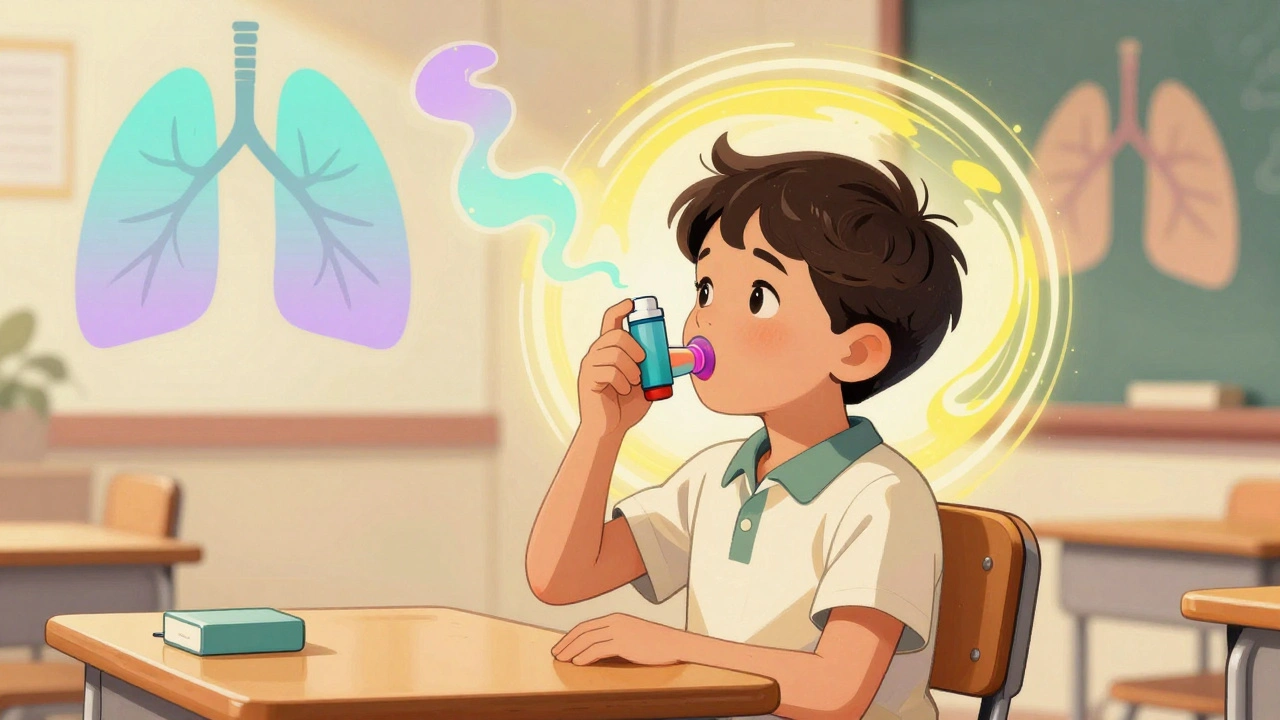
When a child has asthma, the difference between a normal day and an emergency visit often comes down to one small plastic tube: the spacer. It’s not flashy. It doesn’t make noise. But for kids under 10, especially those who struggle to coordinate breathing with an inhaler, it’s the most important tool in their asthma toolkit.
Why Spacers Are Non-Negotiable for Kids
Metered-dose inhalers (MDIs) look simple - press and breathe. But for a 3-year-old? That’s nearly impossible. Without a spacer, up to 80% of the medicine hits the back of the throat or gets spit out. Only a fraction reaches the lungs where it’s needed. Spacers solve this. They’re hollow tubes, usually 10 to 20 centimeters long, that attach to the inhaler. When you press the inhaler, the medicine floats inside the spacer like mist in a tiny room. The child then breathes in slowly through their mouth, no timing needed. No rush. No panic. Studies show this works. Children using a spacer with their inhaler deliver 73% more medication to their lungs than those using the inhaler alone. In emergency situations, like an asthma flare-up, kids using a spacer are nearly half as likely to be admitted to the hospital compared to those using a nebulizer. And here’s the kicker - spacers cost less. Much less. A single spacer lasts for years. Nebulizers? They’re bulky, need electricity, and cost 10 times more to maintain. The guidelines are clear. The Global Initiative for Asthma (GINA), the American Academy of Pediatrics, and the Royal Children’s Hospital all say: every child with asthma should use a spacer with their inhaler. No exceptions. Not for toddlers. Not for teens.How to Use a Spacer Correctly (The 9-Step Rule)
It’s not enough to have a spacer. You have to use it right. Too many parents and even some school nurses get it wrong. Here’s the exact method recommended by the Royal Children’s Hospital in Melbourne:- Have your child sit upright - no slouching.
- Attach the inhaler to the spacer. Make sure it’s snug.
- If your child is under 5, put the mask on their face. Seal it around nose and mouth. For older kids, use the mouthpiece and have them close their lips tightly.
- Hold the spacer and inhaler level. Don’t tilt it up or down.
- Press the inhaler once to release one puff into the spacer.
- Have your child breathe in and out normally - four times. Don’t force deep breaths. Just regular breathing.
- Wait 30 seconds. If a second puff is needed, repeat steps 3-6.
- After use, remove the inhaler. Don’t wash the spacer right away.
- Wash the spacer once a week with warm water and a drop of dish soap. Don’t rinse. Just shake off the excess and let it air-dry. Rinsing creates static, which traps medicine.
Why Schools Are the Missing Link
Asthma is the #1 reason kids miss school. In the U.S., 6.2 million children have asthma. That’s 1 in 12. In the UK, it’s similar. Many of these kids have attacks during school hours - during PE, in the cafeteria, or after recess. But here’s the problem: most schools don’t have a plan. The National Asthma Education and Prevention Program (NAEPP) says every student with asthma should have a written asthma action plan. That plan should include:- Which medications they use (including spacer type)
- When to use them
- Warning signs of worsening asthma
- Emergency contacts
- Who is trained to help - and where the spacer and inhaler are stored
The Teenage Problem: Pride, Portability, and Poor Technique
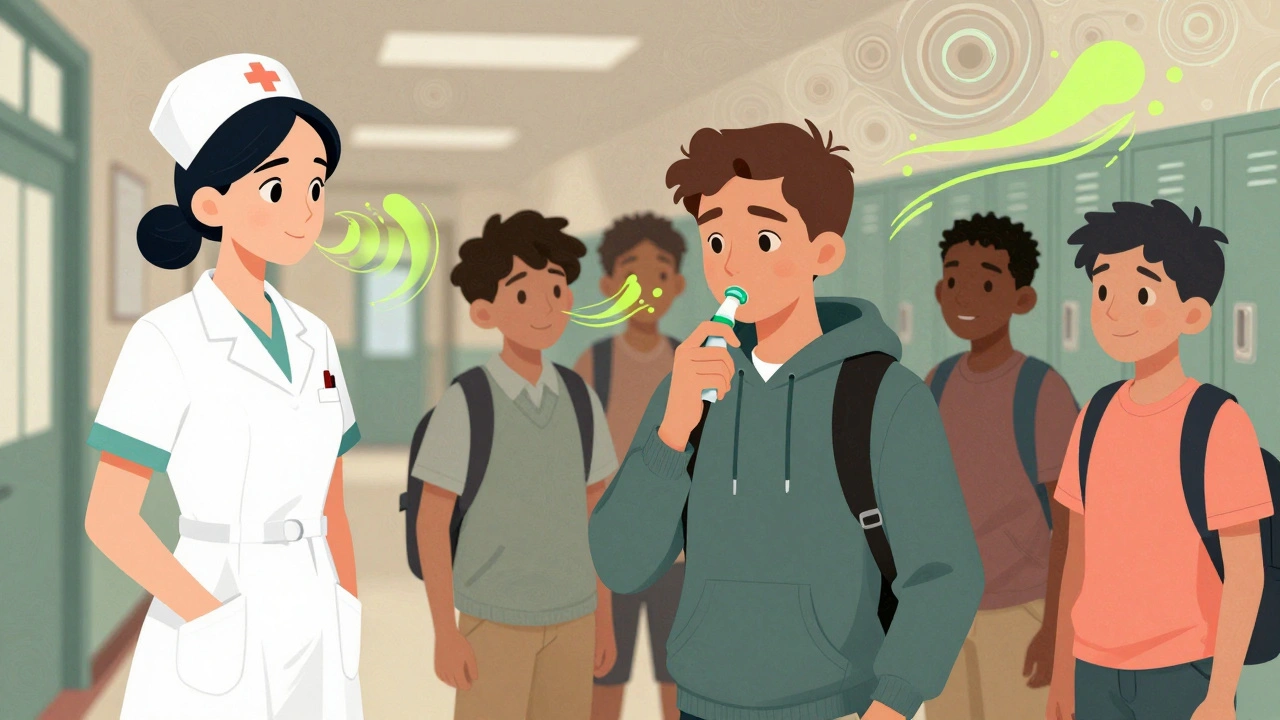
The biggest challenge isn’t toddlers. It’s teens. A study found adolescents (ages 14-18) are 80% less likely to use their spacer correctly than kids aged 4-8. Why? They don’t want to stand out. They don’t want to be the kid who pulls out a big plastic tube in the hallway. One 15-year-old told a researcher: “I just use my inhaler alone. No one sees me.” And here’s the truth: they’re wrong. Using an inhaler without a spacer at 15 is just as ineffective as at 5. Their lungs are bigger, but their technique? Worse. Some schools are solving this. One high school in Bristol started keeping “stealth spacers” - smaller, sleeker models that fit in a hoodie pocket. They also trained student ambassadors to normalize spacer use. “It’s like wearing glasses,” said one 16-year-old. “If you need it, you use it. No shame.” Another trick: apps. The NIH is funding a study testing smartphone apps that use the phone’s camera to check if a child’s spacer technique is correct. Imagine: your kid uses the spacer, takes a video, and the app tells them if they did it right. It’s not mainstream yet - but it’s coming.What a Real Asthma Care Plan Looks Like
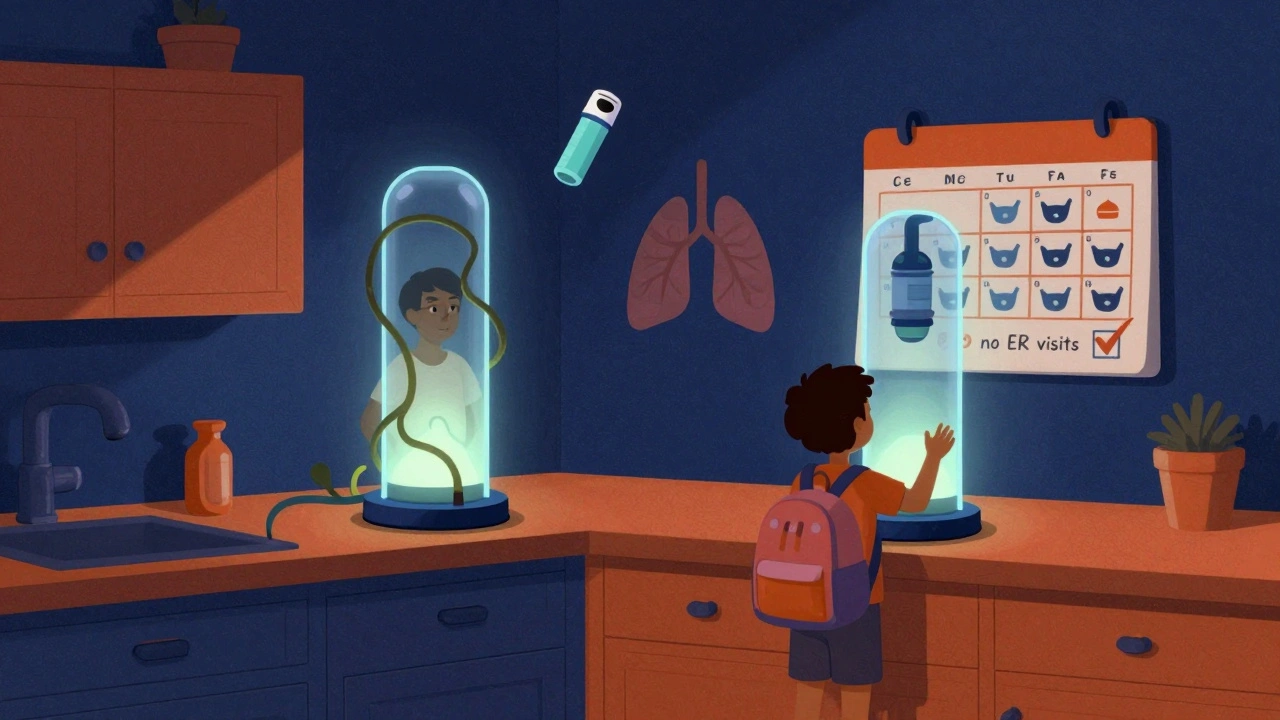
A good asthma care plan isn’t a piece of paper. It’s a system. Here’s what works:- At home: Two spacers - one for home, one for school. Washed weekly. Stored in a cool, dry place. No sun. No heat.
- At school: The child’s inhaler and spacer kept in the nurse’s office or with a trusted teacher. Not in a locker. Not in a backpack. Always accessible.
- Training: The school nurse trains the child, the teacher, and the coach. Every 6 months. Not once.
- Communication: Parents get a reminder every term: “Is your child’s spacer working? Did they have any attacks last month?”
- Emergency protocol: If a child has trouble breathing, they get their spacer and inhaler immediately. No waiting. No calling home first.
What Not to Do
Don’t assume your child knows how to use it. Don’t assume the school has one. Don’t wait for an emergency to act. Avoid these traps:- Using a spacer that’s cracked or broken - it leaks.
- Letting your child use a spacer with a mouthpiece if they’re under 5 - they can’t seal their lips.
- Using a spacer that’s been left in a hot car or near a radiator - plastic warps.
- Skipping the weekly wash. Static builds up. Medicine sticks to the walls.
- Thinking “my child is older now, they don’t need it anymore.” They do.
What’s Next? Better Tools, Better Systems
The science is settled. Spacers work. They’re safe. They’re cheap. They save lives. Now we need to fix the system. Schools need funding to stock spacers. Teachers need training. Kids need dignity. And parents need to know: you’re not overreacting. You’re doing exactly what your child needs. New spacer designs are coming - smaller, quieter, even color-coded for age groups. One company in the UK just launched a spacer with a built-in counter that clicks after each use. Another has a soft silicone mask that’s less intimidating for toddlers. But none of that matters if the person holding it doesn’t know how to use it. The best asthma care plan in the world won’t help if the spacer sits in a drawer. The best inhaler won’t help if the child doesn’t breathe right. It’s simple. But it’s not easy. It takes consistency. It takes communication. It takes courage to ask the school for help. And it’s worth it. Because every time a child uses their spacer correctly, they’re not just breathing easier. They’re going to school. Playing soccer. Sleeping through the night. Living like a kid should.Do all children with asthma need a spacer?
Yes. Every child using a metered-dose inhaler (MDI) should use a spacer, regardless of age. Even teenagers benefit. Spacers ensure more medicine reaches the lungs and less stays in the mouth or throat, reducing side effects like hoarseness or thrush. Guidelines from GINA and the American Academy of Pediatrics require spacer use for all pediatric patients on MDIs.
Can a child use an inhaler without a spacer?
Technically yes, but it’s not effective. Without a spacer, most of the medicine hits the back of the throat and gets swallowed or spit out. Studies show only about 20% of the dose reaches the lungs without a spacer. For kids under 10, this often means poor asthma control and more emergency visits. Even older kids benefit from spacers - their technique improves, and they get more relief from less medicine.
How often should a spacer be cleaned?
Wash your spacer once a week with warm water and a drop of dish soap. Don’t rinse it after washing - just shake off the extra water and let it air-dry. Rinsing creates static electricity, which traps the medicine inside the spacer. Never wipe it dry with a towel. That also creates static. A clean spacer works better and lasts longer.
What if my child’s spacer is wet?
Don’t use it. A wet spacer doesn’t work properly. Moisture causes the medicine to stick to the walls instead of reaching the lungs. Always keep a spare spacer at school or in your child’s bag. If your child needs medicine and the spacer is wet, use the inhaler alone - but get a dry spacer as soon as possible. Wet spacers are a common reason for treatment failure.
Should schools keep spacers on hand?
Yes. In 42 U.S. states, schools are legally required to keep asthma medication on-site. Even where it’s not required, best practice says every school should have spare spacers and inhalers for students who forget theirs or have an unexpected attack. Schools with asthma care plans and accessible spacers see 37% fewer asthma-related absences. It’s not just helpful - it’s lifesaving.
Why do teens struggle with spacers more than younger kids?
Teens often feel self-conscious. Carrying a bulky spacer makes them feel different. Some think they’re too old to need it. Others don’t know how to use it correctly. Studies show adolescents have 80% lower odds of using spacers properly compared to children aged 4-8. Solutions include smaller, discreet spacers, peer education, and normalizing asthma care as part of daily life - like carrying a water bottle or glasses.
Can a spacer be shared between children?
No. Spacers should never be shared. Even if cleaned, they can carry germs or allergens. Each child should have their own spacer, labeled with their name. Schools that keep spacers on-site should have a supply of labeled, single-use spacers for emergencies - but these are backups, not replacements for personal devices.
Gavin Boyne
December 3, 2025 AT 17:44So let me get this straight - we’re spending millions on fancy nebulizers while a $10 plastic tube saves lives, reduces ER visits, and doesn’t need a power outlet? And schools still don’t have them on hand? This isn’t healthcare, it’s performance art with a side of bureaucratic negligence.
Also, teens not using spacers because they’re ‘embarrassing’? Tell that to the kid gasping on the gym floor while his inhaler just puffs air into his shirt. The real embarrassment is the system that lets this happen.
James Kerr
December 4, 2025 AT 02:49My niece uses a spacer and it’s been a game-changer. No more midnight coughing fits. No more panic when she starts wheezing after soccer. We keep one at home, one at school. Washed once a week, no towel, no rinse. Simple. Cheap. Works.
Also - teachers who say ‘it’s not my job’? Buddy, if your kid’s in your class and has asthma, it’s your job now. Just sayin’.
Rashmin Patel
December 5, 2025 AT 03:37OMG I CANNOT BELIEVE THIS IS STILL A PROBLEM 😭
My cousin in Delhi got hospitalized last year because the school didn’t have a spacer - they tried to use the inhaler alone and she nearly coded. Her mom cried for hours. We bought her two spacers, one for school, one for home, labeled with her name, kept in a ziplock in her bag. She’s been fine since.
Why are we still treating this like a luxury? It’s not. It’s basic. Like seatbelts. Like handwashing. Stop making it complicated. Just give them the damn tube.
Also - if your spacer is wet? THROW IT OUT. I don’t care if it’s ‘expensive.’ Your kid’s lungs are more expensive. 🚫💧
Albert Essel
December 6, 2025 AT 18:44The science is unequivocal: spacers increase lung deposition by over 70% compared to inhaler-only use in pediatric populations. The Global Initiative for Asthma (GINA) guidelines have mandated spacer use since 2019 for all children under 18 using metered-dose inhalers. The failure to implement this at the institutional level constitutes a systemic breach of clinical standards.
Furthermore, static charge accumulation due to improper drying - specifically towel-drying or rinsing - reduces effective drug delivery by up to 45%, as demonstrated in controlled in vitro studies by the European Respiratory Society. This is not anecdotal. This is evidence-based medicine being ignored.
Schools that do not maintain accessible, properly maintained spacers are not merely negligent - they are in violation of the Americans with Disabilities Act, as asthma is a recognized disability requiring reasonable accommodation.
Kara Bysterbusch
December 7, 2025 AT 11:33Let me pause for a moment and honor the quiet heroes here: the school nurses who are juggling ten emergencies at once, the parents who wash spacers weekly without complaint, the teachers who learn new protocols on their own time.
This isn’t about gadgets or policy. It’s about dignity. It’s about a 14-year-old who doesn’t want to be the ‘asthma kid’ - but also doesn’t want to miss the game because she couldn’t breathe. The ‘stealth spacer’ concept? Genius. Normalizing care like wearing glasses? Brilliant.
We don’t need more funding. We need more humanity. We need to stop treating asthma like a burden and start treating it like a fact of life - one that deserves quiet, consistent, unglamorous care.
And yes - if your spacer is wet, don’t use it. Just like you wouldn’t take a wet bandage and slap it on a wound. Basic physics. Basic compassion.
sagar bhute
December 9, 2025 AT 06:48This whole thing is a scam. Spacers? Please. The real problem is Big Pharma pushing plastic tubes to replace nebulizers because they’re cheaper to produce. You think they care about kids? They care about profit margins. Nebulizers cost more - so they’re phasing them out. Spacers are a cost-cutting measure disguised as healthcare innovation.
And don’t get me started on the ‘weekly wash’ nonsense. Plastic is plastic. Static? That’s just pseudoscience dressed up in medical jargon. My kid uses his inhaler without a spacer and he’s fine. You’re overcomplicating everything.
Cindy Lopez
December 10, 2025 AT 14:19Wow. So much text. Can we just say: spacers work. Schools don’t have them. Teens are dumb. Done.
Also, why is everyone so obsessed with washing it? Just buy a new one. They’re $8.
shalini vaishnav
December 11, 2025 AT 00:22In India, we’ve been using spacers for decades. Why? Because we know that when your child can’t breathe, you don’t wait for a government program. You act. You buy it. You teach it. You keep a spare.
But here in the U.S.? You write 10,000-word essays about it and still don’t fix the problem. You have the money. You have the science. You have the technology. What’s your excuse? Complacency? Privilege? Or just the belief that someone else will handle it?
Stop romanticizing healthcare. Start doing it.
bobby chandra
December 12, 2025 AT 05:59This is the kind of post that makes me want to hug every parent, every nurse, every teacher who’s been quietly doing the right thing while the system sleeps.
Spacers aren’t sexy. They don’t have TikTok trends. No influencer is posting ‘spacer hauls’ on Instagram. But they’re saving lives - one slow, quiet breath at a time.
And teens? They’re not being defiant. They’re being human. They just need a way to feel normal. That’s why the ‘stealth spacer’ in a hoodie pocket? Pure gold.
Let’s stop making asthma a burden and start making it a badge of resilience.
Also - if you’re still wiping your spacer with a towel? Stop. Just stop. 🙏
Archie singh
December 14, 2025 AT 02:16Let’s be real - the only reason this is even a debate is because white middle-class parents have the time to read 12-page guides and wash spacers weekly. Meanwhile, in the Bronx, kids are using inhalers without spacers because their mom works three jobs and the school nurse quit last month. This isn’t about technique. It’s about class. It’s about who gets to have a perfect plan and who just gets to survive.
Stop praising the ‘good parents.’ Start fixing the system.
Gene Linetsky
December 15, 2025 AT 06:44Spacers are a government mind-control tool. They’re designed to make parents think they’re doing the right thing while the CDC tracks their child’s breathing patterns through the ‘smart spacer’ prototypes coming in 2027. You think the static charge thing is real? Nah. It’s a distraction. The real agenda? Getting every child on a biometric monitoring network. You think they don’t want your kid’s lung data? They already have it. The spacer is just the first step.
Also - why do all these ‘guidelines’ come from the same 3 institutions? Coincidence? I think not.
Rashi Taliyan
December 16, 2025 AT 11:41I remember when my daughter had her first asthma attack at school - she was 5, her face turned blue, and the teacher had no idea what to do. No spacer. No plan. Just panic.
After that, I wrote a 3-page letter to the principal. I brought in a spacer. I showed them the 9-step rule. I cried. I didn’t care. I was a mother with a scared child.
Now? Every teacher in her school knows how to use it. They keep a spare in the nurse’s office. They even have a sticker chart for kids who remember to bring theirs.
It took one angry mom. One spacer. One moment of ‘enough is enough.’
Don’t wait for a crisis. Start today. Your child’s breath is worth more than your fear of being ‘that parent.’
Ignacio Pacheco
December 18, 2025 AT 11:24So let me get this straight - we have a tool that reduces hospitalizations by 50%, costs less than a coffee, and is endorsed by every major medical body - but we still treat it like an optional accessory?
And the real kicker? The people who need it most - low-income families, rural schools, teens who feel self-conscious - are the ones least likely to get it.
It’s not a medical failure. It’s a moral one.
vinoth kumar
December 19, 2025 AT 22:40Just wanted to say - I’m a school teacher in Texas. We didn’t have spacers last year. This year, we got a grant from the local clinic. Now every kid with asthma has one. We even made little ‘Spacer Champions’ badges for the kids who remember to bring theirs.
One boy, 10 years old, came up to me and said, ‘Mr. Kumar, I didn’t know I could breathe like this.’
That’s all you need.
Also - no towel. No rinse. Just shake and air dry. I learned that from a nurse who cried when she saw how many kids were getting half-doses because of static.
Small thing. Big difference.
Jim Schultz
December 21, 2025 AT 00:56Wow. Just… wow. A 12-paragraph essay on a plastic tube? I mean, I get it - it’s important. But the way this is written? Like it’s the Declaration of Independence. ‘The spacer, by the grace of GINA and AAP, shall be wielded with reverence!’
It’s a tube. It’s not magic. It’s not a religion. It’s a tool. Use it right. Wash it right. Don’t be a hero. Just be consistent.
And for the love of god - stop calling it ‘the most important tool in their asthma toolkit.’ It’s a spacer. Not the Holy Grail.