

What Is Contact Dermatitis From Topical Medications?
You put on a cream for your rash, and instead of getting better, your skin gets worse. It burns. It itches. It turns red and flaky. You didn’t change anything else-just the cream. That’s not a bad batch. It’s not your skin being sensitive. It’s likely a topical medication allergy, also known as allergic contact dermatitis.
This isn’t rare. About 1 in 6 people who get patch tested for stubborn skin rashes turn out to be allergic to something in their topical medicine. That’s more than 10% of patients. And the most common culprits? Antibiotics like neomycin and bacitracin, corticosteroids like hydrocortisone and triamcinolone, local anesthetics like benzocaine, and even over-the-counter pain relievers like ketoprofen.
Here’s the twist: you might be allergic to the very thing meant to fix your skin. A 2021 study found that up to 2.2% of people using topical steroids develop an allergy to them. So if your eczema cream makes your skin worse, it’s not just not working-it might be the cause.
How Do You Know It’s Allergic, Not Just Irritated?
Not every red, itchy patch is an allergy. There’s another type called irritant contact dermatitis. That’s when a substance-like soap, alcohol, or even too much handwashing-physically damages your skin. No immune system involved. Just plain irritation.
Allergic contact dermatitis is different. It’s your immune system reacting to a specific chemical. It takes time. You use the product once, no problem. You use it again, and three days later, your skin explodes. That’s the hallmark of a Type IV delayed hypersensitivity reaction.
So how do you tell them apart? Irritant rashes usually show up right away, look dry and cracked, and happen where the product was applied. Allergic rashes take 24-72 hours to show up. They’re often itchy, bumpy, and can spread beyond where you applied the product. If you’ve used the same cream for weeks and suddenly break out, it’s likely an allergy.
And here’s something many doctors miss: 15-20% of people who think they’re allergic to topical meds actually have irritant reactions. That’s why patch testing isn’t optional-it’s essential.
How Patch Testing Works (And Why It’s Your Best Shot)
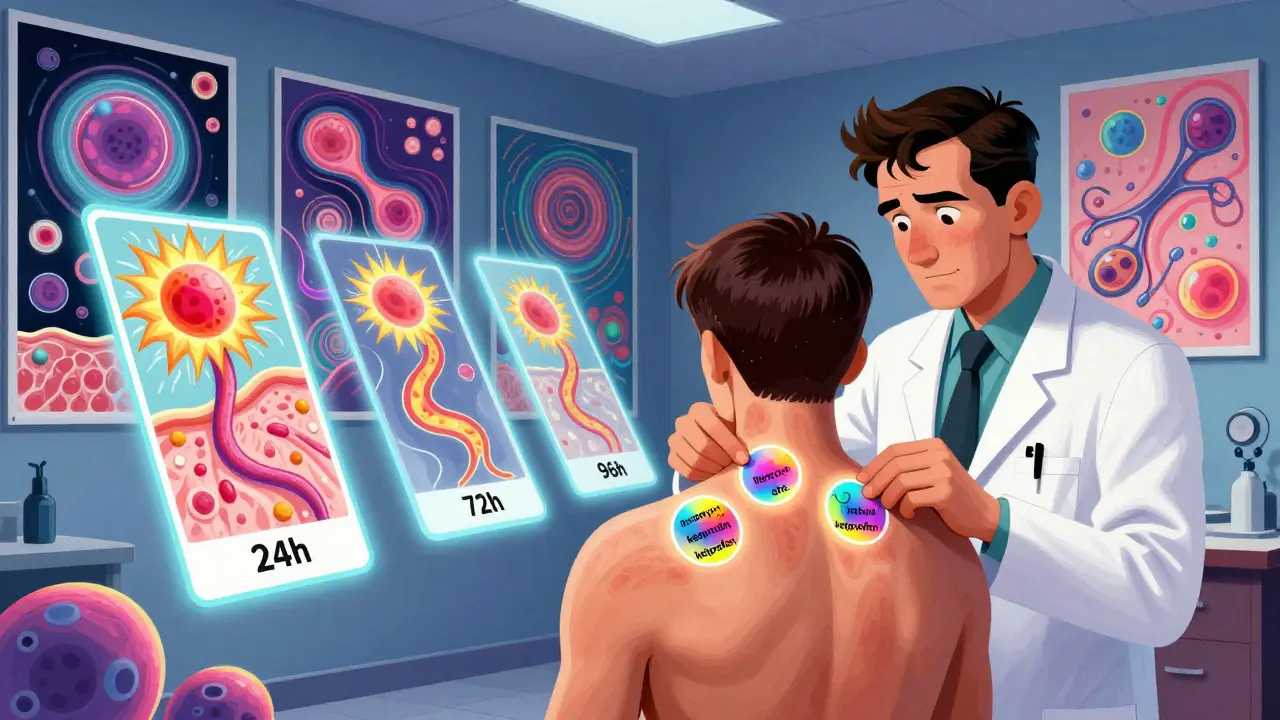
If you’ve had a rash for more than a month, and nothing’s helped, ask for patch testing. It’s not a needle. It’s not a blood test. It’s small patches with potential allergens stuck to your back for 48 hours.
After 48 hours, the patches come off. Your doctor checks for redness or swelling. Then they come back at 72 hours and 96 hours. Why? Because allergic reactions take time. A rash that shows up on day four is still a reaction.
Standard patch test panels include 360+ known allergens, including common topical medications. Neomycin shows up in nearly 10% of positive tests. Bacitracin? 7.5%. Benzocaine? 2.1%. Ketoprofen? 1.8%. These aren’t obscure chemicals-they’re in everything from antibiotic ointments to hemorrhoid creams to sunscreens.
And here’s the kicker: 70% of people who get tested get a clear answer. That means you can finally stop guessing. You can stop using the thing that’s making you worse.
What Happens If You Keep Using the Problematic Cream?
Ignoring a topical allergy is like pouring gasoline on a fire. Your skin doesn’t heal. It gets worse. Chronic rashes develop. The skin thickens. It cracks. It bleeds. You start avoiding showers, afraid of the sting. You might even stop sleeping because the itching is so bad.
Studies show that people with undiagnosed topical medication allergies see symptoms for an average of six months before getting the right diagnosis. They visit three doctors. They try three different creams. They get worse each time.
And the worst part? Many of these people are healthcare workers. Nurses, aides, pharmacists-they’re exposed to topical meds daily. A 2022 JAMA Dermatology study found 18% of healthcare workers developed contact dermatitis from these products. And 63% of them needed workplace changes to keep working.
If you’re treating a rash and it’s not getting better-or it’s spreading-stop using the product. Don’t wait. Don’t hope it’ll go away. Get tested.
How to Treat It-Without Making It Worse
Once you know what’s causing it, the first rule is simple: stop using it. No exceptions.
For mild cases, over-the-counter hydrocortisone 0.5-1% can help. But if you’re still itchy after a week, you’re probably not dealing with a simple rash. You need prescription treatment.
For localized allergic contact dermatitis, mid- to high-potency topical steroids like triamcinolone 0.1% or clobetasol 0.05% are standard. But if the rash is on your face, eyelids, or groin? Those areas are too thin for strong steroids. Use desonide instead. High-potency steroids on thin skin can cause atrophy-skin that gets paper-thin and bruises easily. That happens in up to 35% of people who use them for more than two weeks.
For large rashes-over 20% of your body-you’ll need oral steroids like prednisone. 85% of patients feel relief within 24 hours. But steroids aren’t a long-term fix. You still need to avoid the allergen.
Alternatives to Steroids: What Else Works?
There’s a growing shift toward steroid-sparing treatments, especially for the face and folds of skin. Topical calcineurin inhibitors like pimecrolimus (Elidel) and tacrolimus (Protopic) are now commonly used off-label for allergic contact dermatitis.
They work in 60-70% of cases. On RealSelf, 82% of users reported significant improvement within two weeks. But there’s a catch: they burn. That initial stinging is common and usually fades after a few days. Still, many patients quit because of it.
And yes, the FDA hasn’t officially approved them for contact dermatitis. But dermatologists use them because they’re safer for long-term use than steroids. They don’t thin your skin. They don’t cause stretch marks. They’re your best bet if you’ve had a steroid allergy or need to treat a sensitive area.
What About Cross-Reactivity? (And How to Avoid Traps)
Not all steroids are the same. There are six groups (A through F). If you’re allergic to hydrocortisone (Group A), you can often safely use triamcinolone (Group B) or methylprednisolone aceponate (Group D). That’s a 65% reduction in treatment limitations if you know the group.
Same goes for antibiotics. If you’re allergic to neomycin, you might also react to framycetin or gentamicin. But you can usually use mupirocin without issue.
That’s why patch testing doesn’t just stop at “you’re allergic to neomycin.” Good labs test for cross-reactive pairs. They map out your risk. They give you a personalized avoidance list.
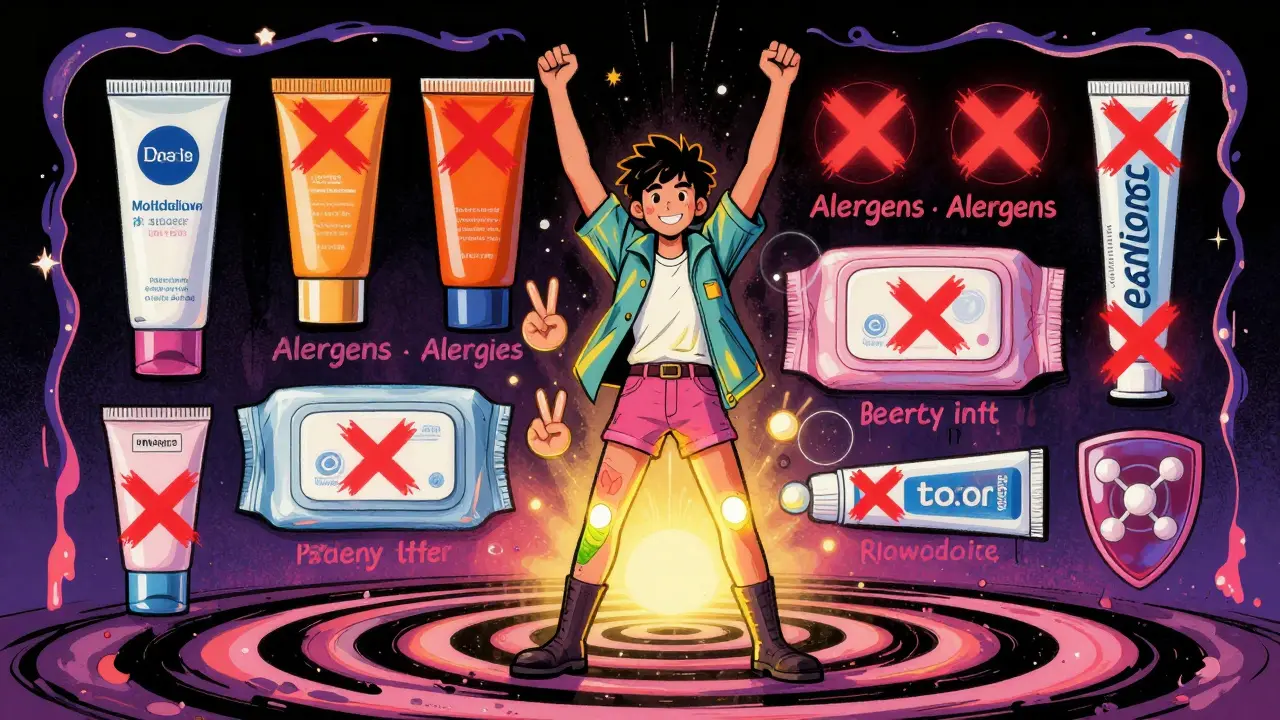
And don’t forget: allergens hide in plain sight. Your moisturizer. Your sunscreen. Your baby wipes. A 2023 survey found that 30% of allergens come from products patients didn’t even think of as “medications.” Bring everything to your appointment-shampoos, lotions, even your toothpaste.
How Long Does It Take to Heal?
Once you avoid the allergen, most rashes clear up in 2-4 weeks. Itching usually drops within 48-72 hours of stopping the trigger.
But if you keep using the product? The rash becomes chronic. Your skin changes. It’s harder to treat. That’s why early diagnosis matters. A 2022 American Academy of Dermatology study showed that 89% of patients fully recovered within four weeks when they avoided the allergen. Only 32% recovered if they kept using the medicine.
And if you’ve had a long-term rash? Healing takes longer. But it’s still possible. The key isn’t stronger creams. It’s stopping the trigger.
What’s New in Diagnosis and Treatment?
Things are changing fast. In 2023, the European Society of Contact Dermatitis introduced a new scoring system called the “Topical Medication Allergy Score.” It uses 12 clinical clues to boost diagnostic accuracy from 65% to 89%.
Researchers at Johns Hopkins found that diluting topical medications 10-fold during patch testing cuts false negatives from 32% to just 9%. That’s huge for people with broken skin barriers.
The FDA now requires full ingredient lists on all topical prescriptions. That’s helped reduce misdiagnosis by 15%.
And the future? Molecular tests that predict allergy risk before you even use a product. The NIH just funded $4.7 million in research for this. If it works, it could prevent 150,000 cases a year.
What Should You Do Right Now?
- If you’ve had a rash for more than a week that’s not improving, stop using all topical products on that area.
- Write down everything you’ve applied to your skin in the last month-prescriptions, OTC creams, lotions, even baby wipes.
- Make an appointment with a dermatologist or allergist who does patch testing. Don’t settle for “just use more steroid.”
- Download the American Contact Dermatitis Society’s app. It lets you scan product barcodes to check for allergens.
- If you’re a healthcare worker, talk to your employer about protective measures. You’re not alone.
You don’t have to live with a rash that won’t go away. The answer isn’t more medicine. It’s knowing what to stop.