
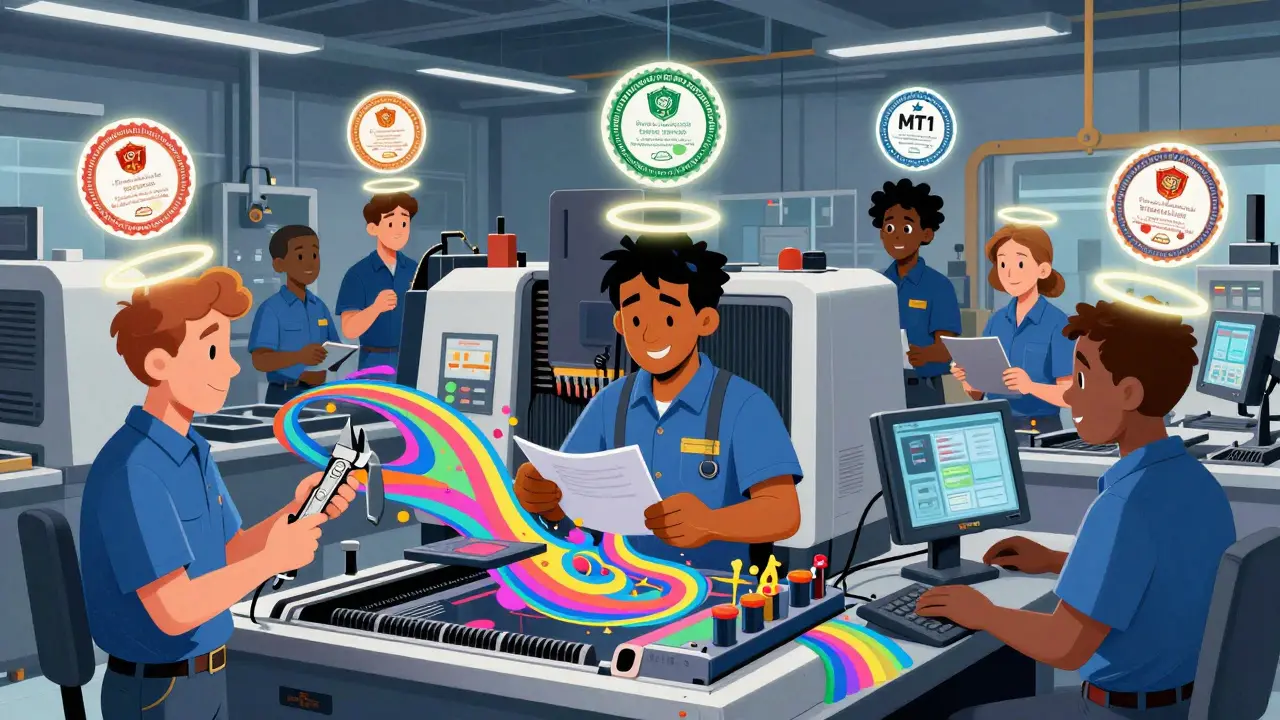
When you walk into a modern manufacturing plant, you might see robots welding, sensors monitoring production lines, and screens displaying real-time quality data. But behind every machine, every process, every quality check - there’s a person. And that person needs more than just a high school diploma to keep up. The qualifications for manufacturing staff today aren’t just about knowing how to push a button. They’re about understanding safety protocols, reading digital dashboards, interpreting tolerance levels, and working as part of a team that can’t afford mistakes.
What It Really Takes to Work in Manufacturing Today
For years, entry-level manufacturing jobs were seen as positions anyone could fill with minimal training. That’s no longer true. While 92% of employers still accept a high school diploma or GED as the baseline requirement, workers without further qualifications face 37% higher turnover rates, according to RSS Inc. (2023). Why? Because today’s manufacturing environments demand more than physical labor. They demand problem-solving, adaptability, and technical fluency.
The shift started with the Certified Production Technician (CPT) credential, developed by the Manufacturing Skill Standards Council (MSSC) in 1998. It was the first nationally recognized, portable certification for frontline workers. Today, it’s still one of the most trusted entry points. The CPT tests four core areas: safety, quality practices, manufacturing processes, and maintenance awareness. Passing it doesn’t just look good on a resume - it means the worker can identify a faulty sensor, follow lockout/tagout procedures, and spot a dimension that’s out of tolerance before a batch gets ruined.
The Certification Landscape: CPT, Six Sigma, and MT1
Not all certifications are created equal. Each serves a different purpose and targets a different level of responsibility.
- Certified Production Technician (CPT) - The go-to for entry-level and production floor roles. It’s affordable, widely accepted, and takes about 40 hours of training. Over 76% of certified workers see higher wages, according to U.S. Department of Labor data (2022).
- Six Sigma - This isn’t for beginners. It’s a structured method for reducing defects and improving efficiency. Levels range from White Belt (basic awareness) to Master Black Belt (strategic leadership). Green Belts earn a median salary of $85,000; Black Belts make $110,000. But getting there takes 100-240 hours of study, plus a real-world project. Retention rates jump from 57% to over 85% when paired with mentorship, says ASQ.
- Manufacturing Technician Level 1 (MT1) - Administered by the Manufacturing Skills Institute, MT1 is unique because it’s built into high school and community college curricula. It’s validated in 42 states and funded by state programs like Virginia’s $2,200 grant for teachers. The certification requires a 3-day trainer course and ongoing recertification every three years.
These aren’t just pieces of paper. They’re proof that someone can operate a CNC machine safely, read a micrometer accurately, and understand why a 0.002-inch deviation matters in an engine part.
What Training Programs Must Include
Good training doesn’t happen by accident. Effective programs follow a clear structure with four non-negotiable components:
- Safety protocols - This isn’t optional. OSHA reports that proper safety training cuts workplace injuries by 52%. Workers must know how to use PPE, respond to emergencies, and follow lockout/tagout procedures for every machine they touch.
- Equipment operation - From basic controls to advanced troubleshooting. A worker shouldn’t just know how to start a press - they need to understand why it’s vibrating, what the error codes mean, and when to call for maintenance.
- Quality control - This includes measuring tools (calipers, gauges), understanding tolerance ranges, interpreting inspection reports, and using statistical process control (SPC) charts.
- Industry-specific processes - A worker in food processing needs different training than someone in electronics assembly. Chemical handling, sterile environments, soldering standards - each sector has its own rules.
Companies that skip even one of these areas see higher error rates, more downtime, and more accidents. The most successful manufacturers start with a skills gap analysis - using production data, quality logs, and incident reports - to build training that fixes real problems, not hypothetical ones.
Apprenticeships vs. Certifications vs. Degrees
There are three main paths to becoming qualified in manufacturing:
- Apprenticeships - Typically 2-4 years of paid on-the-job training with classroom instruction. They’re excellent for hands-on learners but limit mobility. If you move to a new company, your credentials might not transfer.
- Certifications - Shorter (weeks to months), nationally recognized, and portable. CPT, Six Sigma, and MT1 all move with you. They’re ideal for mid-career workers or those looking to switch roles.
- Degrees - A 4-year degree in industrial engineering opens doors to management, design, or R&D roles. But it costs $20,000-$50,000 per year. For most floor-level jobs, it’s overkill.
Community college programs offering Manufacturing Technology diplomas cost $3,000-$8,000 and take 18-24 months. They deliver 91% job placement rates, according to the National Center for Education Statistics (2022). That’s a strong return on investment.
The Hidden Problem: Digital Skills and Resistance to Change
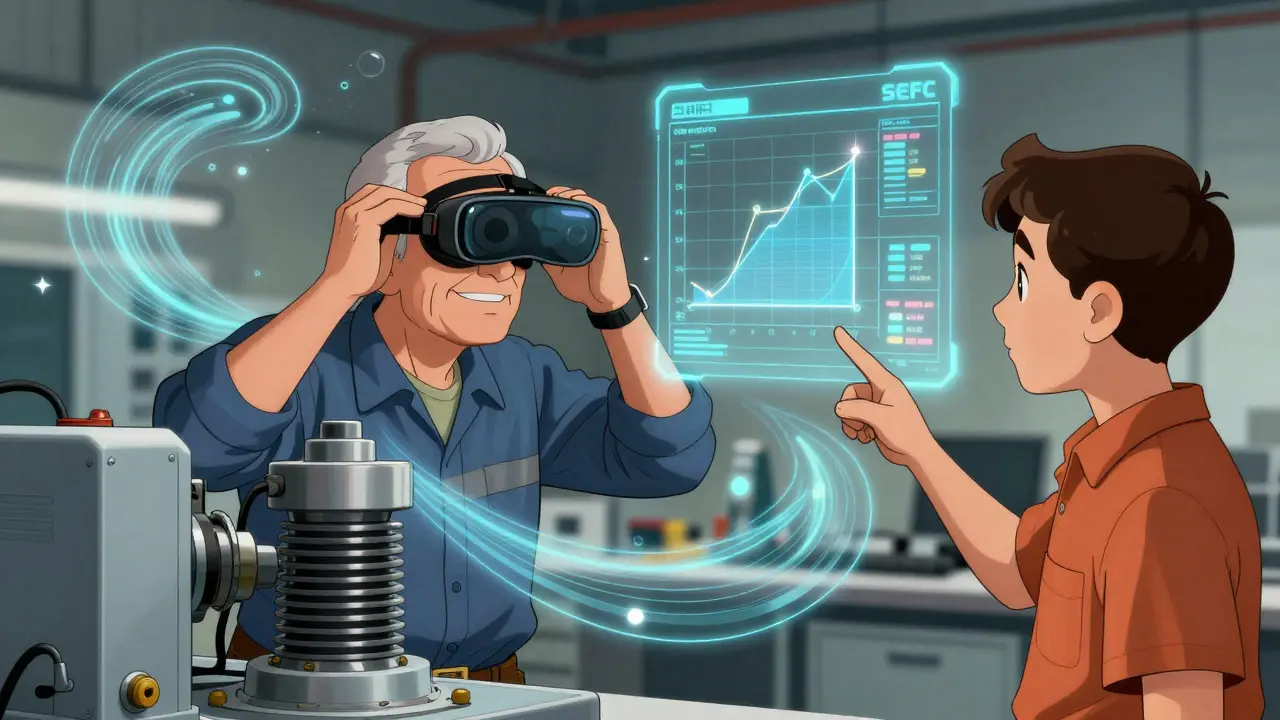
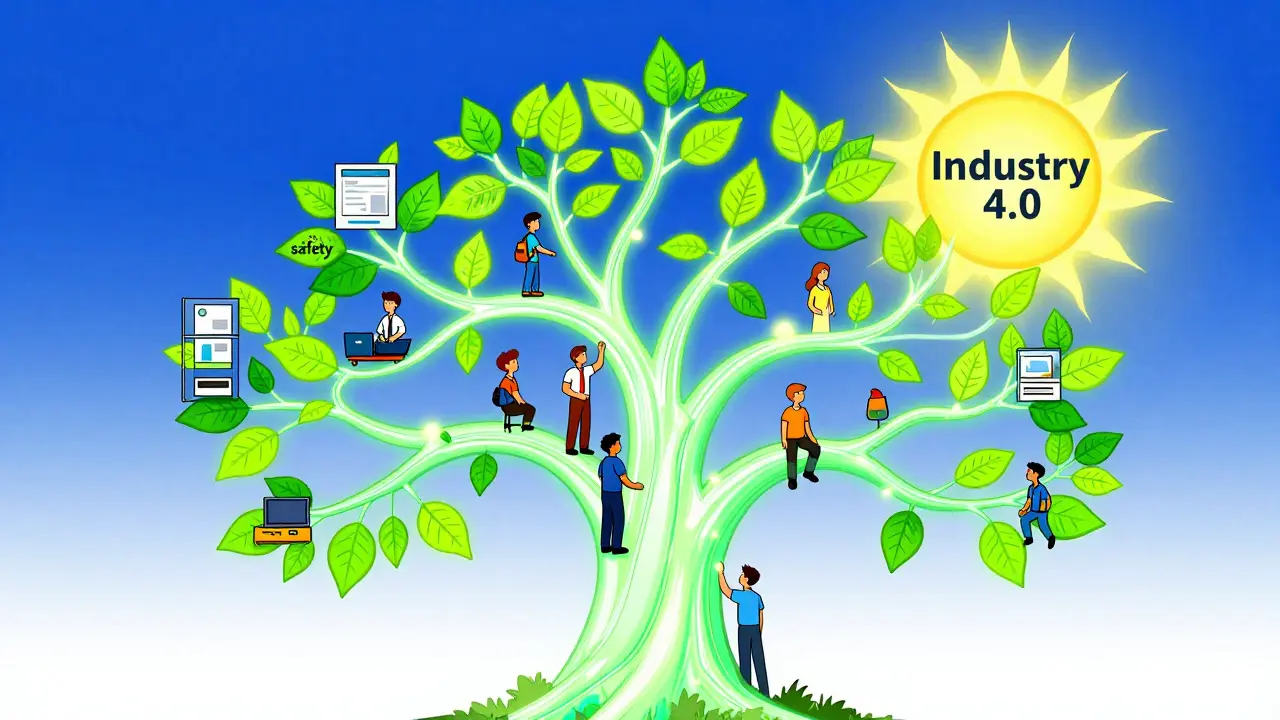
Industry 4.0 isn’t just a buzzword - it’s changing who can work in manufacturing. Today’s machines talk. They send alerts. They log data. Workers need to understand that.
But 68% of veteran workers struggle with digital systems, according to Vector Solutions (2023). They’ve spent decades learning to fix things with wrenches and gut instinct. Now they’re expected to interpret touchscreen interfaces and troubleshoot PLC errors. That’s why cross-training - rotating workers through different stations - is so powerful. It builds versatility and reduces fear of new tech by 41%.
And it’s not just about machines. ASQ’s 2025 certification updates now require proficiency in Python and SQL. Why? Because data is the new quality control tool. If you can’t read a trend chart or spot a pattern in defect rates, you’re falling behind.
Why Some Training Programs Fail
Not every certification or training program delivers. A 2023 MIT study by Professor David Autor found that 43% of manufacturing certifications don’t actually correlate with job performance. They’re bureaucratic checkboxes, not skill validators.
Small manufacturers, especially, struggle. 63% say they can’t afford comprehensive training programs, according to the National Association of Manufacturers. But here’s the catch: companies that do invest see ROI in just 14 months through fewer errors, less downtime, and lower turnover.
Another pitfall? Lack of documentation. Manufacturers that track progress with skills matrices and digital systems see 27% higher retention rates. Why? Because workers know where they stand. They see a path forward. Without that, training feels like busywork.
What’s Next: Micro-Credentials and AI
The future of manufacturing training is modular. Instead of one big certification, workers earn stackable micro-credentials - a safety badge, a machine operation badge, a data literacy badge. By 2025, 63% of manufacturers plan to adopt this model, according to Deloitte.
AI-powered adaptive learning is already in pilot programs. The MT1 certification is testing systems that adjust training content based on how fast a worker learns. Pilot results show 22% faster skill mastery.
And virtual reality? It’s not science fiction anymore. Reddit users in r/manufacturing report 39% fewer errors when using AR/VR for complex assembly training. Companies like Boeing and Siemens are already using it.
But there’s a warning: too many certifications create confusion. Professor Autor calls it “credential inflation.” There are now 247 distinct manufacturing certifications. That’s not empowerment - it’s noise. The best path forward isn’t collecting more papers. It’s choosing the right ones that match real job needs.
Final Thought: Skills Are the New Currency
Manufacturing isn’t dying. It’s evolving. And the workers who thrive won’t be the ones with the most years on the job. They’ll be the ones who keep learning.
Whether you’re hiring, managing, or starting out - don’t look at resumes. Look at skills. Can they read a blueprint? Can they explain why a part failed? Do they know how to shut down a machine safely? Those are the questions that matter.
The best-trained workforce doesn’t just produce parts. It prevents failures, saves money, and keeps people safe. And in manufacturing, that’s everything.
Do I need a college degree to work in manufacturing?
No, a college degree is not required for most manufacturing roles. Entry-level positions typically only need a high school diploma or GED. However, for technical roles like CNC operation, quality control, or maintenance, 1-2 years of community college training (such as a Welding Technology or Manufacturing Technology diploma) is standard. A bachelor’s degree in industrial engineering is only necessary for engineering, management, or design roles.
What’s the difference between CPT and Six Sigma?
CPT (Certified Production Technician) is for frontline workers and covers safety, quality, operations, and maintenance basics. It’s designed for people on the shop floor. Six Sigma is a process improvement methodology aimed at reducing defects. It’s for workers who analyze data, lead improvement projects, and move into supervisory roles. CPT is entry-level; Six Sigma (especially Green Belt and above) is for career advancement.
Is manufacturing training expensive?
It depends. CPT certification costs under $200. Six Sigma Green Belt training runs $1,000-$2,500. A community college manufacturing diploma costs $3,000-$8,000 total. University degrees are much higher - $20,000-$50,000 per year. Many employers cover training costs, and state programs like Virginia’s $2,200 teacher grant help offset expenses. The real cost isn’t the price tag - it’s the cost of not training: higher errors, more downtime, and turnover.
Can older workers learn new manufacturing skills?
Yes. In fact, 42% of today’s manufacturing workforce is 45 or older, and 61% of them need upskilling to use new digital systems. Successful training programs for older workers focus on hands-on, step-by-step learning with plenty of practice. Cross-training and mentorship from younger, tech-savvy workers also help bridge the gap. The key isn’t age - it’s support and relevance.
What if my company can’t afford training programs?
Start small. Use free resources like the Manufacturing Extension Partnership (MEP), which offers free training consultations at over 1,400 centers nationwide. Focus on the highest-priority skills first - safety training alone can cut injuries by 52%. Use online modules, YouTube tutorials, and peer-led training. Even 30 minutes a week of structured learning adds up. The goal isn’t perfection - it’s progress. Companies that start small see results faster than those that wait for a perfect budget.
marjorie arsenault
March 2, 2026 AT 10:07My brother started as a machine operator with just a GED. After doing the CPT, he got a $4/hour raise. Now he trains new hires. It’s not about degrees - it’s about knowing how to read a gauge and not get hurt. Simple stuff, but it changes everything.
Manufacturing isn’t dead. It’s just waiting for people who care enough to learn.
Anyone can do this. You just need someone to show you the way.
Deborah Dennis
March 3, 2026 AT 03:03Oh, here we go again. Another ‘skills are everything’ lecture. Let’s be real - 90% of these certifications are corporate theater. Who even checks if you have a CPT? HR doesn’t care. Managers just want warm bodies who show up on time.
And don’t get me started on Six Sigma - I’ve seen Green Belts spend six months charting defects… while the machine was broken and no one fixed it. It’s all noise. Real work? That’s done by the guy who’s been there 20 years and knows how to kick a belt back into place.
Shivam Pawa
March 5, 2026 AT 01:44Here in India, we see similar shifts. Factories that invested in MT1 training saw 30% drop in rework. But it’s not about the paper - it’s about confidence. Workers who pass feel like they belong. That’s the real ROI.
Also, Python and SQL? Not for everyone. But if you’re on a line with 50 sensors blinking, yeah - you need to know what ‘trend’ means. Not all of us need to code. But we all need to understand what the data is screaming.
Diane Croft
March 5, 2026 AT 16:29My cousin just got her CPT. She’s 52, worked in retail for 15 years, and switched to a parts assembly line. No college. No loans. Just 40 hours of training and a $15/hour job. She says it’s the first time she’s felt proud of her work.
That’s the story nobody talks about. Not the tech. Not the stats. The dignity.
Donna Zurick
March 7, 2026 AT 06:08Training doesn’t have to be fancy. My plant started with 15-minute safety huddles before shift. No slides. No handouts. Just ‘What’s the one thing that could go wrong today?’
Two months later, near-misses dropped by 60%. We didn’t buy new software. We just started talking.
Simple. Human. Works.
Tobias Mösl
March 7, 2026 AT 06:57Let’s cut the BS. This whole ‘skills are currency’ narrative? It’s a scam. Companies want cheap labor with a shiny badge so they can say they’re ‘investing in workforce development’ while still paying $16/hour.
And don’t even get me started on AI training modules. I’ve seen workers get stuck in VR simulations for 3 hours trying to ‘fix’ a machine that was never broken. Meanwhile, the real issues - broken lights, missing parts, no lunch breaks - get ignored.
This isn’t upskilling. It’s distraction. They’re training us to love our chains.
tatiana verdesoto
March 7, 2026 AT 08:39I’ve been a quality inspector for 18 years. When I first started, we used calipers and clipboards. Now? We have tablets that auto-log every measurement. At first, I hated it. Felt like I was being watched.
Then I realized - it wasn’t about surveillance. It was about clarity. I could see patterns. I could tell when a machine was drifting before anyone else. That’s power.
Don’t fear the tech. Learn to speak its language. You’ll be surprised how much more control you gain.
Ethan Zeeb
March 8, 2026 AT 07:30Apprenticeships are the only real path. Certifications? They’re a corporate tax on workers. You pay for the test, you pay for the class, you pay for the renewal - and the company still doesn’t guarantee you a shift.
I did a 3-year apprenticeship. Got paid. Got trained. Got a job. No debt. No fluff.
If you’re serious about manufacturing, skip the paper chase. Find a union. Find a shop that actually trains. Everything else is marketing.
Darren Torpey
March 9, 2026 AT 11:37Man, I remember the first time I saw a CNC machine light up like a Christmas tree with all its error codes. Felt like I was piloting a spaceship.
Then I learned to read the patterns. That flicker on the screen? That’s a bearing about to die. That beep every 47 seconds? That’s the coolant pump struggling.
It’s not magic. It’s music. And once you learn the rhythm? You don’t just fix machines - you dance with them.
Lebogang kekana
March 10, 2026 AT 14:31My uncle in Johannesburg runs a small metal fab shop. He can’t afford fancy training. So he uses YouTube. Every Friday, they watch a 10-minute video on tool calibration. Then they practice. No test. No certificate. Just ‘did we get better today?’
Three years later? Their defect rate is lower than a plant in Ohio that spent $200k on a ‘digital transformation’.
Real training doesn’t need a budget. It needs consistency.
Jessica Chaloux
March 11, 2026 AT 07:52I just got laid off. My company ‘invested’ in CPT training… then cut my hours because they said I was ‘overqualified’. So now I’m stuck with a badge and no job.
What’s the point? Why do we keep doing this? Why does every ‘solution’ end with us paying for our own oppression?
I’m done. I’m going back to retail. At least there, they don’t make you feel guilty for not knowing SQL.
Aisling Maguire
March 13, 2026 AT 05:13My cousin’s kid just got his MT1. He’s 17. High school senior. Got paid to learn. Now he’s got a job lined up. No loans. No drama. Just a skill that matters.
That’s the future right there. Not degrees. Not badges. Just real, usable, transferable knowledge. And yeah - it’s cheaper than a latte.