

What Is Peptic Ulcer Disease?
Peptic ulcer disease (PUD) isn’t just a bad stomach ache. It’s an open sore in the lining of your stomach or the first part of your small intestine - the duodenum. These sores form when the protective mucus layer breaks down, letting stomach acid eat away at the tissue underneath. About 8 million people worldwide live with this condition, and while it sounds serious, it’s one of the most treatable digestive disorders today.
For decades, people thought stress or spicy food caused ulcers. That myth was shattered in 1982 when Australian scientists Barry Marshall and Robin Warren proved that a bacteria called Helicobacter pylori (H. pylori) was the real culprit. They won the Nobel Prize for it. Today, we know H. pylori infects the stomach lining, triggers inflammation, and weakens the natural defenses against acid. But it’s not the only cause. Nonsteroidal anti-inflammatory drugs (NSAIDs) like ibuprofen and aspirin are now responsible for more than half of all peptic ulcers, especially in older adults who take them regularly for arthritis or chronic pain.
How Do You Know You Have an Ulcer?
The most common symptom is a burning or gnawing pain in the upper abdomen, usually between meals or at night. Many people say the pain gets better after eating or taking antacids - which is why it’s often mistaken for heartburn or indigestion. But ulcers don’t just hurt. You might feel full fast, nauseous, or lose your appetite. Greasy foods can make you feel worse. In severe cases, you could vomit blood, notice black or tarry stools, or lose weight without trying. These are red flags that need immediate medical attention.
There’s no reliable home test for ulcers. The only way to confirm it is through an endoscopy - a thin, flexible tube with a camera passed down your throat to look at your stomach and duodenum. Your doctor will also test for H. pylori using a breath test, stool sample, or blood test. If you’re over 50 or have warning signs like unexplained weight loss or vomiting blood, doctors won’t just assume it’s a simple upset stomach. They’ll act fast.
Antibiotics: Eradicating H. pylori
If H. pylori is the cause, antibiotics are your first line of defense. But you don’t just take one pill. You take a combination - usually two antibiotics plus a proton pump inhibitor (PPI) - for 7 to 14 days. This is called triple therapy. Common antibiotic pairs include clarithromycin with amoxicillin, or clarithromycin with metronidazole. Pantoprazole, omeprazole, or esomeprazole are the PPIs used alongside them.
Why two antibiotics? Because H. pylori is sneaky. It can develop resistance, especially to clarithromycin. In the U.S., resistance rates have climbed to 35% in some areas. That’s why new guidelines from the American College of Gastroenterology now recommend quadruple therapy - adding bismuth - as first-line treatment in high-resistance regions. It’s more complex, but it works better.
Side effects from the antibiotics are common. Many people report a metallic taste, especially with metronidazole. Nausea, diarrhea, and bloating are also frequent. But here’s the thing: skipping even one dose can let the bacteria survive. And if it does, your ulcer will come back. Studies show that if you don’t complete the full course, recurrence rates jump from 10% to 70%. That’s why sticking to the schedule matters more than anything else.
Acid-Reducing Medications: PPIs and H2 Blockers
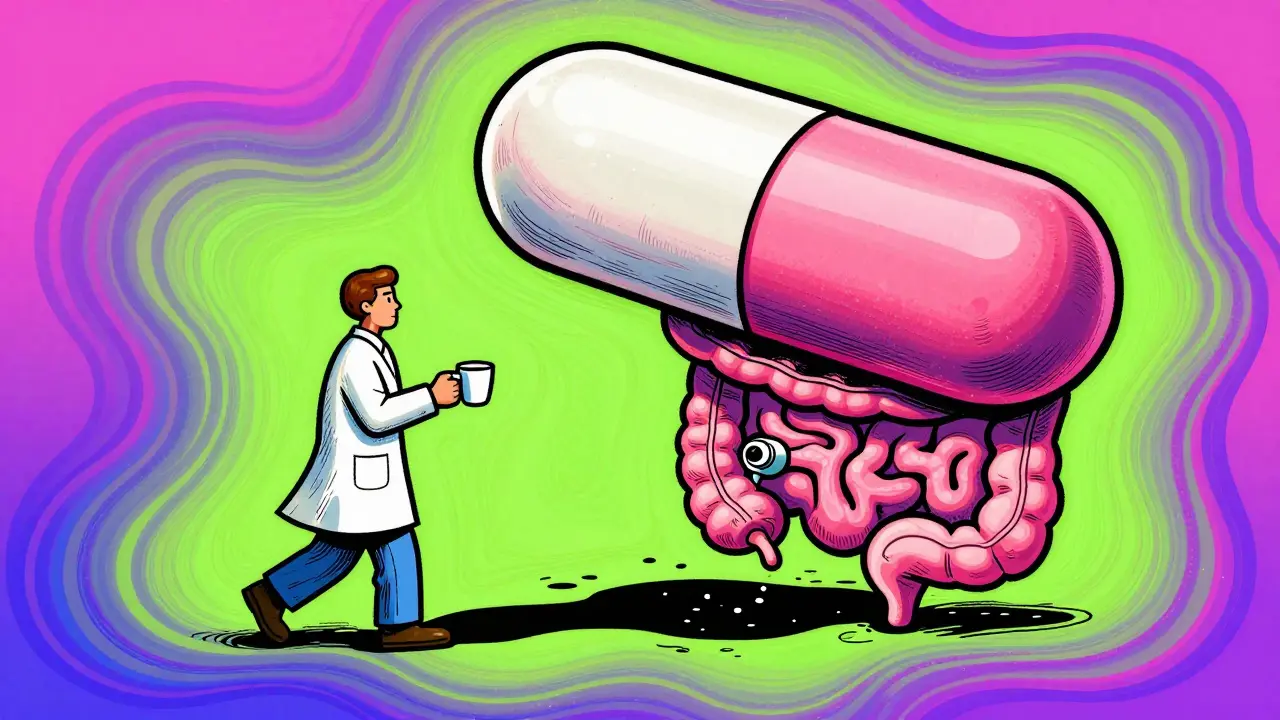
While antibiotics kill the bacteria, acid-reducing drugs give your stomach lining time to heal. The two main types are proton pump inhibitors (PPIs) and H2 blockers.
PPIs - like omeprazole (Prilosec), esomeprazole (Nexium), lansoprazole (Prevacid), and pantoprazole (Protonix) - are the gold standard. They block the final step of acid production in stomach cells. A single dose can suppress acid for 24 to 72 hours. That’s why they’re more effective than H2 blockers like famotidine (Pepcid) or cimetidine (Tagamet), which only last 10 to 12 hours and don’t suppress acid as deeply.
For duodenal ulcers, controlling nighttime acid is critical. That’s why doctors often prescribe PPIs once daily in the morning, right before breakfast. Timing matters: you need to take them 30 to 60 minutes before eating so they’re active when your stomach starts producing acid.
But PPIs aren’t perfect. Long-term use - especially at high doses - has been linked to risks. The FDA has issued warnings about possible increases in bone fractures, low magnesium levels, and a higher chance of Clostridium difficile infection. Some people also experience rebound acid hypersecretion when they stop taking them suddenly. That means their stomach overproduces acid for weeks, making heartburn worse than before. That’s why doctors now aim to taper off PPIs once healing is confirmed, not keep patients on them indefinitely.
NSAID-Induced Ulcers: A Growing Problem
While H. pylori cases are dropping in the U.S. - down from 60% in the 1980s to about 25% today - NSAID-related ulcers are climbing. Why? Because more people over 60 are taking daily painkillers for arthritis, back pain, or other chronic conditions. Even low-dose aspirin, often used for heart protection, can damage the stomach lining.
If you’re on NSAIDs and develop an ulcer, your doctor’s first move is to stop or switch them. If you can’t stop - say, because you have severe osteoarthritis - they may prescribe a COX-2 inhibitor like celecoxib, which is gentler on the gut. Or they’ll add a long-term PPI or misoprostol, a synthetic prostaglandin that helps rebuild the stomach’s protective barrier.
Here’s a hard truth: many people don’t realize their daily ibuprofen is harming them until it’s too late. If you’ve been taking NSAIDs for more than a few weeks and have stomach discomfort, talk to your doctor. Don’t wait for bleeding or black stools.
Lifestyle Changes That Actually Help
Medication alone isn’t enough. Healing requires support from your daily habits.
Smoking cuts healing time in half and doubles your risk of developing an ulcer. Quitting isn’t just good advice - it’s medical necessity. Alcohol is another trigger. Drinking more than three drinks a day increases ulcer risk by 300%. Cutting back or stopping helps your stomach recover faster.
Switching from NSAIDs to acetaminophen (Tylenol) for pain relief can make a huge difference. It doesn’t harm the stomach lining like ibuprofen or naproxen. And while spicy food doesn’t cause ulcers, it can make symptoms worse. Listen to your body. If certain foods bother you, avoid them.
Stress doesn’t cause ulcers, but it can make symptoms feel worse. Getting enough sleep, moving your body, and managing anxiety can help you feel better while your stomach heals.
What’s Next for Ulcer Treatment?
The field is evolving fast. In January 2023, the FDA approved a new drug called vonoprazan - a potassium-competitive acid blocker - originally developed in Japan. Early studies show it clears H. pylori in 90% of cases, compared to 75-85% with traditional PPIs. It works faster, stronger, and might reduce the need for multiple antibiotics.
By 2025, doctors expect to use antibiotic resistance testing before prescribing treatment. Right now, most patients get a standard combo without knowing if their H. pylori strain is resistant. In the future, a simple stool test could tell your doctor which antibiotics will actually work for you. That’s personalized medicine in action.
As the population ages and chronic pain becomes more common, NSAID-induced ulcers will stay a major issue. But with better drugs, smarter testing, and clearer guidelines, peptic ulcer disease is no longer a life sentence. It’s a solvable problem - if you catch it early and follow through.
When to Call Your Doctor
Don’t ignore these signs:
- Severe, persistent stomach pain
- Vomiting blood or material that looks like coffee grounds
- Black, sticky, or bloody stools
- Unexplained weight loss
- Feeling dizzy, faint, or short of breath (signs of internal bleeding)
If you’ve been diagnosed and your symptoms return after treatment, don’t assume it’s just a flare-up. It could mean the bacteria came back, or you’re still taking NSAIDs. Get retested.
pradnya paramita
February 3, 2026 AT 13:00Helicobacter pylori eradication protocols have evolved significantly since the 2017 Maastricht VI guidelines. Triple therapy with clarithromycin is now considered suboptimal in regions with >15% resistance, which includes most of the U.S. Quadruple bismuth-based regimens (PPI + bismuth + metronidazole + tetracycline) demonstrate >90% efficacy in high-resistance zones. Vonoprazan, a potassium-competitive acid blocker (PCAB), offers superior acid suppression compared to PPIs, with faster H. pylori clearance-critical for reducing reinfection rates. Compliance remains the Achilles’ heel; even a single missed dose can select for resistant strains. Stool antigen testing post-treatment is mandatory to confirm eradication.
Jamillah Rodriguez
February 4, 2026 AT 07:31so like… i took ibuprofen for 3 years for my back and then one day i was puking black stuff?? like??? 😵💫 why didn’t anyone tell me???
Susheel Sharma
February 5, 2026 AT 10:27Let’s be candid: the medical establishment’s reliance on PPIs has created a pharmacological dependency crisis. The FDA’s warnings regarding hypomagnesemia, C. diff, and fracture risk are not footnotes-they are red flags ignored by prescribers who treat symptoms rather than root causes. The notion that long-term PPI use is ‘safe’ is a myth perpetuated by pharmaceutical marketing. Furthermore, the normalization of NSAID use among the elderly-often without gastroprotection-is a public health failure. We are medicating symptoms into chronicity while ignoring lifestyle determinants. The data is clear. The inertia is criminal.
Janice Williams
February 6, 2026 AT 08:30It's deeply concerning how casually people treat peptic ulcer disease as if it's a minor inconvenience. This isn't a case of 'eating too much spicy food'-it's a systemic breakdown of mucosal defense mechanisms often exacerbated by poor clinical decision-making. The fact that patients are still being prescribed NSAIDs without adequate risk stratification is unacceptable. And let's not pretend that 'stopping stress' will cure this. The real issue is the lack of mandatory endoscopic screening for patients over 50 on chronic NSAIDs. This isn't just negligence-it's malpractice.
Roshan Gudhe
February 7, 2026 AT 06:50It’s funny how we’ve gone from blaming stress to blaming bacteria to blaming drugs-like we’re chasing the culprit in circles. But maybe the real question isn’t what causes ulcers, but why our bodies are so vulnerable in the first place. We’ve built a world where we eat processed food, sit all day, sleep poorly, and then pop pills to fix the fallout. H. pylori didn’t evolve to hurt us-it evolved to survive us. Maybe healing isn’t just about killing bacteria or blocking acid… maybe it’s about rebuilding the ecosystem inside us. The body doesn’t need more chemicals. It needs rest, real food, and space to breathe.
Rachel Kipps
February 8, 2026 AT 22:30i read this whole thing and i just want to say thank you for explaining the difference between ppi and h2 blockers so clearly. i’ve been on nexium for 5 years and never knew why i had to take it before breakfast. also, the part about vonoprazan sounds amazing. i hope my doctor knows about it. 😊
Prajwal Manjunath Shanthappa
February 9, 2026 AT 13:07It is, quite frankly, an embarrassment of medical epistemology that we are still using regimens developed in the early 2000s, when resistance patterns have demonstrably shifted. The American College of Gastroenterology’s guidelines are outdated, and the reliance on empirical therapy-without resistance profiling-is not only inefficient, it is ethically indefensible. The fact that vonoprazan, which has been used in Japan since 2015, is only now being approved in the U.S. speaks volumes about regulatory capture and pharmaceutical inertia. This is not innovation. This is institutional sloth.
Wendy Lamb
February 10, 2026 AT 01:46Quit smoking. Cut alcohol. Swap ibuprofen for Tylenol. It’s that simple. No magic pills. Just choices.
Antwonette Robinson
February 11, 2026 AT 02:46Oh wow, so NSAIDs cause ulcers? Who would’ve thought? Next you’ll tell me breathing air causes lung cancer. 🙄
Ed Mackey
February 13, 2026 AT 01:18thanks for the info. i’ve been on low-dose aspirin for heart health and didn’t realize it could cause ulcers too. i’ll talk to my doc about switching to a ppi. also, sorry for typos-typing on my phone while my stomach’s acting up 😅