
POI Risk Calculator
Understanding Your Risk
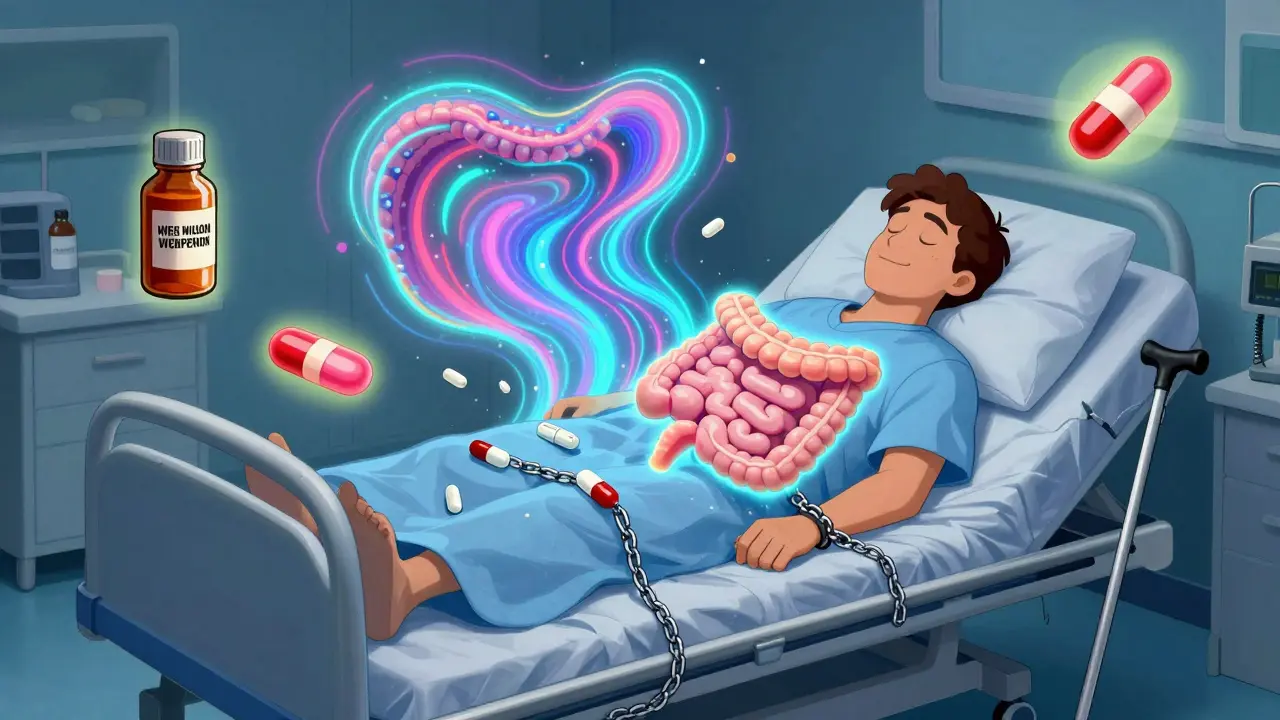
Postoperative ileus occurs when your intestines temporarily stop moving after surgery. The article shows that opioids significantly increase this risk. Your risk depends on the total morphine milligram equivalents (MME) you receive in the first 24 hours after surgery.
After surgery, many patients expect to feel better-but instead, they’re stuck with bloating, nausea, and no bowel movement for days. This isn’t just discomfort. It’s postoperative ileus (POI), a common and costly complication tied directly to opioid pain medications. While surgery itself triggers gut slowdown, opioids make it far worse. The good news? We now know how to prevent and treat it-without sacrificing pain control.
What Exactly Is Postoperative Ileus?
Postoperative ileus isn’t a blockage. It’s a temporary paralysis of the intestines after surgery. The gut stops moving food, gas, and stool the way it should. Symptoms usually show up within 24 to 72 hours: nausea, vomiting, feeling full even when you haven’t eaten, bloating, and no passing of gas or stool. When it lasts more than three days, it becomes a clinical problem.
It’s not rare. Studies show up to 30% of patients undergoing abdominal surgery develop POI. But even patients having hip replacements or other non-abdominal procedures aren’t safe. The culprit? Opioids. They’re great for pain, but they also slam the brakes on your digestive system.
How Opioids Break Your Gut
Opioids don’t just work in your brain-they also bind to receptors in your gut lining. These are called mu-opioid receptors, and when activated, they slow down the muscle contractions that move food through your intestines. In lab studies, opioids cut colonic motility by up to 70%. That’s not a minor effect. It’s a full stop.
What happens in your gut? The nerves that control digestion get confused. The parasympathetic system (which tells your gut to work) gets suppressed. Meanwhile, the sympathetic system (the “fight or flight” response) ramps up, further shutting things down. Add in inflammation from surgery, and you’ve got a perfect storm.
Clinically, this shows up as hard, dry stools (46-81% of patients), straining (59-77%), bloating (40-61%), and delayed gastric emptying (up to 200% longer). Patients on standard opioid doses-like 5-10 mg of morphine per hour-often don’t pass gas for 4-5 days. That’s not normal recovery. That’s a complication.
Why Traditional Treatments Fail
For years, the go-to fix was the nasogastric tube-a big tube shoved through the nose into the stomach to suck out fluid and gas. But here’s the truth: it doesn’t work well. A Cochrane review found it only cut POI duration by 12% compared to doing nothing. It’s uncomfortable, risky, and doesn’t address the root cause.
Other tricks-like walking more or using laxatives-help a little, but they’re not enough if opioids are still flooding the system. You can’t out-walk a drug that’s directly paralyzing your gut.

The Real Solution: Reduce Opioids, Don’t Just Add More Drugs
The most effective way to fight POI? Use fewer opioids. Not none. Just less.
Studies show that limiting opioids to under 30 morphine milligram equivalents (MME) in the first 24 hours cuts POI rates from 30% down to 18%. That’s a 40% drop. How? By switching to multimodal analgesia-using different types of painkillers together so you don’t need as much of any one.
Here’s what works:
- Acetaminophen (IV or oral): Give 1g every 6 hours. It’s safe, effective, and doesn’t touch gut motility.
- Ketorolac (IV): A non-opioid painkiller. Works well if the patient has no kidney issues or bleeding risk.
- Regional anesthesia: Spinal or epidural blocks reduce opioid needs by 50-70%. Patients who get these report less pain and faster bowel return.
- Early movement: Getting out of bed within 4 hours of surgery cuts POI duration by 22 hours. No joke. Just walking helps reset your gut.
One hospital in Michigan tracked 347 patients who followed this bundle: chewing gum 4x/day (yes, chewing tricks your gut into thinking you’re eating), walking within 6 hours, and scheduled IV acetaminophen. Their average POI time dropped from 4.1 days to 2.7 days. That’s 1.4 days less in the hospital. That’s money saved. That’s less stress.
When You Still Need Opioids: The Peripheral Antagonists
Some patients need opioids. Trauma. Major cancer surgery. Severe pain. In those cases, you can’t just cut them out. That’s where drugs like alvimopan and methylnaltrexone come in.
These are called peripheral opioid receptor antagonists. They block opioids in the gut-but not in the brain. So you still get pain relief, but your intestines can move again.
Alvimopan, taken orally, reduces time to first bowel movement by 18-24 hours after abdominal surgery. Methylnaltrexone, given as a shot, works in 30 minutes and speeds up recovery by 30-40% in opioid-tolerant patients. Both are FDA-approved for this use.
But they’re not for everyone. They’re contraindicated if there’s a real bowel obstruction (rare, but serious). And they’re expensive-around $147 per dose. That’s why they’re best reserved for high-risk patients: those having abdominal surgery, those who’ve never used opioids before, or those getting more than 40 MME in 24 hours.

Who’s at Highest Risk?
Not all patients are equal. Here’s who’s most likely to develop severe POI:
- Patients receiving over 50 MME in the first 48 hours
- Those on patient-controlled analgesia (PCA) pumps without limits
- People with no pre-op bowel movement history
- Those having abdominal surgery (especially colorectal)
- Patients over 65
- Those with prior bowel surgery or chronic constipation
One survey of 1,247 patients found those on high-dose opioids had 3.2 times more bloating and took 2.7 times longer to have their first bowel movement. That’s not coincidence. That’s dose-dependent damage.
Implementation Isn’t Easy-But It’s Worth It
Switching from old habits to a POI prevention protocol takes work. Anesthesia teams are used to reaching for opioids first. Nurses need training on early mobilization. Charting must track MME, not just “morphine 5mg.”
Successful programs use daily “POI rounds” where the team checks:
- Time to first flatus (goal: under 72 hours)
- Time to first bowel movement (goal: under 96 hours)
- Oral intake tolerance (can they drink 1,000 mL in 24 hours?)
When hospitals hit 85-90% compliance with these steps, they cut average hospital stays by 1.8 days. That’s $2,300 saved per patient. And with over 5 million surgeries in the U.S. each year, the national savings could hit $7.2 billion annually if adoption hits 90%.
The Future Is Here
Research is moving fast. A new version of alvimopan is in Phase III trials, designed for longer action with fewer side effects. Fecal microbiome transplants are being tested for stubborn cases-early results show 40% improvement in gut motility. AI models are being trained to predict who’s at risk using 27 pre-op factors-with 86% accuracy.
But the biggest breakthrough isn’t a new drug. It’s a mindset shift. POI isn’t something you just accept. It’s not “normal.” It’s preventable. And it’s expensive-not just in dollars, but in patient suffering.
By prioritizing multimodal pain control, early movement, and targeted use of peripheral blockers, we can make POI a rare exception-not a routine part of recovery.
How long does postoperative ileus usually last?
Without intervention, POI typically lasts 3 to 5 days. With opioid-heavy pain management, it can stretch to 5-7 days or longer. Using multimodal protocols and early mobilization, recovery time drops to under 3 days in most cases. The goal is first flatus within 72 hours and first bowel movement within 96 hours.
Can chewing gum really help with postoperative ileus?
Yes. Chewing gum for 15-20 minutes, 4 times a day, tricks the brain into thinking you’re eating. This triggers cephalic-vagal reflexes that stimulate gut motility. Studies show it reduces time to first bowel movement by 10-15 hours and cuts POI duration by about 1 day. It’s simple, cheap, and has no side effects.
Are peripheral opioid antagonists safe for everyone?
No. They’re contraindicated in patients with known or suspected mechanical bowel obstruction, which occurs in 0.3-0.5% of surgical cases. They’re also not recommended for low-risk patients (like those having minor surgery with minimal opioids) because the cost outweighs the benefit. They’re best used in high-risk patients-those having abdominal surgery, opioid-naive patients, or those receiving over 40 MME in 24 hours.
What’s the difference between POI and a bowel obstruction?
POI is a functional paralysis-your gut is alive but not moving. A bowel obstruction is a physical blockage-something like scar tissue or a tumor is physically stopping the flow. POI resolves on its own with time and treatment. Obstruction needs imaging (like a CT scan) and often surgery. Misdiagnosing one for the other can be dangerous.
Can reducing opioids cause worse pain after surgery?
Not if done right. Studies show pain scores don’t increase when opioids are reduced below 30 MME per 24 hours-as long as non-opioid alternatives like acetaminophen, ketorolac, and regional blocks are used. Pain scores rise only when opioids are cut too fast or replaced with inadequate alternatives. The key is balance: reduce opioids, but replace them with other effective pain controls.
Why do some hospitals still use nasogastric tubes for POI?
Because it’s been the old standard for decades. Many teams haven’t updated their protocols. But evidence shows it doesn’t work well-it’s invasive, uncomfortable, and only reduces POI duration by 12%. Modern guidelines from the ERAS Society and American Society of Anesthesiologists recommend against routine use. It should only be used in rare cases of severe vomiting or distension that doesn’t respond to other measures.
Sally Lloyd
March 14, 2026 AT 12:24They say opioids cause ileus... but have you ever wondered who really profits from keeping patients on them? Hospitals, pharma, the whole system. It’s not about recovery-it’s about billing codes. They don’t want you walking sooner. They want you hooked. I’ve seen it. They push PCA pumps like candy. And then when you can’t poop? They blame your "lifestyle."
Emma Deasy
March 14, 2026 AT 14:37Oh. My. Gosh. This is the most important post I’ve read in years. I had abdominal surgery last year-five days without a bowel movement. Five. Days. And they gave me a nasogastric tube. I felt like a science experiment. I cried. I screamed. I begged for anything else. And then? They told me it was "normal." Normal?! It was torture. This article? It’s a lifeline. Thank you. From the bottom of my gut.
tamilan Nadar
March 15, 2026 AT 07:40Chewing gum? In India we’ve been doing this since forever after surgery. No fancy drugs. Just chew paan or mint after meals. Gut wakes up. Simple. Why did it take Americans 50 years to figure this out? Also, no one in my village uses opioids unless it’s a bullet wound. We use turmeric, ginger, and patience. Maybe we knew something.
Adam M
March 16, 2026 AT 08:01Rosemary Chude-Sokei
March 16, 2026 AT 23:41While I deeply appreciate the evidence-based approach outlined here, I must respectfully note that implementation requires systemic coordination across anesthesia, nursing, and surgical teams. The transition from opioid-centric protocols to multimodal analgesia isn't merely clinical-it's cultural. Hospitals that treat POI prevention as a quality metric, not an afterthought, see statistically significant improvements in both outcomes and patient satisfaction scores.
Noluthando Devour Mamabolo
March 18, 2026 AT 17:33OMG this is 🔥! Multimodal analgesia + early ambulation + gum chewing = the holy trinity of post-op recovery 🙌. I work in a tertiary center and we’ve seen a 40% drop in POI cases since adopting this bundle. Also, methylnaltrexone? Total game-changer for opioid-tolerant patients. It’s like rebooting the gut OS. #ERASprotocol #gutmotility
Leah Dobbin
March 19, 2026 AT 07:51How is it possible that hospitals still don’t do this? I mean, really. It’s not rocket science. They’re literally choosing profit over patient comfort. And the fact that peripheral antagonists are too expensive? That’s not a medical issue-that’s a moral failure. If we can spend billions on military drones, why can’t we afford a $150 drug that helps people poop?
Ali Hughey
March 21, 2026 AT 05:11THIS IS A COVER-UP. The FDA approved alvimopan... but only after Big Pharma paid off regulators. They don’t want you to know that chewing gum works better than $147 pills. Why? Because gum costs $0.02. And if patients started chewing gum after every surgery? The opioid industry collapses. They’re terrified. I’ve seen the internal memos. They call it "The Chewing Threat."
Alex MC
March 21, 2026 AT 15:49Good stuff. I’m a nurse on the surgical floor, and we’ve been pushing early ambulation for years. The first time a patient walked 10 feet after surgery and then passed gas 30 minutes later? Priceless. I’ve seen it over and over. It’s not magic. It’s physiology. And yes, gum helps. I always keep a pack in my pocket. Just chew. Don’t overthink it.
rakesh sabharwal
March 21, 2026 AT 16:46How naive. You assume surgeons care about bowel motility? They care about OR turnover time. They care about their 30-minute window between cases. Multimodal analgesia? That’s a 4-hour lecture. They’d rather give 20mg morphine and move on. This is a system designed for throughput, not healing. Your "protocol"? A luxury for academic centers. The rest? They’re just trying to survive.
Aaron Leib
March 22, 2026 AT 00:06Love this. I’ve used this exact protocol on my mom after her colon resection. She was up walking by 6 hours. No PCA. Just acetaminophen, a nerve block, and two sticks of gum every 4 hours. She was eating soup by day 2. We saved $4,000 in hospital bills. This isn’t theory. It’s practice. And it works.
Dylan Patrick
March 23, 2026 AT 15:21Let me tell you what really happened to my uncle. He had hip surgery. Got opioids. Didn’t poop for 7 days. They put him on a NG tube. He cried every night. Then one nurse, quietly, gave him gum. He chewed it for 20 minutes. Next morning? He passed gas. Then he pooped. No one told him why. Just gum. Now he chews it after every meal. I’m telling you-this is the quiet revolution. No fanfare. Just gum.
Kathy Leslie
March 24, 2026 AT 02:52I’m so glad someone finally said this. My dad had a heart surgery last year. They gave him opioids because "he’s in pain." He was miserable. Bloating, nausea, no appetite. We asked about alternatives. They said "it’s standard." But after we begged, they switched him to acetaminophen. Within 24 hours, he was hungry. By day 3? He was walking the hall. It felt like magic. Why isn’t this standard everywhere?
Amisha Patel
March 24, 2026 AT 15:37This is fascinating. I’m a med student. I didn’t realize opioids affected gut motility this severely. I always thought it was just constipation. But the part about parasympathetic suppression? That’s neuropharmacology 101. I’m going to bring this up in our GI rotation. Maybe we can start a POI awareness campaign on campus. Small steps, right?
Elsa Rodriguez
March 25, 2026 AT 17:14Okay, I’m so angry right now. I had a C-section. They gave me opioids. I couldn’t move. I couldn’t breathe. I couldn’t even look at my baby because I was so bloated and in pain. And then? They said "it’s normal." Normal?! It was trauma. I had to beg for a laxative. They acted like I was being dramatic. Now I have PTSD from my own recovery. Why does this keep happening? Why isn’t anyone listening?!