
What Is MRSA, Really?
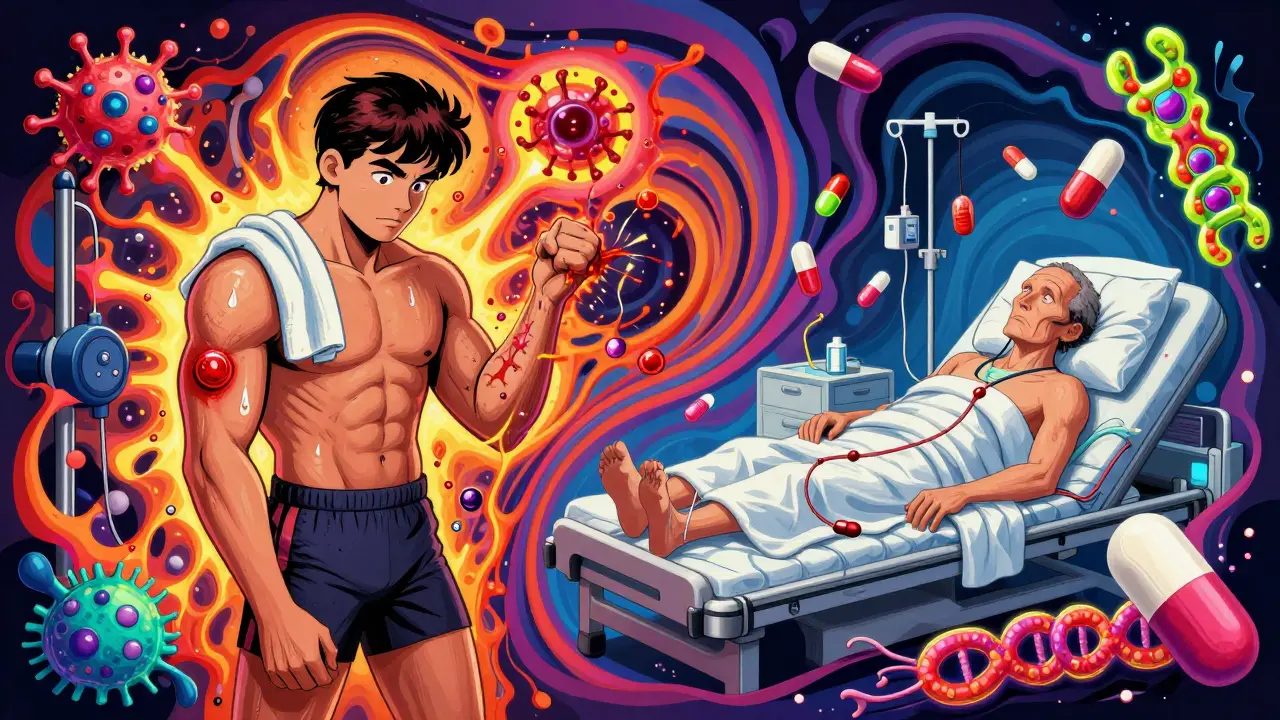
MRSA is a type of Staphylococcus aureus bacteria that won’t die when you give it common antibiotics like penicillin, amoxicillin, or methicillin. It’s not a new bug - it showed up right after methicillin was introduced in 1959. But what changed in the late 1990s was that people who had never been in a hospital started getting it. That’s when we began seeing two very different versions of MRSA: one that spreads in hospitals, and one that spreads in the community.
Community MRSA vs. Hospital MRSA: The Genetic Divide
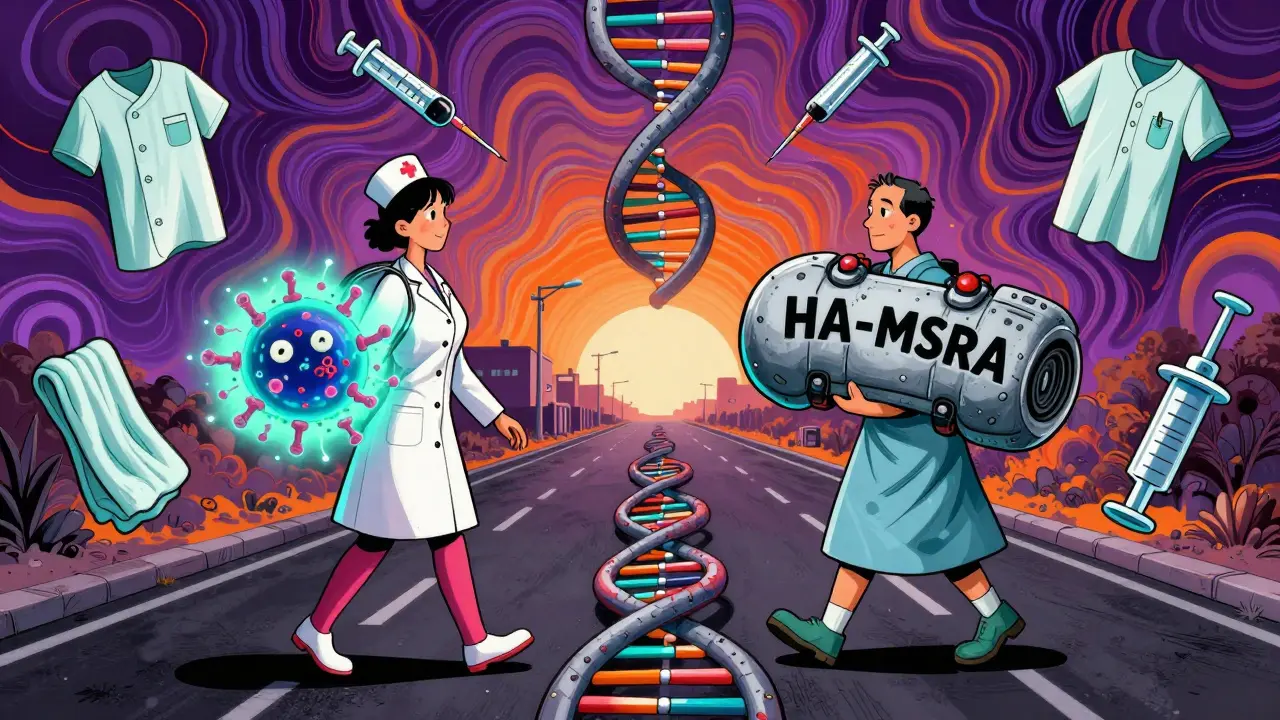
The difference between these two types isn’t just where they’re found - it’s written in their DNA. CA-MRSA (community-associated) usually carries a small piece of genetic material called SCCmec type IV or V. This tiny package doesn’t carry many resistance genes, which means it’s not resistant to dozens of drugs. But here’s the catch: it’s packed with toxins. One of them, called Panton-Valentine leukocidin (PVL), tears through white blood cells and causes nasty skin abscesses or even deadly lung infections.
HA-MRSA (hospital-associated), on the other hand, carries larger SCCmec types - I, II, or III. These are like genetic toolkits full of resistance genes. These strains can survive almost every antibiotic you throw at them: erythromycin, clindamycin, fluoroquinolones - you name it. That’s why hospital patients often need powerful drugs like vancomycin or linezolid just to survive.
USA300 is the most common CA-MRSA strain in the U.S. It’s responsible for about 70% of community cases. In hospitals, you’re more likely to see strains like ST239 or ST59, especially in places like China where these have taken over from older types.
Where Do You Catch Each Type?
CA-MRSA doesn’t care if you’re old or sick. It hits healthy people - athletes, kids in daycare, military recruits, people in prisons. The transmission is simple: skin-to-skin contact, shared towels, dirty gym equipment, or even just touching a surface someone with an open wound recently touched. Crowded places are breeding grounds. In prisons, the risk is nearly 15 times higher than in the general population. In homeless shelters, it’s almost 9 times higher.
Injecting drug users are a major hidden source. Needle sharing, dirty skin before injection, and poor wound care make this group a key reservoir for USA300. The bacteria gets in through tiny punctures, multiplies fast, and spreads easily.
HA-MRSA, by contrast, loves hospitals. It spreads via unclean hands, contaminated IV lines, catheters, or surgical wounds. People with weakened immune systems, those on dialysis, or patients who’ve had recent surgery are most at risk. The longer you stay in the hospital, the higher your chance of picking it up - but here’s the twist: you don’t need a long stay anymore.
The Blurred Lines: When Community Strains Hit Hospitals
For years, doctors thought they could tell CA-MRSA from HA-MRSA by asking: "Have you been in a hospital in the last year?" That rule is broken now.
Studies from Canada show that nearly 28% of MRSA infections picked up in hospitals are actually caused by community strains. And 27.5% of community infections? They’re caused by hospital strains. That’s not a mistake - it’s a two-way street. A nurse who carries CA-MRSA on their skin goes home, then comes back to work and spreads it to a patient. A hospital patient gets discharged with HA-MRSA on their skin and infects their family. The bacteria is moving freely.
Even more worrying: hybrid strains are starting to appear. Some CA-MRSA strains are picking up HA-MRSA’s resistance genes. Some HA-MRSA strains are gaining the PVL toxin. These hybrids are harder to treat and harder to track. They’re the next wave.
How Do the Infections Look Different?
Both types often start as a red, swollen, painful bump on the skin - like a spider bite or a boil. But CA-MRSA tends to be more aggressive. It can turn into a large abscess fast, sometimes needing surgery to drain it. In rare cases, it causes necrotizing pneumonia - a lung infection that destroys tissue and kills quickly.
HA-MRSA infections are more likely to be deeper: bloodstream infections, pneumonia from ventilators, infected surgical sites, or bone infections. These are life-threatening. Patients with HA-MRSA stay in the hospital an average of 21 days. CA-MRSA patients? About 3 days.
That difference isn’t just about severity - it’s about how the body reacts. CA-MRSA’s toxin makes it explode through skin and soft tissue. HA-MRSA’s resistance makes it cling to medical devices and internal organs.
Treatment: What Works for Which Strain?
If you’ve got a small skin abscess from CA-MRSA, the first treatment isn’t even an antibiotic. It’s drainage. A doctor cuts it open, lets the pus out, and you’re often done. No pills needed.
If you do need antibiotics, clindamycin works in 96% of CA-MRSA cases. Trimethoprim-sulfamethoxazole (Bactrim) works in 92%. Tetracyclines like doxycycline are also effective. These are older, cheap drugs - and they still work because CA-MRSA hasn’t built resistance to them yet.
For HA-MRSA, you’re looking at stronger drugs. Vancomycin is the classic go-to. Linezolid, daptomycin, or telavancin may be used if vancomycin fails or the infection is severe. These drugs are expensive, require IV drips, and can damage kidneys or nerves. They’re not something you take at home.
The problem? You can’t always tell which strain you have right away. A patient walks in with a boil - is it CA-MRSA or a hospital strain that jumped into the community? Doctors now have to assume both are possible. That’s why some hospitals now test for MRSA on admission - not just for isolation, but to guide early treatment.
Why Control Is Getting Harder
Traditional hospital infection control - handwashing, isolation gowns, disinfecting surfaces - works great against HA-MRSA. But it’s useless if the bacteria is already living in the community. You can’t quarantine a whole city.
And here’s the real kicker: the longer people carry MRSA on their skin - even without symptoms - the more they spread it. Studies show MRSA can live on skin for months, sometimes years. A person might be colonized after a hospital stay, then pass it to their kids, their partner, their gym buddy. The reservoir is growing.
Health officials now say the old definitions of CA-MRSA and HA-MRSA are outdated. The CDC’s rule - "if you haven’t been in a hospital in a year, it’s community" - doesn’t hold up. A person might never have been hospitalized, but their cousin just got out of the hospital and visited them. The bacteria traveled. The lines are gone.
What’s Next? The Fight Is Changing
Experts are calling for a new approach: treat MRSA as one big problem, not two. Surveillance needs to track strains across hospitals, prisons, schools, and neighborhoods. Labs need to do faster genetic testing to spot emerging hybrids. Antibiotic use in hospitals and even in the community needs tighter control.
For the public, the message is simple: keep wounds covered. Wash hands. Don’t share towels, razors, or sports gear. If you’re a healthcare worker, scrub up before and after every patient - even if you think they’re "just a community case."
And if you’ve had a skin infection that didn’t get better with regular antibiotics? Get it tested. That bump might be more than a pimple - it might be MRSA. And if you’ve been in a hospital recently and now have a fever or a red patch on your skin? Don’t wait. Get checked.
The era of neatly separating hospital and community MRSA is over. The bug doesn’t care about our labels. We need to stop treating them as separate enemies and start fighting them as one.
Frequently Asked Questions
Can you get MRSA from a hug or handshake?
Yes, if the person has an active skin infection or is colonized with MRSA and you have a cut or scrape on your skin. MRSA spreads through direct skin-to-skin contact, especially when one person has open wounds. Casual contact like a quick hug without broken skin is low risk, but sharing towels, razors, or gym equipment is a much bigger threat.
Is MRSA always deadly?
No. Most MRSA infections are skin and soft tissue infections - boils, abscesses, cellulitis - and they’re treatable. Only a small percentage become life-threatening, usually when the infection spreads to the blood, lungs, or heart. CA-MRSA can cause deadly pneumonia, but this is rare. HA-MRSA is more likely to cause severe illness in people who are already sick or hospitalized.
Can you be a carrier of MRSA without knowing it?
Absolutely. Many people carry MRSA on their skin or in their nose without any symptoms. This is called colonization. About 1.3% of the general population carries MRSA without being sick. Carriers can spread it to others, even if they never get sick themselves. That’s why infection control in hospitals focuses on screening and decolonization.
Are natural remedies like honey or tea tree oil effective against MRSA?
Some studies show medical-grade honey and tea tree oil can inhibit MRSA in lab settings, but they’re not reliable treatments for active infections. If you have a serious skin abscess or fever, don’t rely on home remedies. Drainage and prescribed antibiotics are proven, effective, and necessary. Natural products might help with minor skin irritation, but never replace medical care for suspected MRSA.
Does washing clothes kill MRSA?
Yes, but only if you do it right. Wash clothes, towels, and bedding in hot water (at least 60°C or 140°F) and dry them on high heat. Use detergent - it helps break down the bacteria’s outer layer. If you’re dealing with an active infection, wash infected items separately and don’t shake them before washing, as that can spread bacteria into the air.
Why don’t doctors just test everyone for MRSA?
Testing everyone isn’t practical or cost-effective. Most people don’t carry MRSA, and testing takes time. Hospitals screen high-risk patients - those going into surgery, ICU, or dialysis - because the risk of spread is highest there. In the community, testing is only done if someone has a suspicious infection or is part of an outbreak investigation. Widespread testing would overwhelm labs and lead to unnecessary anxiety and treatment.
Aditya Gupta
February 1, 2026 AT 06:10MRSA in gyms? Bro, I saw a guy wipe sweat off a bench with his shirt and then do push-ups. No wonder we got that boil on my cousin’s thigh.
Donna Macaranas
February 1, 2026 AT 15:09I work in a ER and we see this every week. One day it’s a teen with a pimple that turns into a golf ball. Next day, it’s a 70-year-old with a catheter infection. Same bug, different story.
Lisa Rodriguez
February 3, 2026 AT 06:32My dad got MRSA after knee surgery. They gave him vancomycin for two weeks. He still talks about how his veins felt like they were on fire. I never realized how brutal hospital antibiotics are until then.
Bob Cohen
February 3, 2026 AT 17:56Yeah but let’s be real - if you’re not washing your hands after touching your own butt and then shaking someone’s hand, you’re part of the problem. I’ve seen nurses scrub for 30 seconds and still get MRSA on their scrubs. It’s not rocket science, it’s basic hygiene.
Jamie Allan Brown
February 4, 2026 AT 11:11It’s funny how we treat CA-MRSA like it’s some wild beast from the streets, but HA-MRSA? Oh, that’s just ‘the hospital’s fault.’ The truth? We’re all connected. One person’s ‘community case’ is another’s ‘hospital nightmare.’ We need to stop blaming and start adapting.
Naomi Walsh
February 4, 2026 AT 12:14Let me guess - next they’ll tell us that ‘hybrid strains’ are just a media fabrication. I’ve been saying this since 2018. The CDC is still using 2005 definitions. They’re not just behind - they’re dangerously out of touch.
Angel Fitzpatrick
February 6, 2026 AT 08:59They don’t want you to know this - but MRSA is engineered. The PVL toxin? It’s too precise. The way it jumps from prisons to gyms to hospitals? Coincidence? Nah. Big Pharma wants you dependent on vancomycin. They’ve been suppressing cheaper alternatives since the 90s. The ‘hybrids’? They’re not evolving - they’re being released.
Nidhi Rajpara
February 7, 2026 AT 14:40Actually, the genetic markers for SCCmec types IV and V are well-documented in peer-reviewed literature from the Journal of Clinical Microbiology, 2016, volume 54, issue 7. The PVL gene is encoded on bacteriophage phiPVL, and its presence correlates strongly with necrotizing pneumonia in otherwise healthy individuals.
Ed Di Cristofaro
February 8, 2026 AT 14:29My cousin got MRSA from a tattoo parlor. They didn’t sterilize the needle. The owner said ‘it’s fine, we do this all the time.’ Yeah, and now he’s got a scar bigger than his face. People are stupid.
Jaden Green
February 9, 2026 AT 05:44It’s exhausting how the public health narrative keeps reducing this to a hygiene issue. The real problem is antibiotic overuse in agriculture, the lack of investment in novel antimicrobial development, and the systemic failure of hospital disinfection protocols. We’re patching a levee with duct tape while the floodwaters rise. And yet, we still treat this like a problem of individual responsibility. Pathetic.
Sami Sahil
February 10, 2026 AT 16:19My brother is a firefighter and he told me they have to wash their gear after every call. Even if they don’t see blood. MRSA lives on fabric for months. I started washing my towels in hot water after that. Small change, big difference.
Nicki Aries
February 11, 2026 AT 21:06Wait - so you’re telling me that if I get a boil and it doesn’t go away with Neosporin, I should go to the doctor? Not just pop it with a needle and call it a day? I mean… really? That’s the advice now? I thought we were past this.
Nancy Nino
February 12, 2026 AT 14:54As a nurse who’s seen MRSA kill patients in ICU and then reappear in a high school wrestler’s groin - I can tell you: the labels are dead. The bacteria doesn’t read CDC guidelines. It doesn’t care if you’re ‘community’ or ‘hospital.’ It just wants to survive. And so should we - by treating it as one threat, not two. We’ve been fighting the wrong war.