

Macrolide Arrhythmia Risk Estimator
Select your profile and click calculate to see the estimated relative risk multiplier compared to a healthy baseline.
Have you ever been prescribed an antibiotic for a simple respiratory infection, only to later hear whispers about heart risks? You are not alone in wondering if that course of pills could affect your heartbeat. Macrolide antibiotics are a widely used class of antimicrobial agents including azithromycin, clarithromycin, and erythromycin. While they have saved countless lives since their introduction in the 1950s, these drugs carry a specific cardiac warning: they can disrupt the electrical rhythm of your heart.
This disruption is known as QT prolongation, which refers to a lengthening of the time it takes for your heart’s ventricles to recharge between beats. When this interval stretches too far, it can trigger a dangerous arrhythmia called Torsades de pointes (TdP), a potentially fatal polymorphic ventricular tachycardia. The good news? For most healthy people, the risk is extremely low. But for those with certain underlying conditions or taking other medications, understanding this risk is vital.
How Macrolides Affect Your Heart Rhythm
To understand why macrolides cause heart issues, we need to look at what happens inside your heart cells. Your heart relies on potassium channels to reset its electrical charge after each beat. Specifically, a channel encoded by the hERG gene controls the rapid potassium current (Ikr) during repolarization.
Macrolide antibiotics bind to the intracellular vestibule of these hERG-encoded Ikr channels. Think of it like putting a blockage in a drain. This blockade slows down the flow of potassium, prolonging phase 3 of the cardiac action potential. On an electrocardiogram (ECG), this shows up as a longer QT interval. If the delay is significant, it creates conditions for early afterdepolarizations (EADs)-erratic electrical sparks that can ignite TdP.
Interestingly, this effect isn’t uniform across all heart tissue. Research indicates that the repolarization delay occurs primarily in His-Purkinje tissue and ventricular M cells, but not significantly in the endocardium or epicardium. This unevenness creates transmural dispersion of repolarization, which serves as the arrhythmogenic substrate for TdP. In simpler terms, different parts of your heart muscle recover at different speeds, creating a chaotic environment where abnormal rhythms can take hold.
Risk Profiles: Not All Macrolides Are Equal
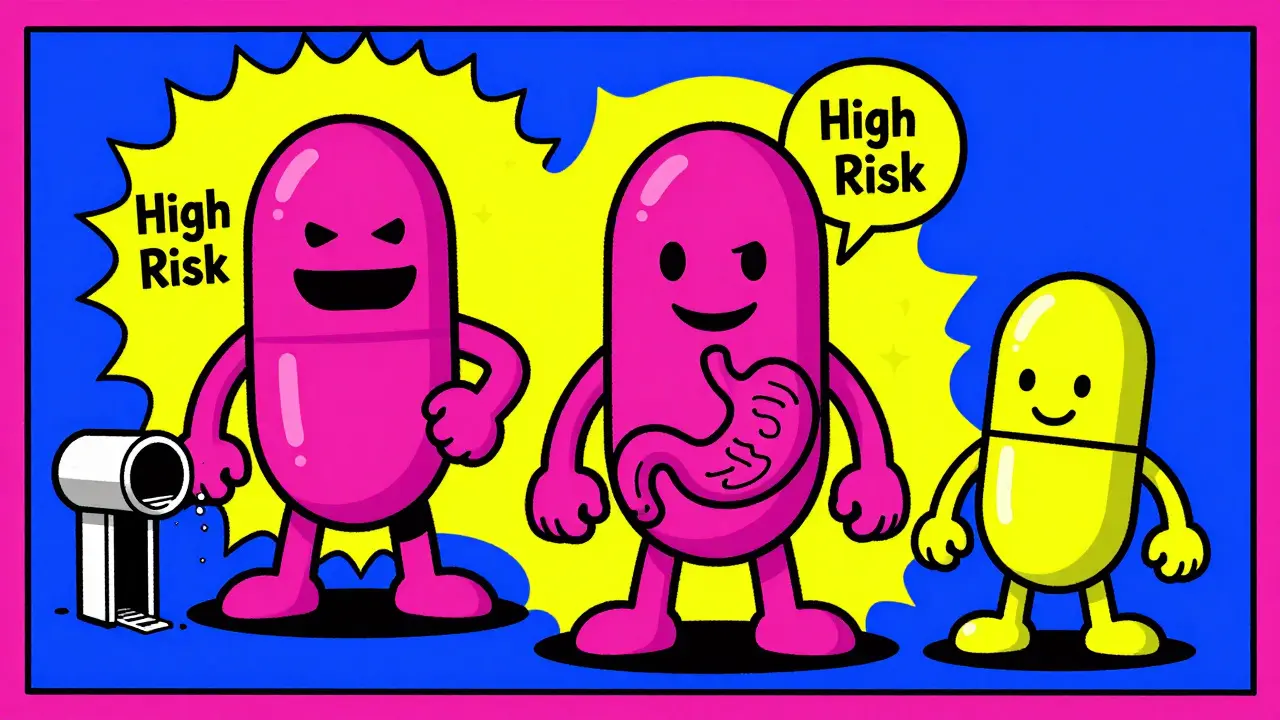
Not every macrolide carries the same weight of risk. The potency of Ikr blockade varies among agents, influencing their safety profiles:
- Clarithromycin: Demonstrates the highest risk due to potent Ikr channel blockade and strong CYP3A4 inhibition (50-70% inhibition at therapeutic doses). It also elevates concentrations of other QT-prolonging drugs.
- Erythromycin: A weaker CYP3A4 inhibitor (20-30% inhibition) but causes significant gastrointestinal side effects that can trigger hypokalemia, further increasing arrhythmia risk.
- Azithromycin: Once considered the safest due to minimal CYP3A4 inhibition (less than 10%) and lower Ikr blockade potency. However, studies show it still carries risk, particularly when combined with other agents.
| Antibiotic | Ikr Blockade Potency | CYP3A4 Inhibition | Regulatory Warning Status |
|---|---|---|---|
| Clarithromycin | High | Strong (50-70%) | Black Box Warning (US) |
| Erythromycin | Moderate | Moderate (20-30%) | Warning Label |
| Azithromycin | Low-Moderate | Minimal (<10%) | Warning Label |
Market data reflects this hierarchy. Azithromycin accounts for 65% of macrolide prescriptions in the US according to IQVIA 2022 data, largely due to its perceived cardiac safety. Meanwhile, clarithromycin prescriptions for respiratory infections dropped by 23.5% in Medicare Part D beneficiaries between 2020-2021 following the American Heart Association’s 2020 classification.
Who Is Most at Risk?
The absolute risk of macrolide-associated TdP remains extremely low-fewer than 1 case per 10,000 prescriptions-outside specific high-risk scenarios. However, certain factors dramatically increase vulnerability. According to the 2025 NIH review, six major risk factors stand out:
- Female Sex: Women account for 68% of TdP cases associated with these drugs.
- Age Over 65: Older adults face a 2.4-fold increased risk.
- Baseline QTc >450 ms: This increases risk by 4.7-fold.
- Concomitant Medications: Each additional QT-prolonging drug adds 1.8x risk.
- Electrolyte Abnormalities: Hypokalemia (low potassium) increases risk 3.1-fold.
- Structural Heart Disease: Heart failure increases risk 5.3-fold.
Crucially, 5-20% of patients who develop TdP after taking QT-prolonging medications have subclinical congenital long QT syndrome. This means some individuals carry hidden genetic vulnerabilities that only manifest when exposed to these specific drugs.

Clinical Monitoring and Safety Guidelines
If you fall into a higher-risk category, proactive monitoring is essential. The American College of Cardiology (2023 update) recommends baseline ECG for patients with two or more risk factors. Repeat ECGs are advised if the corrected QT interval (QTc) exceeds 470 ms in men or 480 ms in women, or if it increases by more than 60 ms from baseline.
The FDA has established clear contraindications: Clarithromycin is contraindicated in patients with known QT prolongation or ventricular arrhythmias. All macrolides should be avoided in patients with hypokalemia or concurrent use of class IA/III antiarrhythmics. Dr. Charles Antzelevitch notes that macrolide-induced TdP typically occurs when the corrected QT interval exceeds 500 ms or increases by more than 60 ms from baseline, providing critical thresholds for clinicians.
Implementation challenges remain. The concept of 'repolarization reserve' suggests that patients with near-normal QT intervals may still have subclinical channelopathies. Therefore, clinicians must consider family history of sudden cardiac death even when baseline QT appears normal.
Emerging Tools and Future Directions
Technology is helping to mitigate these risks. The 2023 FDA approval of the CardioCare QT Monitor provides automated QTc measurement with less than 5 ms error margin, facilitating real-time monitoring during therapy. Additionally, the 2024 launch of the Macrolide Arrhythmia Risk Calculator (MARC) uses 12 clinical variables to predict individualized TdP risk with 89% accuracy.
Research continues into safer alternatives. Solithromycin, a 'cardiosafe' macrolide derivative, demonstrated 78% less Ikr blockade than clarithromycin in Phase II trials, though development was halted in 2022 due to hepatotoxicity concerns. Pharmacogenomic studies aim to identify patients with hERG polymorphisms that increase sensitivity, with preliminary data suggesting 15% of the population carries variants that increase TdP risk 4.2-fold.
Can azithromycin cause heart problems?
Yes, azithromycin can cause QT prolongation and increase the risk of Torsades de pointes, although its risk is generally lower than clarithromycin or erythromycin. Studies show an excess of 2.85 cardiovascular deaths per 1,000 courses during the first 5 days of treatment compared to amoxicillin.
What symptoms should I watch for while taking macrolides?
Watch for palpitations, dizziness, fainting, or unexplained shortness of breath. These can indicate irregular heartbeats. If you experience chest pain or severe lightheadedness, seek immediate medical attention.
Are there safer alternatives to macrolide antibiotics?
For many respiratory infections, penicillins like amoxicillin or doxycycline are safer alternatives regarding cardiac risk. Consult your doctor to choose an antibiotic based on your specific health profile and local resistance patterns.
Does age increase the risk of QT prolongation?
Yes, patients over 65 years old face a 2.4-fold increased risk of macrolide-induced arrhythmias. Age-related changes in drug metabolism and higher prevalence of comorbidities contribute to this elevated risk.
How does electrolyte imbalance affect macrolide safety?
Hypokalemia (low potassium) increases the risk of Torsades de pointes by 3.1-fold. Maintaining normal electrolyte levels through diet or supplementation, as advised by your physician, is crucial before starting macrolide therapy.
Amelia Vaughan
May 9, 2026 AT 23:15People need to stop ignoring basic pharmacology. It is not rocket science. You take the drug you get the side effect. Simple as that.
Kevin S
May 11, 2026 AT 02:51This is such a helpful breakdown! 😊 I always worry about my heart health so this gives me peace of mind knowing what to ask my doctor. Thanks for sharing this info! 🙌
Madison Jones
May 11, 2026 AT 21:03Oh wow, this is incredibly detailed information!! I really appreciate how clearly the risks are explained here. It is so important to know about these interactions before taking any medication. Please keep writing posts like this because they truly save lives!!! 💖
Jake Williams
May 13, 2026 AT 09:07Typical American healthcare negligence wrapped in a pretty bow. You think reading a blog post replaces actual medical oversight? Pathetic. The system is broken and you are all just pawns waiting to drop dead from a $20 pill.
Nilesh Mandani
May 13, 2026 AT 10:34I have been thinking about this balance between treatment and risk. It is interesting how the body reacts differently to each person. We must respect the complexity of biology while trying to stay healthy. Good read overall.
Liz and Nick
May 14, 2026 AT 14:44i took azithromycin last year and felt fine but maybe i was just lucky or maybe the doctors dont care anymore who knows really it is all just luck i guess
Guy Birtwhistle
May 14, 2026 AT 15:20Look, I am not a cardiologist but if you have a history of heart issues you should probably talk to someone qualified instead of relying on internet forums. That is just common sense.
Kenny Pines
May 16, 2026 AT 12:18Yeah right another scare tactic 😂 Like we all have time to check our QT intervals every day. Just take the meds and hope for the best buddy 🤷♂️
Brian Lee
May 18, 2026 AT 04:19thats a lot of info to process but good to know. i had erythromycin once and felt weird so maybe it was that. thanks for the heads up guys. hope everyone stays safe out there.
Sarah Grenberg
May 18, 2026 AT 16:08This is absolutely fascinating research! The way the hERG channels interact with these drugs is so complex yet beautifully explained. I urge everyone to share this with their loved ones because knowledge is power when it comes to our health! Let us all be proactive and informed! ✨