
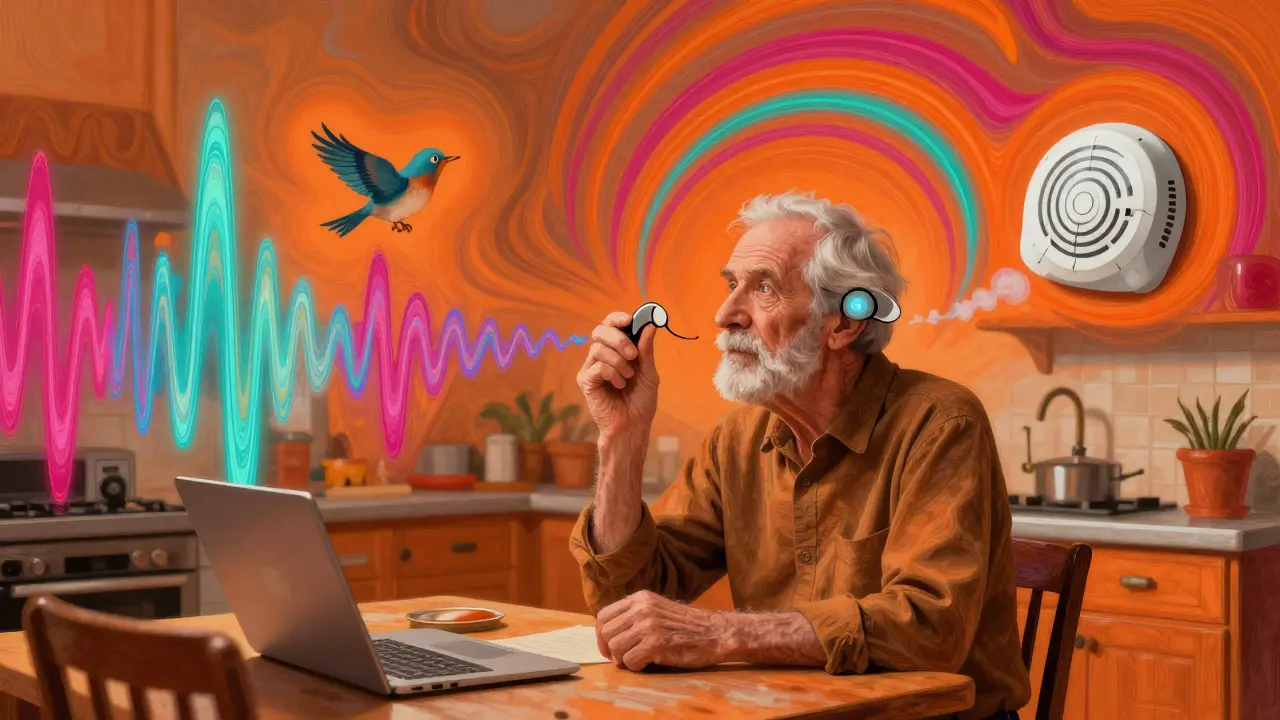
By the time you’re 65, there’s a better than one-in-three chance you’re struggling to hear clearly-not because you’re not paying attention, but because your ears have changed. This isn’t just about turning up the TV. It’s presbycusis, the medical term for age-related hearing loss, and it’s quietly reshaping how millions of people connect with the world. Unlike sudden hearing loss from an injury or infection, presbycusis creeps in slowly. You don’t notice it until you’re asking people to repeat themselves, turning the TV louder than your spouse can stand, or missing the high-pitched chime of your smoke alarm. It’s not normal aging-it’s a measurable, treatable condition that affects over 33% of Americans between 65 and 74, and nearly half of those over 75.
How Presbycusis Actually Works
Your inner ear holds about 16,000 tiny hair cells. These aren’t like the hairs on your head-they’re sensory receptors that turn sound waves into electrical signals your brain understands. You’re born with all of them, and they don’t grow back. Starting around age 30, you lose about 1% per year. By 70, you might have lost 40% or more. These cells are most sensitive to high frequencies, which is why you struggle to hear children’s voices, birdsong, or consonants like ‘s’, ‘th’, and ‘f’. Speech doesn’t just get quieter-it gets fuzzy. A 2023 ColumbiaDoctors study found that people with presbycusis lose 15-30% of their ability to distinguish words, even when the volume is fine. It’s not just wear and tear. Genetics play a role in 35-50% of cases, with genes like GRHL2 and GJB2 linked to faster decline. But environment matters just as much. If you’ve spent decades working near machinery, attending loud concerts, or living in a noisy city, you’ve added years of damage. A 2023 WHO report found that exposure to noise above 85 decibels for more than 8 hours a day increases your risk of presbycusis by 40%. Medical conditions make it worse, too. Diabetes raises the risk by 28%, high blood pressure by 23%, and smoking by over 15%. These don’t just affect your heart-they starve the delicate blood vessels feeding your inner ear.The Hidden Costs of Ignoring It
Most people think hearing loss is just inconvenient. It’s not. Untreated presbycusis is linked to serious health risks. A 2020 Lancet Commission study found that people with unaddressed hearing loss have a 50% higher chance of developing dementia. Why? Because your brain doesn’t just hear-it processes. When sound signals fade, the areas of your brain responsible for speech and memory start to shrink from lack of use. The longer you wait, the harder it is to reverse. Socially, the toll is just as heavy. The NIDCD reports that people with untreated hearing loss are over five times more likely to feel isolated. Forty-one percent of older adults avoid gatherings because they can’t follow conversations. Twenty-nine percent miss important health details during doctor visits. One man in Bristol told his audiologist he didn’t realize his wife had been diagnosed with diabetes until she mentioned it three weeks after the appointment-he’d missed the entire conversation. Financially, a 2021 Better Hearing Institute study found that people with untreated hearing loss earn $30,000 less per year on average than peers with normal hearing, likely due to reduced workplace communication and confidence.
Hearing Aids: Not Just Amplifiers Anymore
The good news? You don’t have to live with it. Hearing aids today aren’t the bulky, whistling devices of the past. Modern devices are digital computers that fit behind your ear-or even inside it. They use 16 to 64 frequency channels to boost only the sounds you’re missing, not everything. Directional microphones focus on the person you’re talking to and reduce background noise by 3-6 decibels. Bluetooth lets you stream calls, music, and TV audio directly from your phone. Some models even track your steps or detect if you’re socially active. There are two main paths: prescription and over-the-counter (OTC). Prescription hearing aids-fitted by an audiologist-cost $1,800 to $3,500 per ear. Brands like Phonak Paradise, Oticon More, and Signia Styletto lead the market. They’re custom-tuned, come with follow-up care, and often include rechargeable batteries that last 16-20 hours. Consumer Reports rates Widex Moment and Oticon More as top performers, with scores of 87 and 85 out of 100. OTC hearing aids, available since the FDA’s 2022 rule, cost $200 to $1,000 for a pair. They’re not custom-fit, but they’re a real option for mild-to-moderate loss. Jabra Enhance Select leads the OTC category with a 78/100 rating. They’re easier to access, but you won’t get professional ear molds or fine-tuning. A 2023 American Academy of Audiology survey found that 20% of people stop using their hearing aids within six months-mostly because they’re uncomfortable, don’t fit right, or don’t help in noisy places like restaurants.What Works? Real User Experiences
On Reddit’s r/HearingAids community, stories pour in. One user, ‘HearingHopeful42’, said after 15 years of pretending to hear, her Phonak Audeo M-312s let her hear her granddaughter’s laughter for the first time. Another said he finally understood his wife’s joke about the cat-after 20 years of silence. But it’s not perfect. Thirty-eight percent of users complain about wind noise. Twenty-seven percent struggle with Bluetooth disconnects. Forty-two percent say restaurants are still a nightmare. One man in Bristol said his hearing aid picked up every clink of cutlery but still couldn’t separate his wife’s voice from the background chatter. That’s why fitting matters. A 2023 Vanderbilt University study found that users need about 12 hours of practice to master smartphone controls and app settings. Most people adapt to basic use in 4-6 weeks, but true comfort takes patience.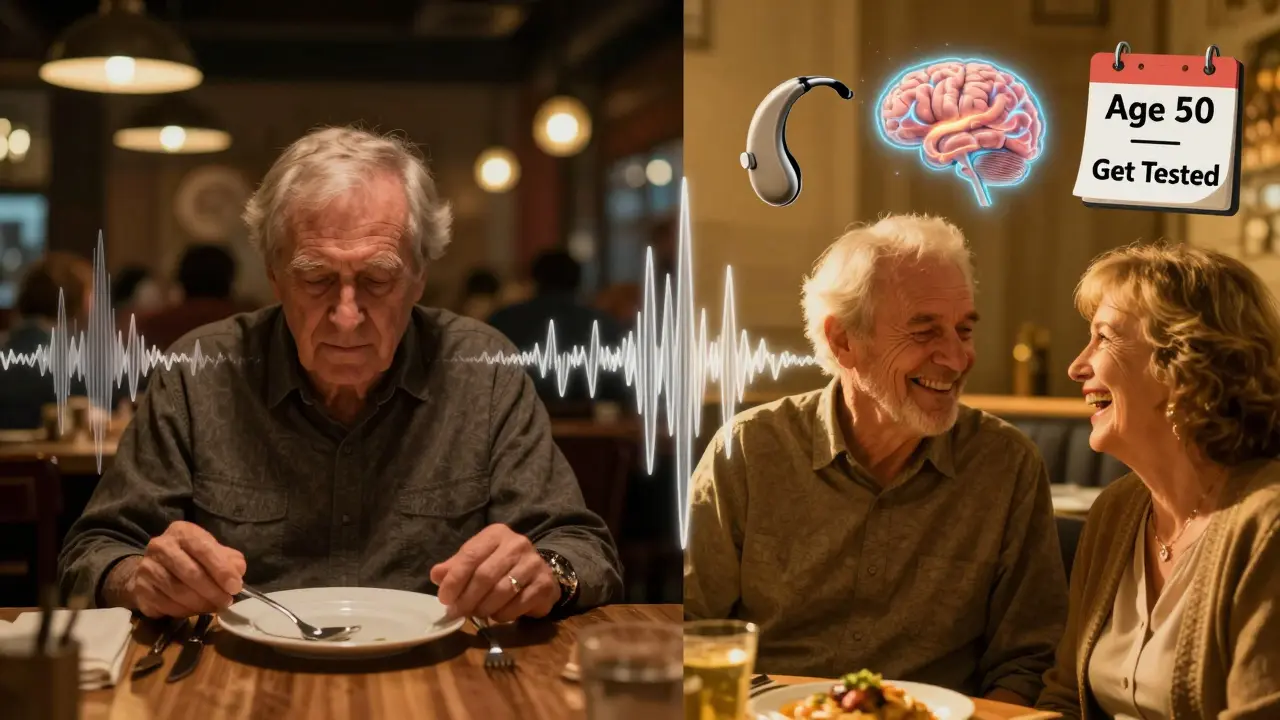
Getting Started: What to Do Next
If you suspect presbycusis, don’t wait. The American Speech-Language-Hearing Association (ASHA) recommends a baseline hearing test at age 50, then every two years. A simple test takes 20 minutes and costs little or nothing at many clinics. Don’t rely on your doctor to bring it up-only 15% of primary care physicians screen for hearing loss, even though it’s recommended. If you’re a candidate for hearing aids, ask for a 30- to 60-day trial. Most clinics offer this. Don’t settle for the first model you’re shown. Try different brands. Ask about rechargeable options if you hate changing batteries. Ask if they offer remote fine-tuning-62% of audiology practices now do. That means you can adjust settings from home without driving to the clinic. And if cost is a barrier, know this: Medicare Advantage plans now cover hearing aids for 28 million beneficiaries as of 2024. Some private insurers do too. Check your plan. Even if you’re not covered, OTC devices are a viable, affordable first step.The Bigger Picture
The global hearing aid market is growing fast-projected to hit $14.7 billion by 2030. New tech is emerging: AI that reduces listening effort by 20%, apps that test your hearing in minutes, devices that monitor your activity and social engagement. The World Health Organization warns that without action, 1.5 billion people will have hearing loss by 2050. But every person who gets help today reduces the long-term cost-not just in dollars, but in loneliness, cognitive decline, and lost connection. This isn’t about fixing a broken ear. It’s about keeping your mind sharp, your relationships alive, and your safety intact. You don’t need to hear every whisper. You just need to hear the ones that matter-your grandchild’s voice, your doctor’s advice, your spouse’s laughter. That’s not a luxury. It’s your right.Is presbycusis the same as just being hard of hearing?
Yes and no. All presbycusis is age-related hearing loss, but not all hearing loss is presbycusis. Presbycusis specifically refers to the gradual, natural decline in hearing due to aging, primarily affecting high-frequency sounds. Other types of hearing loss can be caused by noise exposure, ear infections, medications, or genetics, and may happen at any age. Presbycusis is the most common form in older adults.
Can hearing aids restore my hearing to normal?
No, hearing aids don’t restore hearing to what it was when you were younger. But they can dramatically improve it. Most users report 40-60% better speech understanding in quiet environments and 25-40% improvement in noisy places. The goal isn’t perfect hearing-it’s clearer communication. Many people say they feel like they’ve regained parts of their life they thought were lost.
Why do some people stop using hearing aids?
The top reasons are poor fit (45%), discomfort (30%), and not hearing well in noisy places (25%). Many people expect hearing aids to work instantly, like glasses. But they need time to adjust, and they need to be properly fitted. A 2023 survey found that 85% of users who got professional follow-up care kept using their devices long-term. If you’re struggling, go back to your audiologist. Don’t give up after the first week.
Are over-the-counter hearing aids any good?
For mild-to-moderate hearing loss, yes. OTC devices like Jabra Enhance Select and Eargo have improved dramatically since 2022. They’re affordable, easy to buy, and often come with smartphone apps for self-tuning. But they’re not custom-fit, and they don’t include professional support. If you have moderate-to-severe loss, or if you’re unsure, see an audiologist. OTC is a great starting point-but not a substitute for proper diagnosis.
Can I prevent presbycusis?
You can’t stop aging, but you can slow it. Protect your ears from loud noise-use earplugs at concerts or when using power tools. Manage conditions like diabetes and high blood pressure. Quit smoking. Get regular hearing checks starting at age 50. Early detection means early help, which preserves your brain’s ability to process sound. The earlier you act, the more you protect your long-term hearing and cognitive health.
Philip Blankenship
February 15, 2026 AT 17:50Man, I never realized how much I was missing until I got my OTC aids. Used to think my wife was mumbling, but turns out she was just saying "I love you" and I was hearing "I luv yu". Now I catch every joke, every sigh, every damn bird outside. Still hate when the dog barks though-sounds like a chainsaw in my ear.
Carrie Schluckbier
February 16, 2026 AT 09:39They’re not helping you-they’re tracking you. Those ‘smart’ hearing aids? They’re listening to your conversations, sending data to Big Pharma and the VA. That ‘step counter’? It’s logging where you go. That ‘Bluetooth stream’? It’s feeding your voice to AI models that decide if you’re ‘cognitively at risk.’ Wake up. This isn’t medicine-it’s social control disguised as a solution.
Adam Short
February 17, 2026 AT 19:20Over here in the UK, we’re told to ‘just live with it’-like it’s some noble rite of passage. Meanwhile, the NHS waits 18 months just to test you. By then, your brain’s already rewired to ignore speech. I got mine from a private clinic-£2,200, worth every penny. They don’t care about your hearing here. They care about your pension.
James Lloyd
February 19, 2026 AT 14:20Just wanted to add something real quick: the 2023 Vanderbilt study isn’t just about adaptation time-it’s about neural plasticity. Your brain doesn’t just ‘get used to’ hearing aids; it literally rebuilds synaptic pathways to process sound again. That’s why consistency matters. Wear them every day, even if it’s just for coffee. Your brain will thank you. And yes, restaurants are still hell. Try the ‘focus mode’ in the app. It’s a game-changer.
John Haberstroh
February 21, 2026 AT 13:46It’s wild how something so biological-tiny hair cells dying off like autumn leaves-gets turned into a $14 billion tech industry. We’re not just treating hearing loss anymore; we’re monetizing loneliness. The fact that you can now track your social engagement via your hearing aid? That’s not innovation. That’s surveillance with a warranty. And yet… I still got mine. Because hearing my kid say ‘Dad’ again? Priceless. Even if the system’s rigged.
Steph Carr
February 22, 2026 AT 05:08So let me get this straight: we’re told to ‘get help early,’ but the system is designed to make you feel broken until you’re desperate enough to spend $3k on a device that still can’t filter out a soup spoon clinking? Classic. I love how the article says ‘it’s your right’ to hear your spouse laugh… but doesn’t mention that your right depends on your insurance plan, your zip code, and whether you’re willing to fight a bureaucracy that thinks aging = irrelevance.
Prateek Nalwaya
February 23, 2026 AT 09:37In India, we don’t have this luxury. My uncle, 78, uses a $50 device bought off Amazon. It whistles, it’s loud, but it lets him hear his grandkids. No audiologist, no trial period, no Bluetooth. Just… hope. Maybe the real innovation isn’t in the tech, but in how people adapt when systems fail. We don’t need fancy apps-we need access.
Jonathan Ruth
February 24, 2026 AT 17:42Presbycusis is just another word for getting old. Stop treating it like a disease. You think your ears are the only thing that wears out? Your knees, your eyes, your memory-none of it’s perfect. Why are we pathologizing aging? The real problem? Society refuses to let seniors be seniors. They want us to be young again, plugged in, always connected. Bullshit. Let us be quiet. Let us be slow. Let us be old.
Liam Earney
February 26, 2026 AT 05:20And yet… I still cry when I hear my daughter’s voice on the phone. I didn’t realize how much I’d lost until I heard it again-clear, bright, unfiltered. I’ve been wearing aids for eight months. Still hate the wind noise. Still hate that my left one disconnects when I’m in the car. But… I hear her. I hear her. And I think… maybe that’s enough.
Sam Pearlman
February 27, 2026 AT 22:47LOL you guys are all so serious. I got my OTCs, turned them on, and immediately heard my cat sneeze. That’s it. That’s the whole story. I didn’t need a PhD to figure this out. Sometimes, the simplest solution is the one you can buy at Walmart. Stop overthinking it. Just try it. Worst case? You’re 500 bucks poorer and still hear better than before.
Tony Shuman
March 1, 2026 AT 11:36They say hearing aids help you ‘reconnect.’ But what if you don’t want to reconnect? What if the world got too loud, too fast, too fake? I stopped going to family dinners because I couldn’t keep up. Now I wear my aids only when I’m alone. I listen to rain. To silence. To the hum of the fridge. Maybe the real cure isn’t amplification… it’s learning to live with the quiet.
guy greenfeld
March 2, 2026 AT 07:24Think about it: if your brain shrinks from lack of sound, then what happens when you force sound back in? Are you restoring your mind… or just flooding it with noise that never belonged there? The hearing aids don’t fix hearing-they fix your guilt. They make you feel like you’re trying. Like you’re not a burden. But what if the burden isn’t your hearing? What if it’s the world that stopped listening to you first?