

Levothyroxine Timing Calculator
How to Use This Tool
This tool calculates the optimal time to take your thyroid medication based on your eating schedule and other medications.
For best absorption, take levothyroxine on an empty stomach with water only, and avoid other substances for at least 30-60 minutes afterward.
Your Schedule
Levothyroxine is the most common medication for hypothyroidism, but how you take it can make or break its effectiveness. Even if you’re taking the right dose, poor absorption due to timing or food interactions can leave you feeling tired, cold, or depressed-despite doing everything else right. This isn’t theoretical. Real people see their TSH levels jump from 1.8 to 4.3 after accidentally taking it with coffee. Others find stability only after switching from morning to bedtime dosing. The science is clear: absorption matters. And if you’re not getting it right, your body isn’t getting the hormone it needs.
Why Timing and Food Matter So Much
Levothyroxine is absorbed in the upper part of your small intestine. But it doesn’t just need to reach that spot-it needs to be absorbed efficiently. That’s where timing and what you eat or drink come in. This isn’t like taking a vitamin you can swallow with your morning oatmeal. Levothyroxine has a narrow therapeutic window. That means even a 10-20% drop in absorption can throw your TSH levels off track. And since TSH is how your doctor checks if your dose is working, small changes add up to big symptoms.
Research shows food can cut absorption by up to 36%. A 2009 study in the Journal of Clinical Endocrinology & Metabolism found that when patients took levothyroxine with breakfast, their TSH levels rose by 176% compared to when they took it on an empty stomach. That’s not a minor fluctuation-it’s enough to push someone from well-controlled to under-treated. The same study showed that even taking it at bedtime, after dinner, still resulted in higher TSH than fasting morning dosing. So yes, timing isn’t just a suggestion. It’s a biological requirement.
What You Must Avoid With Your Dose
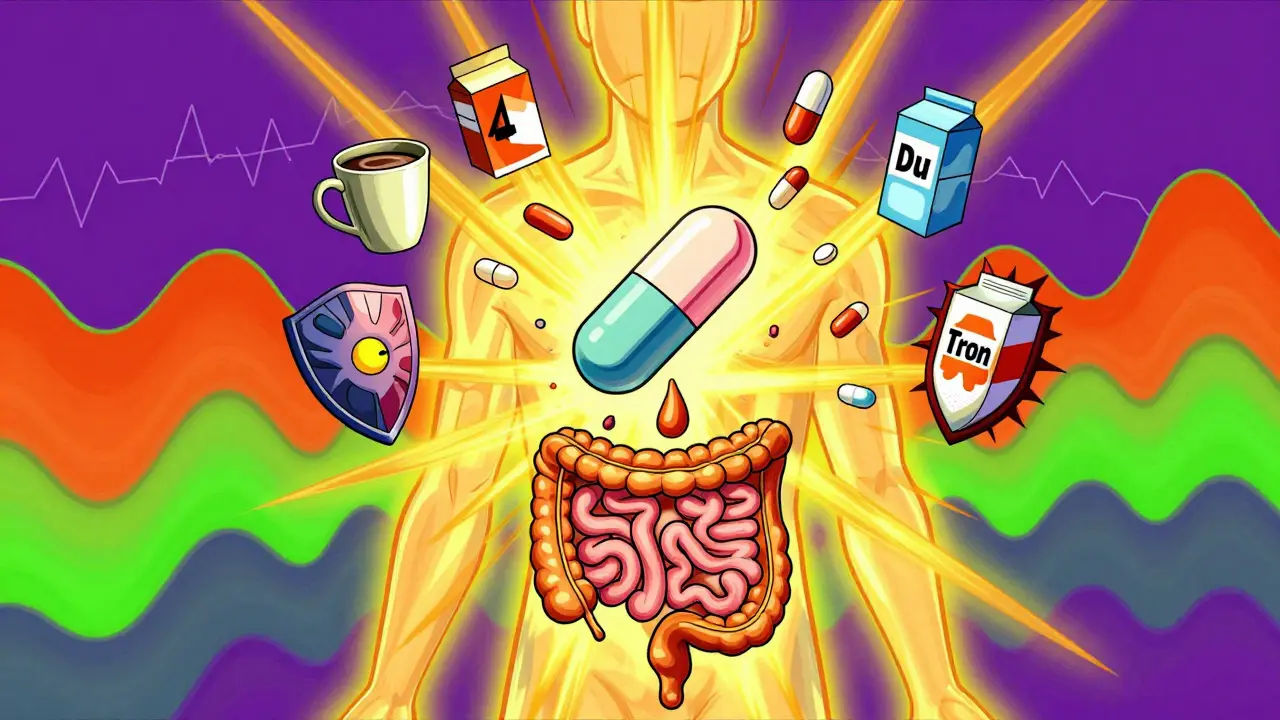
It’s not just food. A lot of common supplements and medications interfere with levothyroxine. Calcium supplements? They reduce absorption by 27-36%. Iron? Up to 39%. Coffee? A 2017 study in Thyroid found a 36% drop in absorption when taken within an hour. Even soy milk, fiber supplements, and proton pump inhibitors like omeprazole can block it.
You don’t need to stop these things entirely. You just need to separate them. The standard advice is to wait 3-4 hours after taking levothyroxine before consuming anything else besides water. That includes:
- Calcium or iron supplements
- Multivitamins with minerals
- Antacids or acid reducers
- Soy products
- Fiber supplements
- Coffee, tea, or milk
Some patients swear by taking their thyroid med with water at 5 a.m., then eating at 7 a.m. Others take it at 10 p.m., after their last meal at 6 p.m. The key isn’t the clock-it’s the gap. No food, no drink (except water), no other pills for at least 30-60 minutes after swallowing the tablet.
Morning vs. Evening: Which Is Better?
For decades, doctors told patients to take levothyroxine first thing in the morning, 30-60 minutes before breakfast. That’s still the official recommendation from the American Thyroid Association and Mayo Clinic. But here’s the twist: newer studies suggest bedtime dosing might work just as well-or even better-for some people.
A 2020 systematic review of 12 studies with over 1,000 patients found that taking levothyroxine at night led to lower TSH and higher free T4 levels compared to morning dosing. Another study followed 86 patients for three months and found no significant difference in TSH between morning and evening groups. One Reddit user wrote: “I switched to bedtime dosing after years of erratic TSH. Now I’m at 1.2 and I haven’t felt this good in a decade.”
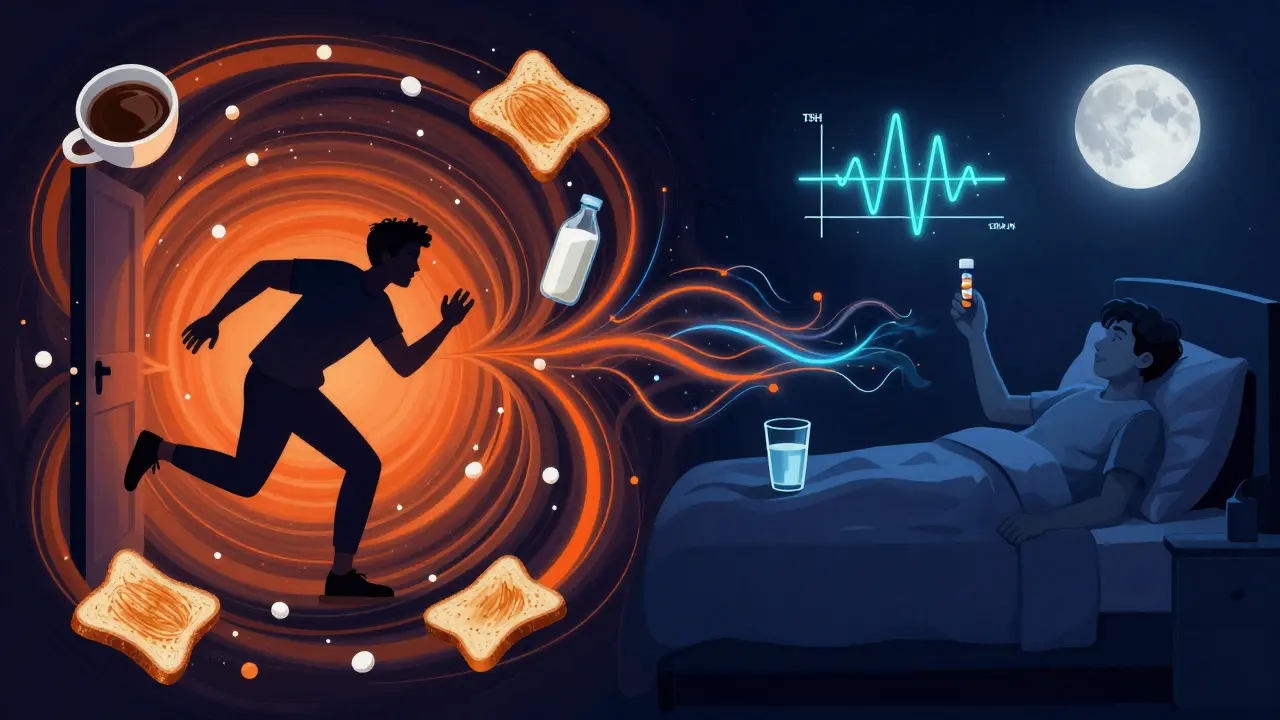
Why the contradiction? It comes down to consistency. If you’re the type who forgets your pill before breakfast because you’re rushing out the door, or if breakfast is delayed by meetings, kids, or coffee, then morning dosing might be setting you up to fail. But if you’re already done eating by 7 p.m. and don’t snack before bed, evening dosing gives you a clean 4-hour window without the morning chaos.
There’s no universal answer. But if you’re struggling with morning adherence, talk to your doctor about switching. Just don’t switch without monitoring. Your TSH should be checked again in 6-8 weeks to make sure it’s stable.
Special Cases: Pregnancy, Cancer, and Aging
Some people can’t afford to be flexible. Pregnant women need tight control because thyroid hormone is critical for fetal brain development. The American Thyroid Association says pregnant women must take levothyroxine on an empty stomach, 30-60 minutes before breakfast. No exceptions. TSH targets are stricter too-under 2.5 mIU/L in the first trimester.
Patients with thyroid cancer on suppressive therapy are even more sensitive. Their TSH targets are often below 0.1 mIU/L. Any drop in absorption could mean the difference between cancer control and recurrence. For them, consistency isn’t just helpful-it’s life-saving.
Older adults face a different challenge: polypharmacy. Many take calcium, iron, or blood pressure meds daily. The Endocrine Society recommends spacing levothyroxine at least 4 hours apart from other medications. That’s tough if you’re taking 6 pills at breakfast. But it’s doable. Use a pill organizer with labeled compartments. Set phone alarms. Even small adjustments can prevent dangerous interactions.
Real Solutions for Real Life
Let’s be honest: sticking to a strict 30-minute fasting window before breakfast is hard. You’re tired. You’re rushed. You forget. You’re not alone. A 2023 survey on Reddit’s r/Hypothyroidism found that 68% of people struggle with morning dosing. Nearly half say they get stomach upset when taking it on an empty stomach.
Here’s what actually works:
- Set a phone alarm for the same time every day. A 2022 study showed smartphone reminders boosted adherence by 38%.
- Place your pill bottle next to your toothbrush or keys. Make it part of your routine.
- Use a weekly pillbox with separate compartments. Fill it on Sundays.
- Drink water only with your dose. No coffee, no juice, no milk.
- Wait 30-60 minutes before eating-even if you’re starving.
- Track your TSH after any change in timing. Don’t assume it’s working.
Some patients try taking it with breakfast anyway. A 2022 survey by the American Autoimmune Related Diseases Association found that 57% had tried it-and 33% said they didn’t notice any change in symptoms. But here’s the catch: they might not feel worse… but their TSH could be rising. Symptoms lag behind lab changes. You might feel fine now, but in six months, your body could be under-treated.
New Formulations Are Coming-But Not Yet
There’s hope on the horizon. In 2017, the FDA approved Tirosint-SOL, a liquid form of levothyroxine that doesn’t interact with food. A 2019 study showed no difference in absorption whether taken with or without breakfast. That’s huge. But it’s expensive, not widely covered by insurance, and still only makes up a tiny fraction of prescriptions.
Another delayed-release tablet is in phase 3 trials. Early results from the 2023 American Thyroid Association meeting showed 92% of patients stayed within target TSH range-even when they took it with meals. That’s promising. But until these options become mainstream, the old rules still apply. Over 89% of prescriptions are still for standard tablets. That means timing, fasting, and separation still matter.
Bottom Line: Consistency Trumps Perfection
You don’t need to be perfect. But you do need to be consistent. If you take it at 7 a.m. every day, 30 minutes before breakfast, that’s ideal. If you take it at 10 p.m. every night, 4 hours after dinner, that’s also good. What’s not good is switching randomly-sometimes before breakfast, sometimes after coffee, sometimes with your multivitamin.
Your body needs steady hormone levels. Fluctuations cause fatigue, weight gain, brain fog, and mood swings. If you’re not feeling right, don’t assume your dose is wrong. Ask yourself: When and how am I taking it? That’s often the missing piece.
Start tracking your timing. Talk to your doctor about your routine. If morning doesn’t work, try evening. But don’t guess. Test your TSH after any change. And if you’re still struggling, ask about Tirosint-SOL. It’s not the answer for everyone-but for some, it’s the breakthrough they’ve been waiting for.
Gary Hartung
December 26, 2025 AT 00:23Let me just say-this article is the most *meticulously* researched, clinically *elegant* piece I’ve read on levothyroxine in years. The 2009 JCEM citation? *Chef’s kiss.* The 36% absorption drop? That’s not a footnote-it’s a war cry. And the fact that you mentioned Tirosint-SOL? Bravo. Most doctors still treat this like it’s aspirin. You’ve just given me a new reason to hate my endocrinologist.
Ben Harris
December 26, 2025 AT 04:41Oluwatosin Ayodele
December 26, 2025 AT 11:32Interesting. In Nigeria, most patients take levothyroxine with pap or swallow it dry because water is expensive. We don’t have the luxury of 30-minute fasting windows. TSH monitoring is rare. Many just take what the pharmacy says. The real issue isn’t timing-it’s access. This article reads like a luxury manual for people who have time, money, and a doctor who listens. What about the rest of us?
Jason Jasper
December 27, 2025 AT 20:26I’ve been on levothyroxine for 12 years. I used to take it at 6 a.m. with water, wait an hour. Then I switched to bedtime after reading the 2020 review. My TSH went from 3.1 to 1.4. No symptoms. I didn’t change my dose. Just timing. I’m not saying bedtime is better for everyone-but if you’re struggling with mornings, it’s worth a try. Just test after 6 weeks. Don’t guess.
Mussin Machhour
December 28, 2025 AT 00:00Y’all are overthinking this. I take mine with my coffee and my multivitamin and I’m still running 5Ks and sleeping 8 hours. My TSH is 1.9. I’m not a lab rat. If you feel good, you’re good. Stop chasing numbers and start living. Also-why are we all so obsessed with thyroid meds? It’s not a magic potion. It’s a hormone replacement. You’re not a broken machine.
Carlos Narvaez
December 28, 2025 AT 23:03Harbans Singh
December 29, 2025 AT 17:50I’m from India and we don’t have Tirosint-SOL here. But I’ve been taking mine at 10 p.m. for 8 months. I used to take it at 5 a.m. and wake up with heart palpitations. Now I take it after dinner, no food after 7 p.m., and I sleep better. I didn’t know this was a thing until I read this. Thank you. Also-do you know if calcium supplements from Indian brands (like Calcium Sandoz) interfere the same way as the US ones? I use them for osteoporosis.
Justin James
December 30, 2025 AT 18:57Here’s what they don’t tell you: the FDA approves levothyroxine from 30 different manufacturers. Each has different fillers. Some use gluten, some use lactose, some use titanium dioxide. The real reason your TSH is all over the place? You’re switching brands. Your pharmacy swaps it without telling you. That’s why your doctor says ‘it’s your timing’-they don’t know either. I switched to a compounding pharmacy that uses only lactose-free, dye-free, soy-free levothyroxine. My TSH dropped from 4.8 to 1.1 in 6 weeks. No change in dose. No change in timing. Just the pill. The system is rigged. Don’t let them gaslight you.
Zabihullah Saleh
December 31, 2025 AT 05:43There’s something poetic about this whole thing. We’re trying to control a biological rhythm with clockwork precision-like we’re trying to force nature into a spreadsheet. But the body doesn’t care about our morning routines or our alarms. It just wants consistency. Maybe the real lesson isn’t about coffee or calcium. It’s about showing up for yourself. Even if it’s just swallowing a pill with water before bed, when you’re tired and the day has already broken you. That’s the quiet act of self-care they never write about in journals.
Winni Victor
January 1, 2026 AT 21:13Ugh. Another ‘thyroid gospel’ post. I’ve been on this crap for 15 years and I’ve tried everything. Morning. Night. Coffee. Water. Fasting. Eating. I’m still fat, tired, and emotionally unstable. So thanks for the 2000-word lecture on how I’m doing it wrong. Maybe the problem isn’t my timing-it’s that this drug doesn’t fix the root cause. Maybe my gut is broken. Maybe my adrenals are fried. Maybe I’m just… broken. But nope. It’s the coffee. Always the coffee.
Rick Kimberly
January 1, 2026 AT 23:42While the empirical evidence supporting optimal levothyroxine administration is robust, one must also consider the sociological implications of prescribing behavioral compliance as a therapeutic modality. The assumption that patients possess the cognitive, temporal, and economic resources to adhere to such stringent protocols is, in many cases, epistemologically flawed. The burden of self-management, while clinically rational, may exacerbate health inequities. A more equitable approach would involve systemic reform-not individual discipline.
Terry Free
January 2, 2026 AT 04:34Look. If you’re taking your thyroid med with food, you’re basically lying to your doctor. And if you’re blaming coffee, you’re just making excuses. This isn’t a suggestion. It’s a medical protocol. You wouldn’t take insulin with a donut. Why treat levothyroxine like it’s a candy? You want results? Do the work. No excuses. No ‘I feel fine.’ Your TSH doesn’t lie. You do.
Lindsay Hensel
January 3, 2026 AT 12:58Thank you for writing this with such clarity. As a nurse who works with endocrine patients daily, I see the frustration-patients who do everything right, yet still feel awful. It’s heartbreaking. I’ve started handing out laminated cards with the ‘do’s and don’ts’ of levothyroxine. One patient cried because she’d been taking it with her morning tea for 7 years. She had no idea. Knowledge is power. And you’ve just given someone power.
Sophie Stallkind
January 3, 2026 AT 19:20While the data presented is compelling, I would urge caution in generalizing findings from controlled studies to real-world populations. Individual variability in gastric pH, motility, and intestinal flora may significantly modulate absorption dynamics. Furthermore, the long-term clinical outcomes associated with bedtime dosing remain insufficiently characterized in longitudinal cohorts. Further research is warranted before altering standard-of-care guidelines.
Gary Hartung
January 3, 2026 AT 20:18Oh, so now you’re the ‘I feel fine’ brigade? Let me guess-you also think your 20-year-old car doesn’t need oil changes because it still runs? Your TSH isn’t a feeling. It’s a biomarker. And if your doctor didn’t test it in 18 months, they’re not your doctor-they’re a vending machine for prescriptions. This isn’t about being ‘perfect.’ It’s about not being dangerously negligent. And if you’re going to dismiss science because you ‘feel fine,’ then please, go ahead and die quietly. We’ll miss you.