
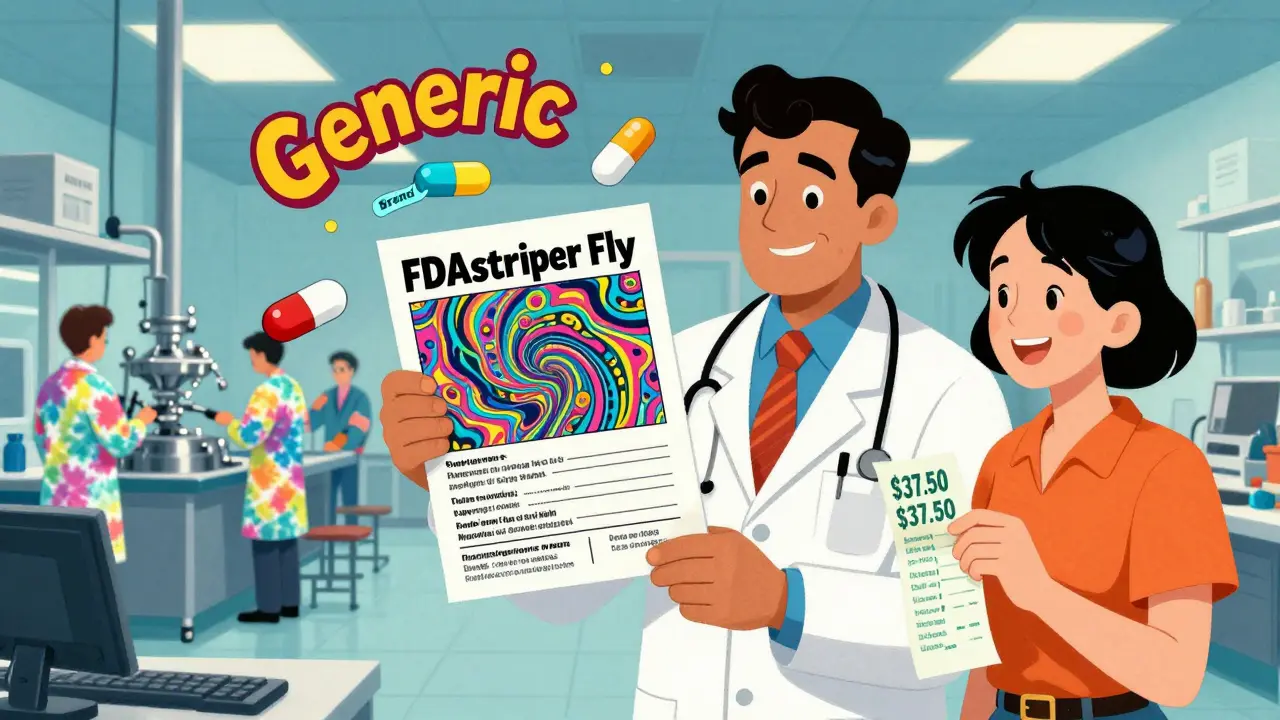
Doctors prescribe generics more than ever-90% of all prescriptions filled in the U.S. are for generic drugs. Yet many still hesitate. Why? Because they’ve heard patients say, “The brand-name worked better.” Or they worry the generic might not be as safe. Or worse-they just don’t know enough to confidently explain the difference.
The truth? Generics aren’t cheaper because they’re worse. They’re cheaper because they don’t need to repeat expensive clinical trials. The FDA requires them to be bioequivalent-meaning they deliver the same active ingredient, in the same amount, at the same rate as the brand. That’s not a guess. It’s science. And the data backs it up: in 2022, the FDA analyzed over 24,000 adverse event reports for generics and brand-name drugs. The numbers were nearly identical.
What the FDA Actually Requires for Generic Approval
Before a generic drug hits the shelf, the manufacturer must file an Abbreviated New Drug Application (ANDA). That doesn’t mean it’s rushed. It means they don’t have to re-prove the drug works. Instead, they prove it behaves the same way in the body.
The key metric? Bioequivalence. The generic must deliver the drug into the bloodstream within an 80% to 125% range of the brand-name version. That’s not a wide margin-it’s tight. For example, if the brand releases 100 mg of the drug over 4 hours, the generic must release between 80 and 125 mg in the same timeframe. That’s validated in studies with 24 to 36 healthy volunteers. These aren’t theoretical models. They’re real blood tests.
And the manufacturing? Same standards. The FDA inspects generic drug factories just like brand-name ones. In fact, many brand-name companies make their own generics under different labels. The FDA’s 2023 Generic Drugs Stakeholder Toolkit includes an infographic titled “What Makes a Generic the Same as a Brand-Name Drug?”-it shows side-by-side photos of manufacturing lines. They look identical.
Why Doctors Still Doubt Generics
It’s not about science. It’s about perception.
A 2021 FDA survey found 42% of Hispanic patients believed generics were less effective. Among patients earning under $25,000 a year, the rate of stopping medication due to cost was 3.7 times higher than for wealthier patients. That means doctors aren’t just fighting misinformation-they’re fighting fear rooted in real financial pain.
Some doctors also worry about complex drugs: inhalers, topical creams, injectables. These aren’t simple pills. Their delivery systems matter. A generic inhaler might use a different propellant or nozzle design. That doesn’t mean it’s less effective-but it does mean the prescribing doctor needs to know the specifics. The FDA’s resources don’t always cover these edge cases well. Only 42% of prescribers feel confident prescribing biosimilars or complex generics, according to a 2023 FDA report.
And then there’s the EHR problem. Most electronic health record systems don’t pop up generic education when a brand is selected. A 2023 KLAS Research report found only 37% of major EHRs include even basic generic drug facts. So doctors are left guessing-unless they’ve taken the time to learn it themselves.

What the Best Resources Actually Offer
The FDA’s Prescriber Flyers (updated March 2022) are one-page, pocket-sized references. They fit in clinic literature racks. Version 2 includes QR codes linking to Spanish-language materials-because if your patient doesn’t understand the explanation, the prescription won’t be filled.
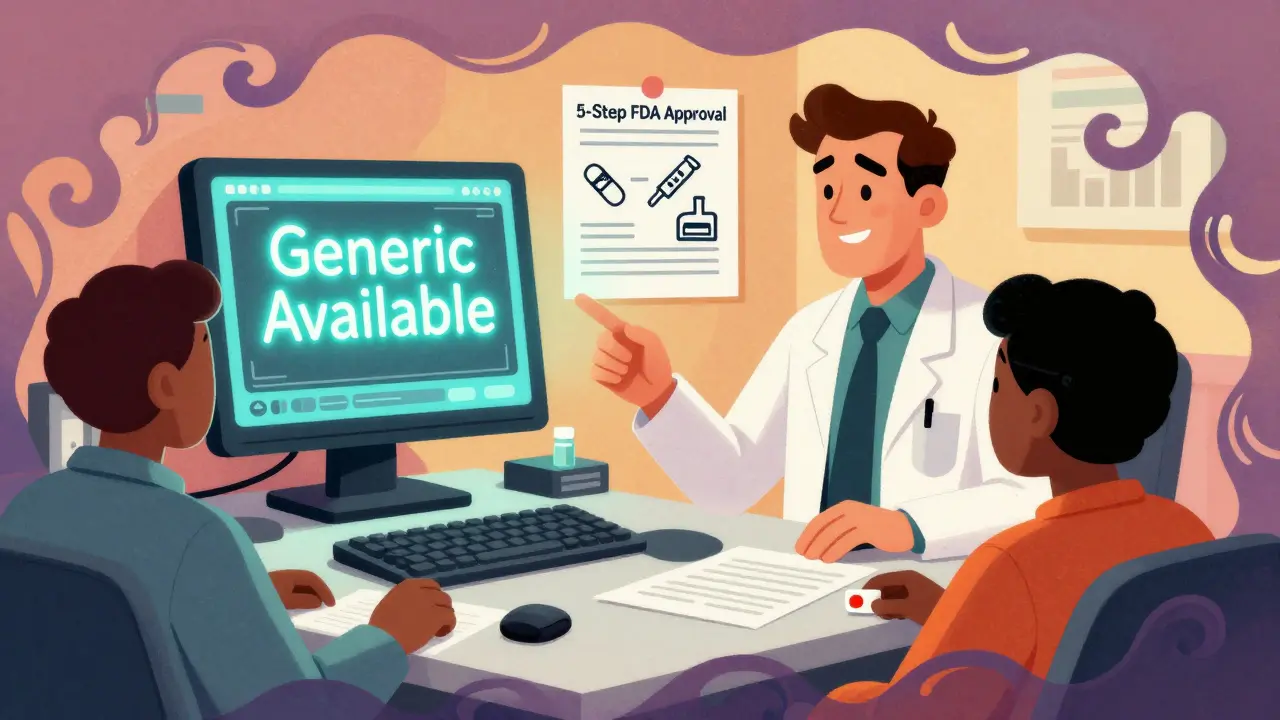
The Generic Drugs Stakeholder Toolkit, released in January 2023, has 12 ready-to-use social media templates, 5 printable info cards, and 3 infographics. One card, titled “5 Steps to FDA Approval for Generics,” breaks it down simply:
- Active ingredient matches the brand
- Same dosage form (pill, injection, etc.)
- Same route of administration (oral, topical, etc.)
- Same bioequivalence (80-125% range)
- Same manufacturing standards
These aren’t academic documents. They’re written at a 6th-8th grade reading level. Tested by the NIH. Designed for patients who are tired, stressed, or scared.
The American College of Physicians (ACP) has been pushing this for years. Since their 2015 position statement, they’ve urged every clinician to prescribe generics whenever possible. Why? Because cost is the #1 reason patients don’t take their meds. And when they skip doses, hospitalizations go up. The ACP estimates 20-30% of new prescriptions are never filled-mostly because of price.
How to Talk to Patients About Generics
It’s not enough to say, “It’s the same.” Patients have heard that before-and didn’t believe it.
Dr. Aaron Kesselheim from Harvard says the most effective approach combines science with a clear cost breakdown. Show them: “This brand costs $300 a month. The generic? $37.50. You save $262.50 every month. And the science says it works the same 99.7% of the time.”
Use the FDA’s scripts. They’re built for real conversations:
- “Your insurance wants you to switch. I get that. But here’s why it’s safe: the FDA tests these drugs just like the brand.”
- “The pill might look different, but the medicine inside is the same. It’s like buying store-brand aspirin-it’s the same active ingredient.”
- “If you’ve had issues with the brand, we can check if it’s the drug-or the filler. Sometimes the coating causes stomach upset. The generic might be better for you.”
One rural family physician in Nebraska, Dr. Sarah Chen, raised her generic prescribing rate from 62% to 89% in 18 months-just by showing patients the FDA infographic comparing manufacturing sites. “They saw the same machines, the same inspectors,” she said. “That changed their minds.”
Why Some Doctors Still Don’t Use These Resources
Time. That’s the real barrier.
A 2022 study in the Annals of Internal Medicine found 73% of physicians said they didn’t have time to access educational materials during patient visits. The FDA flyers are great-but if you have to print them, hunt them down, and explain them between two other patients, you won’t do it.
That’s why Kaiser Permanente’s approach works. They integrated FDA-approved generic facts directly into their Epic EHR system. When a doctor selects a brand-name drug, a pop-up appears: “Generic available. Saves patient $262/month. FDA-approved equivalent.” Within six months, brand prescribing dropped 18.7%.
And it’s getting better. In July 2023, the FDA launched an API pilot connecting generic drug data directly to Epic and Cerner. Early results? A 15.2% increase in generic prescribing among participating doctors in just six months.
But here’s the catch: most independent practices still rely on PDFs. Only 63% say their support is “adequate but not exceptional,” according to MGMA’s 2022 survey. Academic centers offer grand rounds on generics. Community clinics? Not so much.
What You Can Do Today
You don’t need a training seminar. You don’t need to read a 50-page report.
Start here:
- Download the FDA’s Prescriber Flyer (Version 2). Print one. Keep it on your desk.
- Use the 5-step card during your next patient visit. Point to it. Say: “This is what the FDA checks before they let this drug be sold.”
- Ask your EHR vendor: “Can you add a generic substitution alert?” If they say no, ask again next quarter.
- Next time a patient says, “The brand works better,” ask: “Have you tried the generic? What happened?” Listen. You might learn something.
It’s not about convincing every patient. It’s about giving them the facts-clear, simple, and backed by the same agency that approves every drug in the country.
And if you’re still unsure? Look at the numbers. Generics saved the U.S. healthcare system $2.29 trillion between 2010 and 2020. The Congressional Budget Office estimates that increasing generic use by just 5% would save Medicare $3.7 billion a year. That’s not just money. That’s lives. Because when patients can afford their meds, they take them. And when they take them, they stay healthy.
You’re not just prescribing a pill. You’re prescribing access. And generics are the most powerful tool we have to make that happen.
Are generic drugs really as effective as brand-name drugs?
Yes. The FDA requires generics to have the same active ingredient, strength, dosage form, and route of administration as the brand-name drug. They must also be bioequivalent-meaning they deliver the drug into the bloodstream at the same rate and extent, within an 80-125% range. This is proven through clinical studies in healthy volunteers. In 2022, the FDA reviewed over 24,000 adverse event reports and found no meaningful difference in safety between generics and brand-name drugs.
Why do some patients say the brand worked better?
Patients often confuse differences in inactive ingredients-like fillers, dyes, or coatings-with the drug itself. These can affect how a pill tastes, how quickly it dissolves, or whether it causes mild stomach upset. But they don’t change how the medicine works. Sometimes, switching from one generic to another (or back to brand) causes a perceived change because the body is adjusting to a new formulation. This doesn’t mean the generic is less effective-it just means the body noticed a difference in texture or timing, not in therapeutic effect.
Are generics made in the same facilities as brand-name drugs?
Yes, and often by the same companies. Many brand-name manufacturers also produce their own generic versions under different labels. The FDA inspects all facilities-brand and generic alike-using the same standards. In fact, over 50% of generic drugs in the U.S. are made in facilities owned by brand-name companies. The FDA’s 2023 infographic shows side-by-side photos of identical manufacturing lines for both types of drugs.
What about complex generics like inhalers or topical creams?
These are more challenging. For inhalers, the delivery device matters as much as the drug. For topical creams, absorption through the skin can vary based on base ingredients. The FDA still requires bioequivalence, but proving it is harder. Not all prescribers are trained on these nuances. The FDA’s current resources focus mostly on oral tablets. Experts recommend consulting specialty guidelines for complex generics-especially for drugs like insulin, biologics, or asthma inhalers. Always check the product’s FDA-approved labeling for specific equivalence statements.
Can I trust generics from other countries?
Only if they’re approved by the FDA. The U.S. does not regulate drugs imported from other countries unless they’re officially imported and approved. Many countries have different standards. The FDA only approves generics made in facilities it has inspected and certified. Even if a drug is labeled “generic” and sold online, if it’s not FDA-approved, it’s not legal or safe to use in the U.S. Always fill prescriptions at licensed U.S. pharmacies.
Do generics have the same side effects as brand-name drugs?
The active ingredient causes the side effects-and that’s identical in generics and brands. However, inactive ingredients (like dyes or preservatives) can cause rare allergic reactions or intolerances. If a patient reports a new side effect after switching to a generic, it’s likely due to a filler, not the drug itself. The FDA tracks these reports and updates labeling if needed. If in doubt, try switching back to the brand or to a different generic. The problem is rarely the active ingredient.
Why don’t EHR systems push generic alternatives more often?
Most EHR systems were built for billing and documentation-not clinical decision support. Only 37% of major EHRs include FDA-approved generic education pop-ups. But that’s changing. The FDA’s 2023 API pilot connected generic data directly to Epic and Cerner. Doctors using this saw a 15.2% increase in generic prescribing in six months. If your system doesn’t have this feature, ask your vendor to integrate the FDA’s Generic Drugs API. It’s free, official, and proven to work.
What’s the difference between a generic and an authorized generic?
An authorized generic is made by the brand-name company and sold under a generic label. It’s identical to the brand-same ingredients, same factory, same packaging (just without the brand name). It’s not a copy. It’s the real thing, priced lower. About 61% of prescribers don’t know this exists, according to a 2023 University of Arizona study. If a patient says, “I want the real thing,” an authorized generic gives them exactly that-at generic prices.
Terri Gladden
January 4, 2026 AT 02:40Jennifer Glass
January 4, 2026 AT 22:03Jay Tejada
January 5, 2026 AT 10:27mark etang
January 6, 2026 AT 06:50josh plum
January 8, 2026 AT 01:04John Ross
January 10, 2026 AT 00:13Brendan F. Cochran
January 11, 2026 AT 15:05jigisha Patel
January 13, 2026 AT 06:52Mandy Kowitz
January 13, 2026 AT 17:45Vicki Yuan
January 13, 2026 AT 21:49Uzoamaka Nwankpa
January 14, 2026 AT 03:29