
Imagine handing a patient a life-saving heart medication, only to discover later that the active ingredient was just chalk dust. It sounds like a scene from a thriller, but it is a terrifying reality for millions of people worldwide. For pharmacists, the stakes have never been higher. You are no longer just dispensing pills; you are the final checkpoint in a global battle against sophisticated criminal networks.
The landscape of pharmaceutical security has shifted dramatically. Gone are the days when checking a box's spelling was enough. Today, criminals use high-quality printing and advanced packaging to mimic genuine products perfectly. This makes counterfeit detection not just a skill, but a critical survival mechanism for public health. With over 6,400 incidents of pharmaceutical counterfeiting recorded globally in 2024 alone, the need for specialized pharmacist education has moved from 'nice to have' to absolutely essential.
The Evolving Threat Landscape
To understand why training matters, we first need to look at who we are up against. It is not just a guy in a basement mixing powders anymore. We are dealing with organized crime syndicates that operate across borders. In 2024, law enforcement agencies uncovered incidents affecting 136 countries. These criminals targeted 2,428 distinct medicines, ranging from common painkillers to complex oncology drugs.
The scale of this problem became painfully clear during Interpol's Operation Pangea XVI in 2025. This massive coordinated effort involved police, customs, and health authorities from 90 countries. The results were staggering: 769 arrests, the dismantling of 123 criminal groups, and the seizure of more than 50 million counterfeit doses. They also shut down roughly 13,000 illegal online platforms. If these numbers don't make you sit up and take notice, what will? The threat is real, it is global, and it is getting smarter.
| Metric | Value / Detail |
|---|---|
| Total Incidents (2024) | 6,424 |
| Countries Affected | 136 |
| Distinct Medicines Targeted | 2,428 |
| Arrests (Operation Pangea XVI, 2025) | 769 |
| Illegal Online Platforms Shut Down | ~13,000 |
Core Competencies in Pharmacist Education
So, what does effective training actually look like? It goes far beyond memorizing brand names. Modern pharmacist education on counterfeit drug detection focuses on building a mindset of healthy skepticism combined with technical know-how. The International Pharmaceutical Federation (FIP) and the World Health Organization (WHO) recognized this gap and launched a major initiative in 2021. Funded by the European Union, they developed a bilingual competency-based curriculum available in English and French.
This wasn't just theory. They piloted this curriculum with 355 pharmacy students across three sub-Saharan African countries: Cameroon, Senegal, and Tanzania. The results showed measurable improvements in students' knowledge about substandard and falsified medical products. As of 2025, the WHO is finalizing an updated toolkit to expand this pilot globally, with a specific focus on the online sales of fake drugs-a sector that exploded after 2021.
Key areas of focus in these educational programs include:
- Supply Chain Verification: Understanding how legitimate drugs move from manufacturer to patient.
- Price Anomaly Detection: Recognizing when a price is too good to be true.
- Digital Literacy: Identifying rogue websites and verifying authorized distributors.
- Physical Inspection Skills: Spotting subtle defects in packaging, labeling, and tablet appearance.
Technology as a Force Multiplier
Education provides the foundation, but technology provides the tools. The old method of calling a supplier or examining paper certificates is slow and prone to human error. Newer approaches integrate hardware and software directly into the pharmacist's workflow.
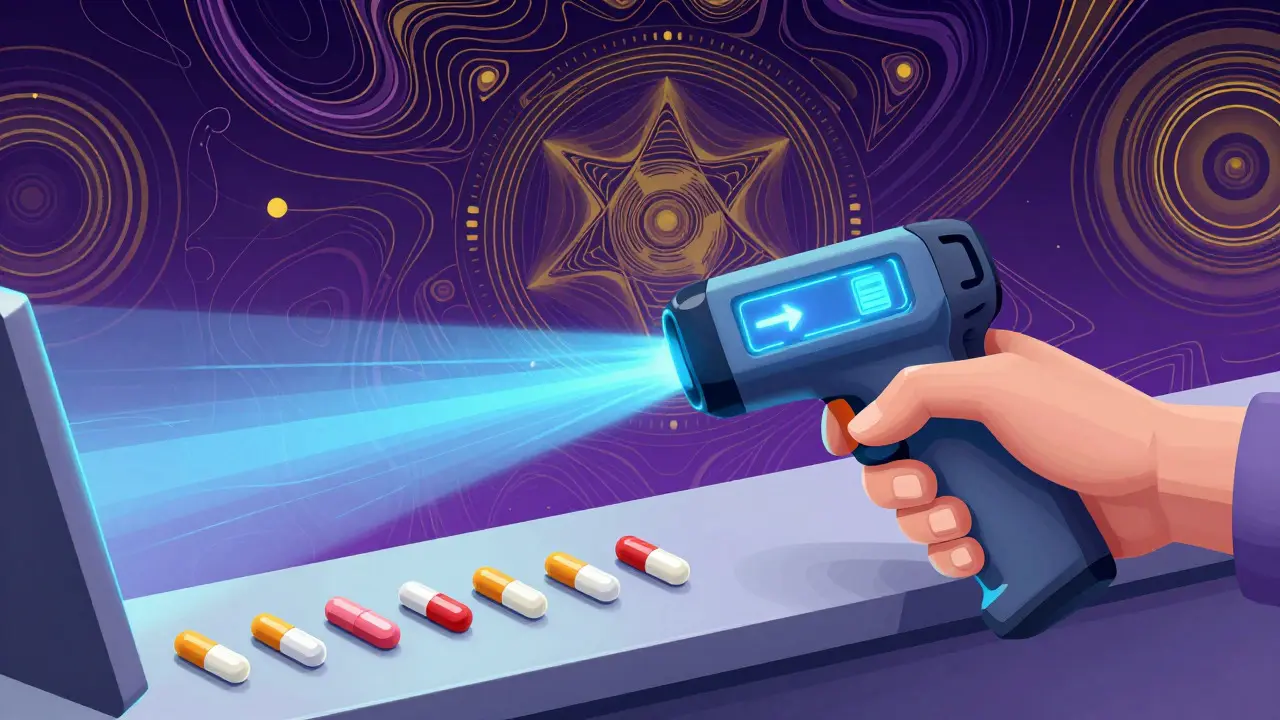
Take RxAll, for example. Their approach combines comprehensive training with handheld devices that use spectral analysis and AI-powered algorithms. These devices can verify medication authenticity in seconds by detecting subtle chemical differences between genuine and counterfeit drugs. Imagine being able to scan a bottle on your counter and get an instant green checkmark or red alert. That is the kind of confidence traditional methods simply couldn't provide.
For regulatory compliance, especially in the United States, online courses remain a staple. Platforms like TrainingNow.com offer 45-minute Medicare Fraud, Waste, and Abuse (FWA) certification courses. These are mobile-friendly, feature audio narration, and provide Continuing Education Unit (CEU) credits. While the Centers for Medicare & Medicaid Services (CMS) no longer mandates their specific course format since 2019, the requirement for FWA training within 90 days of hire remains a standard practice for many employers.
Regulatory Frameworks and Global Standards
The push for better education isn't coming from nowhere; it is backed by hard laws. In the U.S., the Drug Supply Chain Security Act (DSCSA), passed in 2013, set a ten-year plan to build a system that tracks prescription drugs through the supply chain. This established national licensing standards for wholesale distributors and created a digital trail for medications.
The Partnership for Safe Medicines calls pharmacists "the last line of defense." They emphasize that while the U.S. has one of the most advanced tracking systems in the world, implementation varies wildly elsewhere. Many developing nations lack comparable infrastructure, making local pharmacist vigilance even more critical. The DSCSA requires interoperable electronic tracing, which means every entity in the chain-from manufacturer to dispenser-must be able to share data quickly if a product is questioned.
In India, the Ministry of Home Affairs (@Cyberdost) has issued regular alerts regarding fake vaccines and other medications. However, reports suggest that as of early 2021, there were fewer reported incidents of online counterfeit sales compared to physical diversion, highlighting regional differences in how counterfeits enter the market.
Practical Steps for Pharmacists
How do you apply this education in your daily routine? It starts with a few simple habits that become second nature.
- Trust Your Gut on Pricing: If a distributor offers a specialty drug at a price drastically below the Wholesale Acquisition Cost (WAC), pause. Verify the source immediately. Criminals often lure buyers with rock-bottom prices.
- Verify Distributor Authorization: Don't assume a supplier is legit because they have a website. Check the manufacturer's official site for a list of authorized distributors. This is crucial for specialty drugs, which typically distribute through limited, controlled channels.
- Inspect Packaging Closely: Look for misspellings, blurry images, poor color matching, or damaged seals. Genuine manufacturers invest heavily in quality control; counterfeits often cut corners here.
- Use Available Tools: If your pharmacy has access to spectral analyzers or verification apps, use them. Don't let convenience override caution.
- Report Suspicious Items: If something looks off, report it. Pfizer's Anti-Counterfeiting Program has prevented over 302 million counterfeit doses from reaching patients since 2004 largely because people spoke up. Collaboration between pharmacists, wholesalers, and law enforcement is key.
The Human Element: Vigilance and Advocacy
Technology helps, but it doesn't replace human judgment. Nakul Pasricha, President of the Authentication Solution Providers' Association (ASPA), noted in a 2020 interview that "a continued immersive awareness and education programme is crucial for healthcare workers so that they can be vigilant towards the presence of a counterfeit product."
Pharmacists also play a vital role in patient education. Patients are often the first to notice something is wrong-their blood pressure isn't improving, or the pill tastes different. Create an environment where patients feel comfortable asking questions. RxAll’s platform includes resources to help patients understand the risks of counterfeit drugs and how to protect themselves. When you empower your patients, you add another layer of security to the supply chain.
The learning curve for new tools can vary. Basic online courses require minimal prep, but mastering devices like spectral analyzers takes hands-on practice. TRC Healthcare notes that combining continuing education libraries with unbiased medication management resources significantly improves competency. Make time for this training. It is not just a checkbox; it is part of your professional duty of care.
Future Trends in Detection and Training
Where is this all heading? The future of pharmacist education involves deeper integration of artificial intelligence and machine learning. Algorithms are becoming better at spotting patterns that humans might miss, such as slight variations in batch coding or shipping origins.
We are also seeing an expansion of training to cover emerging threats like counterfeit biologics and oncology products. These high-value drugs are prime targets for criminals. The WHO's upcoming toolkit, expected in late 2024, will place greater emphasis on these complex therapies and the digital marketplace where they are increasingly sold.
As criminals adapt, so must we. The partnership between academia, industry, and government is strengthening. Programs like the PowerPak continuing education course "Fakes in the Pharmacy" highlight the growing prevalence of counterfeiting globally. By staying informed and utilizing both traditional inspection skills and modern technology, pharmacists remain the strongest barrier between dangerous fakes and vulnerable patients.
What is the Drug Supply Chain Security Act (DSCSA)?
The DSCSA is a U.S. law passed in 2013 that aims to prevent counterfeit, stolen, contaminated, or otherwise harmful drugs from entering the legitimate drug supply chain. It established a ten-year plan to create a secure, interoperable electronic system for tracking prescription drugs from manufacturer to dispenser, requiring verification of product information at each transaction.
How can pharmacists identify counterfeit medications?
Pharmacists can identify counterfeits by inspecting packaging for defects like misspellings or poor print quality, verifying distributor authorization via manufacturer websites, monitoring for unusually low prices, and using technological tools like spectral analysis devices. Maintaining skepticism and reporting suspicious items to authorities are also critical steps.
Is online training sufficient for counterfeit detection?
Online training is a valuable component, particularly for regulatory compliance (like Medicare FWA) and foundational knowledge. However, it works best when combined with practical, hands-on experience with verification technologies and real-world case studies. Programs like the WHO/FIP curriculum demonstrate that blended learning approaches improve competency significantly.
What role does technology play in drug verification?
Technology plays a transformative role by enabling rapid, accurate verification. Handheld devices using spectral analysis and AI can detect chemical differences between genuine and fake drugs in seconds. Digital tracking systems mandated by laws like the DSCSA allow for end-to-end supply chain visibility, reducing reliance on manual checks and phone calls.
Why is pharmacist education critical in developing countries?
In many developing countries, robust national tracking infrastructure may be lacking. Therefore, the pharmacist serves as the primary line of defense. Educational initiatives like the WHO/FIP pilot in sub-Saharan Africa aim to equip local healthcare workers with the skills to identify substandard and falsified medicines, protecting communities where regulatory oversight might be weaker.