
What is hypoparathyroidism?
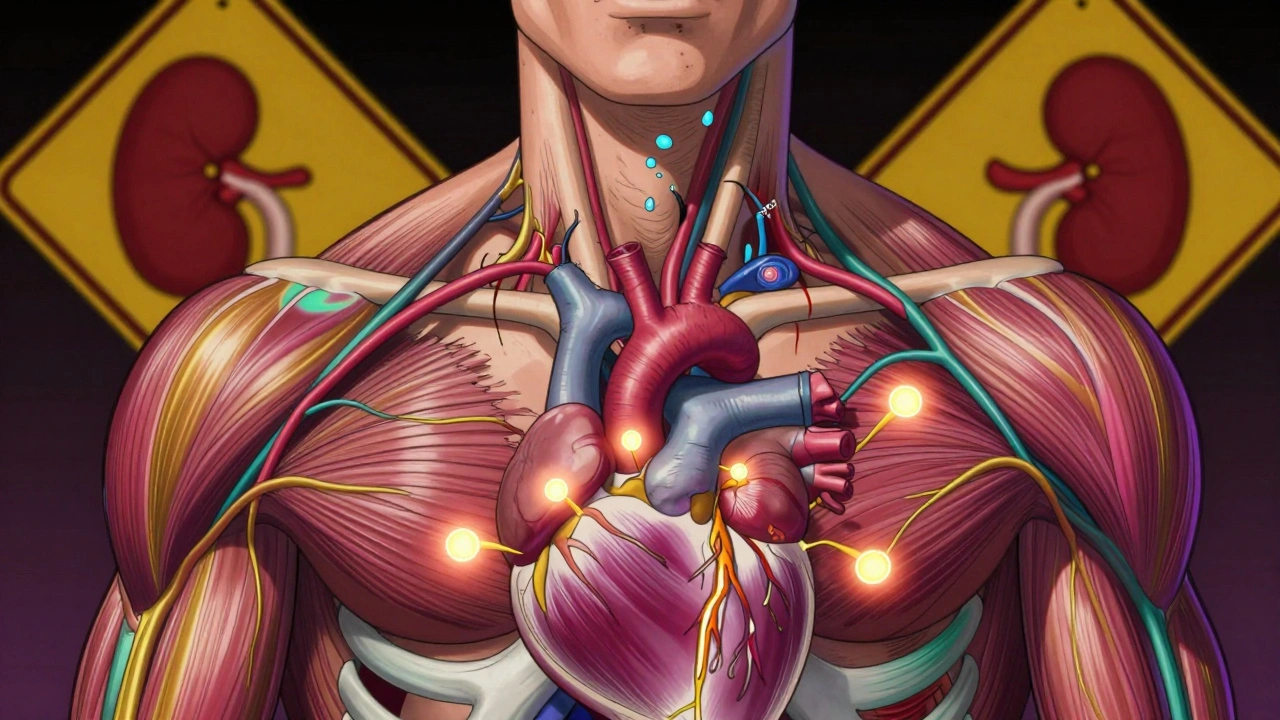
When your parathyroid glands don’t make enough parathyroid hormone (PTH), your body can’t keep calcium levels where they need to be. This condition is called hypoparathyroidism. It’s rare, but it’s not rare enough to ignore-especially if you’ve had thyroid or neck surgery. About 75% to 90% of cases happen after those procedures. Other causes include autoimmune diseases, genetic disorders like DiGeorge syndrome, or radiation damage. Without enough PTH, calcium drops too low, phosphate rises too high, and your bones, nerves, and muscles start to misfire.
Why does low calcium matter?
Calcium isn’t just for bones. It’s essential for your heart rhythm, nerve signals, and muscle contractions. When levels fall below 2.00 mmol/L, you might feel tingling around your mouth, fingers, or toes. Muscle cramps, especially in your hands and feet, are common. Some people get seizures or irregular heartbeats if levels dip too far. The goal isn’t to push calcium back to the top of the normal range-it’s to keep it in the lower half (2.00-2.25 mmol/L). Going higher increases your risk of kidney stones, calcium deposits in your brain, and long-term kidney damage.
How is it treated? The standard approach
Right now, the only widely accepted treatment is replacing what your body can’t make: calcium and active vitamin D. You won’t get PTH injections unless other options fail. Most people take calcium supplements and a form of vitamin D that’s already activated-like calcitriol or alfacalcidol. These bypass the need for PTH to activate vitamin D in the kidneys. Regular vitamin D3 (cholecalciferol) doesn’t work well here because your body can’t convert it without PTH.
Calcium is usually given as calcium carbonate because it’s cheaper and packs more elemental calcium-40% per pill. That means you might need 1,250 to 2,500 mg of calcium carbonate daily, split into two or three doses taken with meals. Taking it with food helps your body absorb it better and also helps bind excess phosphate in your gut. Calcium citrate is an alternative if you have stomach issues, but you’d need more of it because it only has 21% elemental calcium.
Active vitamin D doses typically start at 0.25 to 0.5 micrograms per day. Your doctor will adjust this slowly based on blood tests. You’ll also need 400 to 800 IU of regular vitamin D3 daily to keep your 25-hydroxyvitamin D levels between 20 and 30 ng/mL. This supports overall bone health and helps your body use the active form properly.
What you need to monitor
Managing hypoparathyroidism isn’t a set-it-and-forget-it situation. You need regular blood and urine tests. Key numbers to watch:
- Serum calcium: Target 2.00-2.25 mmol/L (8.0-8.5 mg/dL)
- Urinary calcium: Must stay under 250 mg per day (6.25 mmol). Higher levels mean kidney damage risk goes up.
- Serum phosphate: Keep between 2.5-4.5 mg/dL
- Magnesium: Should be above 1.7 mg/dL. Low magnesium makes calcium treatment less effective.
Tests usually happen every 1 to 3 months at first, then every 3 to 6 months once things stabilize. Skipping these checks can lead to silent kidney damage. About 35% to 40% of people on standard treatment develop too much calcium in their urine without realizing it.

When standard treatment isn’t enough
Some people just can’t get stable with calcium and vitamin D alone. If you need more than 2 grams of calcium or more than 2 micrograms of active vitamin D daily-and you still have symptoms or high urinary calcium-it’s time to talk about alternatives. That’s when doctors consider PTH replacement.
Two options exist: Natpara (recombinant human PTH 1-84) and Forteo (teriparatide). Natpara is approved in the U.S. and Europe but requires a special program to get it because of past manufacturing issues. It’s injected daily and can cut your calcium and vitamin D needs by 30% to 40%. But it costs around $15,000 a month. Forteo is cheaper but not officially approved for hypoparathyroidism-it’s used off-label.
For now, most patients stick with conventional therapy. But if you’re struggling with side effects or unstable levels, ask your endocrinologist about PTH replacement. It’s not a cure, but it can make life much easier.
Dietary tips that actually help
Food matters more than you think. You need calcium-rich foods: milk (300 mg per cup), yogurt, leafy greens like kale (100 mg per cup), broccoli (43 mg per cup), and fortified plant milks. But you also need to cut back on phosphate. Processed foods, soda, and hard cheeses are loaded with it. A single can of soda has 500 mg of phosphoric acid. One ounce of cheddar cheese has 500 mg. That’s your entire daily limit in one snack.
Try to keep phosphate under 800-1,000 mg per day. Read labels. Avoid anything with “phos” in the ingredients. Choose fresh meats over processed ones. Skip the soda. It’s not about perfection-it’s about reducing the burden on your kidneys.
Why magnesium is often overlooked
Low magnesium doesn’t cause hypoparathyroidism, but it makes it worse. If your magnesium drops below 1.7 mg/dL, your body can’t respond to PTH-even if you’re taking supplements. You’ll keep having low calcium symptoms even with high doses of calcium and vitamin D.
Most people need 400-800 mg of magnesium daily. Magnesium oxide is common, but it can cause diarrhea. Magnesium citrate is gentler on the stomach. If you’re still having trouble, ask for a blood test. Fixing magnesium often stabilizes everything else.
What patients really struggle with
Surveys of over 400 people with hypoparathyroidism show the same problems over and over:
- 68% say their calcium levels swing like a rollercoaster-tingling one day, exhausted the next
- 52% still have symptoms every day, even on treatment
- 45% get constipated from high-dose calcium
- Many take 6 to 10 pills a day and find it overwhelming
One trick that helps: split your calcium into four or five smaller doses instead of two or three. Taking calcium with every meal and snack keeps levels steadier. Also, take your vitamin D at bedtime-it absorbs better when your body’s resting.
What to do in an emergency
If you suddenly feel numbness spreading up your arms, your heart races, or you get a muscle spasm you can’t control-chew 2 to 3 calcium tablets right away. That’s 500 to 1,000 mg of elemental calcium. Don’t wait. Call your doctor or go to urgent care. Have a plan. Keep extra tablets in your bag, car, and at work.
What’s coming next?
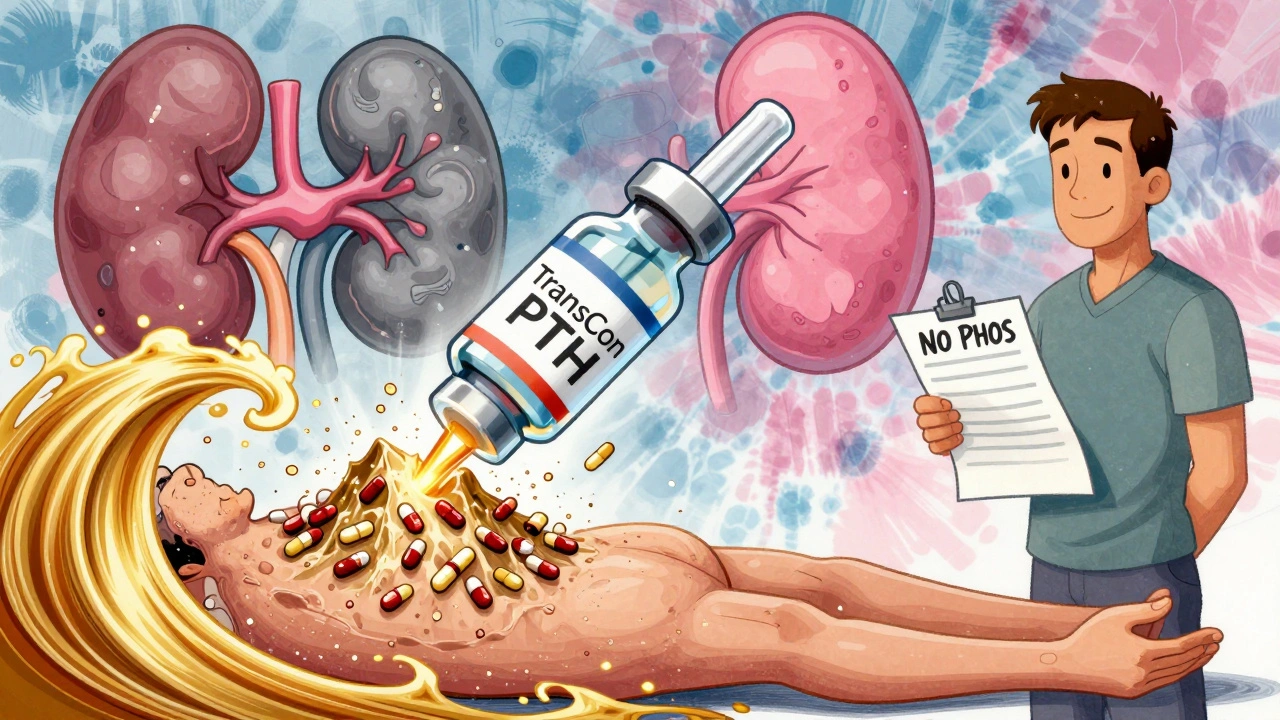
Research is moving fast. A new drug called TransCon PTH, which is injected once a day, showed in a 2022 trial that it normalized calcium in 89% of patients-compared to just 3% on placebo. It could cut pill burden dramatically. It’s not approved yet, but Phase 3 results are strong. Also, gene therapies targeting the calcium-sensing receptor are in early animal trials. Human trials aren’t expected before 2026.
Right now, the biggest risk isn’t just low calcium-it’s long-term kidney damage. About 15% to 20% of people on conventional therapy develop stage 3 or worse kidney disease after 10 years. Keeping calcium in the lower half of normal isn’t just about feeling better-it’s about protecting your kidneys for life.
Who should manage your care?
Start with an endocrinologist. You’ll need 3 to 4 visits in the first few months to find the right dose. Once stable, 3 to 4 visits a year are usually enough. Many family doctors feel unprepared to handle this condition. A 2021 survey showed 78% of them didn’t feel trained in hypoparathyroidism. Don’t be afraid to ask for a referral. You need someone who knows the numbers, the risks, and the new options.
Declan O Reilly
December 3, 2025 AT 08:24Man, I wish I'd had this guide when I first got diagnosed. Took me 2 years to figure out that calcium with meals isn't just advice-it's survival. I used to take it all at night and wake up feeling like my hands were made of glass. Splitting into 4 doses? Game changer. Also, magnesium citrate saved my gut from the calcium constipation hell. 🙌
Conor Forde
December 4, 2025 AT 15:02So let me get this straight-you’re telling me the entire medical establishment is just… winging it with calcium pills and hoping for the best? And the ‘new’ drug costs 15K a month? That’s not treatment, that’s corporate extortion wrapped in a lab coat. Next they’ll charge us for breathing. 😏
patrick sui
December 5, 2025 AT 22:07Big thanks for laying this out so clearly. One thing I’d add: if you’re on calcitriol, watch your phosphate like a hawk. I missed that for months and ended up with calcification in my tendons-yep, that’s a real thing. Also, magnesium isn’t optional. Low Mg = PTH resistance. It’s not magic, it’s biochemistry. 💡
Priyam Tomar
December 6, 2025 AT 12:19Everyone’s talking about calcium and vitamin D like it’s rocket science. It’s not. You take what the doctor says. If you’re still symptomatic, you’re probably not following the protocol. I’ve seen people take 5000mg calcium and still complain. That’s not the treatment’s fault. It’s laziness. Also, avoid plant milks-they’re full of additives. Stick to real dairy. End of story.
Jack Arscott
December 7, 2025 AT 02:49This is gold 🙏 I’ve been on this for 8 years and no one ever told me about the bedtime vitamin D trick. Just tried it last night. Felt better this morning. Also, I keep calcium tabs in my wallet, glovebox, and gym bag. If you’re not doing this, you’re playing Russian roulette with your nerves. 💪
Irving Steinberg
December 7, 2025 AT 16:07Wow this post is long but honestly it’s just a lot of ‘take pills’ and ‘avoid soda’ and ‘go to endo’ like we didn’t already know that. I’ve had this for 15 years and the only thing that helped was quitting my job and not stressing. Stress makes calcium drop. That’s the real secret. Also why are we still using calcitriol? It’s 2025. 🤷♂️
Lydia Zhang
December 9, 2025 AT 09:32Interesting. I take calcium carbonate and it works. I don’t need to overthink it.
Kay Lam
December 10, 2025 AT 18:08I want to say thank you for mentioning the kidney damage risk because that’s the part nobody talks about. I was told to keep calcium normal and I did, but I didn’t know that normal was actually too high for me. My nephrologist found microalbuminuria from years of urinary calcium overload. Now I’m in the lower half of the range and my creatinine’s improving. It’s not about feeling good today, it’s about not needing a transplant in 10 years. That’s the real goal. And yeah, magnesium matters. I had to get tested because my doctor didn’t even think to check it. Don’t assume they know. Ask. Always ask.
Matt Dean
December 12, 2025 AT 04:58So you’re telling me the only people who get this right are the ones who read Reddit posts and not their doctors? That’s not a treatment protocol, that’s a failure of the entire medical system. I’ve been telling my endo for years that 2.5mmol/L is too high and he still says ‘it’s in range’. I’m 53, I’ve had this since 2012, and I still have to educate my own specialist. This isn’t rare-it’s neglected. And the fact that Natpara is this expensive? Criminal.