
Off-Label Drug Use Calculator
Understanding Off-Label Drug Use
Off-label drug use occurs when doctors prescribe FDA-approved medications for conditions not specifically approved on the label. This is common in many medical specialties and can be a vital treatment option when no alternatives exist.
Select Your Specialty or Condition
What You Should Know
Always ask your doctor:
- Is this drug approved for my condition?
- What's the evidence supporting this off-label use?
- Will my insurance cover this prescription?
- What are the known side effects for this use?
Results
Select a specialty to see statistics about off-label use prevalence and evidence support.
Every year, millions of people in the U.S. take medications that aren’t officially approved for their condition. That’s not a mistake. It’s off-label drug use-and it’s more common than you think. In fact, about 1 in 5 prescriptions written in America are for uses the FDA never approved. In some fields, like oncology or pediatrics, that number jumps to over 60%. This isn’t illegal. It’s not even rare. It’s standard practice. But why does it happen? And what does it mean for patients?
What Exactly Is Off-Label Drug Use?
When a drug gets approved by the FDA, it’s approved for specific conditions, age groups, doses, or ways of taking it. For example, a pill might be approved to treat high blood pressure in adults, but not for children, or not for use as an injection. Off-label use is when a doctor prescribes that same drug for something else-like using a chemotherapy drug approved for lung cancer to treat a rare type of lymphoma, or giving a teenager a dose of an antidepressant that’s only approved for adults. This can include:- Using a drug for a different disease than what it was approved for
- Prescribing it to a different age group (like kids or elderly patients)
- Changing the dose (higher or lower than what’s on the label)
- Changing how it’s given (swallowing a pill meant to be injected, or using a cream as an eye drop)
The FDA doesn’t control how doctors prescribe drugs-only how companies market them. That’s why off-label prescribing is legal. The agency says plainly: “Once the FDA approves a drug, healthcare providers generally may prescribe the drug for an unapproved use when they judge that it is medically appropriate.” But the drugmaker can’t advertise or push that use. If they do, they face huge fines. GlaxoSmithKline paid $3 billion in 2012 for illegally promoting off-label uses. Pfizer paid $2.3 billion in 2012 for similar violations.
Why Do Doctors Do It?
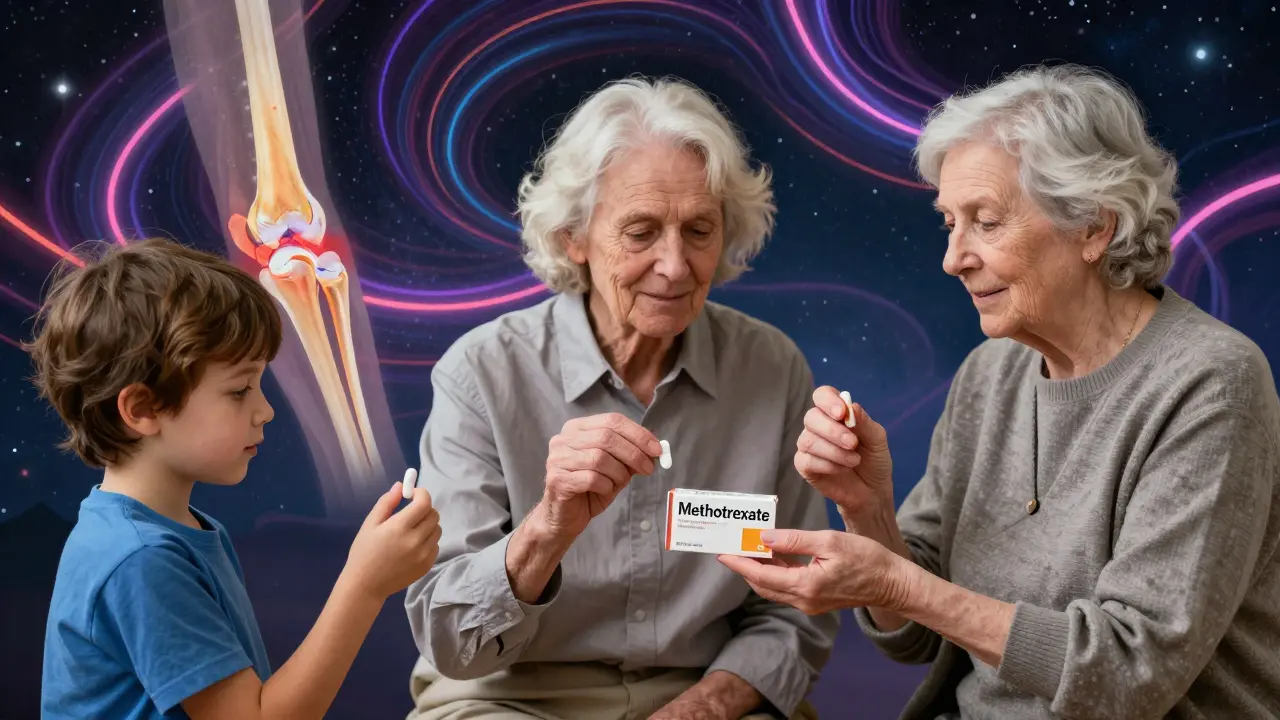
The answer is simple: because patients need it.In oncology, up to 85% of cancer drugs are used off-label. Why? Because cancer doesn’t follow neat categories. A tumor might have the same genetic marker whether it’s in the breast, lung, or colon. If a drug works on one type, doctors will try it on others-even if it’s not officially approved. Methotrexate, originally for cancer and psoriasis, is now commonly used off-label for rheumatoid arthritis and lupus because the science supports it.
In pediatrics, the numbers are even starker. Only 20-30% of drugs have specific labeling for children. That means 7 out of 10 prescriptions for kids are off-label. Why? Because drug trials rarely include children. Companies don’t want to spend $50-100 million and 5-7 years to get approval for a pediatric use when they can sell the same drug for adult conditions. So doctors fill the gap.
Psychiatry is another big area. About 31% of psychiatric prescriptions are off-label. Antidepressants like sertraline are often prescribed for anxiety, insomnia, or even PTSD-even when those aren’t on the label. Antipsychotics like quetiapine are commonly used for sleep or agitation in older adults, even though they’re only approved for schizophrenia and bipolar disorder.
And now, we’re seeing it with diabetes drugs like semaglutide (Ozempic). Originally approved for type 2 diabetes, these drugs are now being prescribed off-label for weight loss. Sales have exploded-up 300% from 2020 to 2023. But long-term safety data for this use? Still lacking.
The Risks: When Off-Label Use Goes Wrong
Just because it’s legal doesn’t mean it’s always safe.The biggest danger is using a drug without solid evidence. Take Fen-Phen. Fenfluramine and phentermine were both approved individually. But when doctors combined them off-label for weight loss, thousands of patients developed serious heart valve damage. The combination was never tested. The result? A public health disaster and a market withdrawal.
Another risk is side effects that aren’t well studied. A patient might be prescribed an antipsychotic off-label for insomnia. They might gain weight, develop high blood sugar, or have movement disorders-side effects that weren’t tracked in the original trials because they weren’t the approved use. And since insurance often won’t cover off-label prescriptions without proof, patients might pay out of pocket and never get follow-up care.
According to a 2018 study in JAMA Internal Medicine, 78% of off-label uses had little or no scientific backing. Only 22% were supported by strong evidence. That means a lot of prescriptions are based on anecdotes, small studies, or expert opinion-not large clinical trials.
How Do Doctors Decide?
It’s not random. Good doctors rely on evidence.They check resources like the National Comprehensive Cancer Network (NCCN) Compendium, which rates off-label cancer drugs based on clinical data. Medicare uses NCCN guidelines to decide what to cover. The American Medical Association recommends doctors document their reasoning: “Why this drug? Why this dose? What’s the evidence?”
Some doctors spend 27 minutes per patient just researching off-label uses and fighting insurance denials. One oncologist on Reddit said she uses vincristine differently for rare sarcomas-weekly instead of biweekly-because studies show better outcomes. But she has to get prior authorization every single time.
Insurance companies like UnitedHealthcare require one of three things to cover off-label use: FDA approval for a similar condition, peer-reviewed studies, or inclusion in recognized compendia like NCCN or DRUGDEX. If it doesn’t meet those, patients pay full price-or go without.
Who’s Driving This?
It’s not drug companies. They’re legally barred from promoting off-label uses. It’s doctors-guided by research, experience, and sometimes desperation.Specialists in oncology, psychiatry, and pediatrics rely on off-label use more than anyone else. Academic hospitals use it 37% more than community clinics because they have access to clinical trials, specialists, and research databases. Primary care doctors use it too-but they’re more worried about liability.
The economic incentive? Huge. The global off-label drug market was worth $285 billion in 2022. That’s 20% of all U.S. pharmaceutical spending. Companies know they’ll make money even if they don’t get formal approval. And why bother with the $100 million price tag and 5-year wait when the drug already works?
What’s Changing?
The FDA is starting to catch up.The 21st Century Cures Act of 2016 let manufacturers share real-world data with doctors-even if it’s not yet approved. In 2022, the FDA clarified rules to allow limited communication about off-label uses if the data is factual and not misleading. In 2023, they released draft guidance to use electronic health records and patient registries to speed up label expansions.
That’s important. If a drug works well for 10,000 patients in real life, why wait a decade to get it officially approved? The goal isn’t to stop off-label use. It’s to turn it into approved use-faster.
Dr. Robert Califf, FDA Commissioner, put it bluntly in 2023: “Off-label use remains a necessary component of medical practice, but we must improve mechanisms for generating evidence to support these uses more efficiently.”
What Should Patients Know?
If your doctor prescribes a drug off-label:- Ask: “Is this approved for my condition?”
- Ask: “What’s the evidence? Is it from a big study or just a few cases?”
- Ask: “Will my insurance cover it?”
- Ask: “What are the known side effects for this use?”
Don’t assume off-label means unsafe. Many life-saving treatments started off-label. But don’t assume it’s risk-free either. The best outcomes happen when the science is strong, the doctor is transparent, and the patient is informed.
Is off-label drug use legal?
Yes. Doctors can legally prescribe any FDA-approved drug for any use they believe is medically appropriate. The FDA regulates how drugs are marketed-not how they are prescribed. The only illegal part is if a drug company promotes off-label uses to doctors or patients.
Why don’t drug companies get more uses approved?
Because it’s expensive and slow. Getting a new indication approved can cost $50-100 million and take 5-7 years. For many drugs, especially older ones or those with generic versions, companies don’t see a big enough return to justify the investment. Off-label use lets them keep selling the drug without the cost.
Is off-label prescribing dangerous?
It can be-if there’s no good evidence. Some off-label uses are backed by decades of research and are as safe as approved uses. Others are based on weak data or anecdotal experience. The risk isn’t the off-label part-it’s the lack of solid evidence. Always ask your doctor for the science behind the choice.
Can insurance deny coverage for off-label drugs?
Yes. Most insurers require proof of medical necessity. They’ll cover it only if it’s listed in recognized compendia like NCCN, supported by peer-reviewed studies, or similar to an approved use. Without that, you may pay full price or be denied.
Are children at higher risk for off-label use?
Children are more likely to receive off-label drugs-not because they’re riskier, but because so few drugs are tested in kids. About 62% of prescriptions for children are off-label. That doesn’t mean it’s unsafe, but it does mean doctors rely more on experience and limited data.
What’s the future of off-label prescribing?
It won’t disappear. But it may become less common as real-world data from electronic records and patient registries helps get more drugs officially approved faster. The goal isn’t to eliminate off-label use-it’s to turn good off-label practices into approved treatments, faster.
Off-label drug use isn’t a loophole. It’s a lifeline. For patients with no other options, it’s often the only path forward. But it needs to be guided by science-not convenience, profit, or guesswork. The best medicine doesn’t always come with an FDA sticker. Sometimes, it comes from a doctor who looked beyond the label.
Amadi Kenneth
March 19, 2026 AT 15:42Let me tell you something they don’t want you to know… the FDA? Controlled by Big Pharma. They delay approvals on purpose so drug companies can keep charging premium prices-then doctors get stuck using off-label stuff because patients can’t afford the “approved” versions. It’s a scam. I’ve seen it. My cousin’s oncologist prescribed a $12,000/month drug off-label because the “approved” version had a 6-month waiting list. Coincidence? Nah. It’s calculated. And now they’re using EHR data to “speed up” approvals? That’s just a cover for more profit. The system is rigged. Always has been.
Shameer Ahammad
March 20, 2026 AT 07:15It is an absolute travesty that medical practice has devolved into this state of unregulated experimentation. The Hippocratic Oath demands evidence-based action, yet we permit physicians to prescribe medications without formal approval, relying on anecdotal evidence and personal bias. This is not medicine-it is reckless improvisation. The FDA exists for a reason: to protect the public from unproven interventions. To argue that off-label use is a 'lifeline' is to romanticize negligence. Where is the accountability? Where is the oversight? We are gambling with human lives, and it is morally indefensible.
Alexander Pitt
March 21, 2026 AT 10:09The NCCN Compendium is the real hero here. It’s not perfect, but it’s peer-reviewed, updated quarterly, and based on real clinical data-not marketing. Oncologists don’t just wing it. They cross-reference multiple sources: ASCO guidelines, Cochrane reviews, institutional protocols. And yes, insurance denials are brutal, but that’s a reimbursement problem, not a clinical one. The system punishes innovation. If a drug works in 80% of patients across 3 tumor types, why does it need 5 more years of Phase 3 trials? The answer: bureaucracy.
David Robinson
March 22, 2026 AT 01:17Everyone’s acting like this is some revolutionary insight. Newsflash: it’s been happening since the 1980s. We’ve got 30-year-old drugs being used for 10 different conditions because no one wants to spend $80 million to get a new indication. And now we’re pretending it’s a ‘lifeline’? It’s a loophole. A financial loophole. The fact that insurance won’t cover it unless it’s in NCCN means the real gatekeepers aren’t doctors-they’re actuaries. And guess who gets stuck paying? The patient. Again. This isn’t science. It’s insurance arbitrage dressed up as innovation.
Laura Gabel
March 23, 2026 AT 17:10So we’re okay with doctors just making stuff up now? That’s not medicine. That’s witchcraft. And don’t give me that 'it's legal' excuse. Just because it’s not illegal doesn’t mean it’s right. We used to bleed people for infections. Now we give kids antidepressants for anxiety because the pharma reps didn’t bother to test it on them. America’s healthcare is a circus. And we’re all paying for front-row seats.
Andrew Mamone
March 24, 2026 AT 17:25Off-label use isn’t a flaw-it’s a feature of adaptive medicine. 🧬 We’ve got a 70-year-old drug for epilepsy being used in autism because it modulates sodium channels. No one did a trial. But 500 clinicians saw results. That’s real-world evidence. The FDA’s old model is like trying to update Windows XP with a 2024 patch. We need faster feedback loops. Real-world data, registries, AI analysis-this isn’t about bypassing science. It’s about evolving it. The future isn’t waiting for FDA approval. It’s watching what works.
MALYN RICABLANCA
March 26, 2026 AT 12:59OMG I CAN’T BELIEVE THIS IS HAPPENING!! I read this whole thing and I’m just shaking-imagine your kid getting a drug that’s only been tested on rats for a condition they don’t even have?? And then insurance says NO? And then you have to sell your car? And then the doctor says 'it’s common practice'-like that’s supposed to comfort you?? I cried. I actually cried. This is why we need universal healthcare. No one should have to beg for a pill that could save their life. And don’t even get me started on how Ozempic is being used for weight loss like it’s a magic potion. It’s not. It’s a band-aid on a broken system. And we’re all just… just… stuck in the middle. 😭💔
gemeika hernandez
March 28, 2026 AT 03:14My grandma got off-label meds for her arthritis. Said it worked better than the stuff the doctor tried first. I don’t know what NCCN is. I just know she didn’t die. That’s all that matters. People act like science is this perfect machine. It’s not. It’s slow. And people are dying while it catches up. So yeah, doctors use what works. And if you’re mad about it, go help fix the system instead of yelling on Reddit.
Nicole Blain
March 28, 2026 AT 09:42So… like… I got prescribed gabapentin for anxiety and it’s technically off-label? But it’s the only thing that helped me? And my doc said it’s super common? So… yeah. I’m glad it’s legal. 🤷♀️✨
Kathy Underhill
March 29, 2026 AT 11:01The real question isn’t whether off-label prescribing is necessary-it is. The question is whether we’re building systems to validate it efficiently. The current model relies on individual clinicians to shoulder the burden of evidence-gathering. That’s unsustainable. We need institutional infrastructure: shared databases, mandatory reporting of outcomes, streamlined pathways for label expansion. Off-label use isn’t the problem. The lack of structured feedback loops is. We’re not failing patients because we use drugs off-label. We’re failing them because we don’t systematize what works.
Srividhya Srinivasan
March 30, 2026 AT 15:55They say it’s legal… but who really controls the FDA? The pharmaceutical lobbyists? The same ones who buried studies on fenfluramine? I’ve seen the documents. They knew. They knew the heart risks. They just didn’t want to pay for pediatric trials. Now they’re pushing Ozempic for weight loss-same playbook. It’s not medicine. It’s a financial weapon. And you? You’re the target. They don’t care if you live or die. They care if your insurance pays. And if it doesn’t? You’re on your own. Wake up.
Prathamesh Ghodke
March 31, 2026 AT 13:08Look, I get why this is scary. But here’s the thing: I’m a pediatrician in rural India. We don’t have 10 different drugs for kids. We have one. And if it works for adults? We use it for kids. Not because we’re reckless. Because we’re desperate. And sometimes, that one drug is the only thing between a child and a ventilator. So yeah, I prescribe off-label. And I sleep at night because I’ve got 12 years of notes, 3 peer-reviewed papers, and a kid who’s now playing soccer. You can call it risky. I call it responsibility.