
Lithium-NSAID Risk Calculator
Risk Assessment Tool
Enter your details to determine your risk level when taking lithium with NSAIDs. Based on data from JAMA Network Open and clinical guidelines.
Discontinue NSAID immediately. Contact your psychiatrist within 24 hours. Lithium levels must be checked urgently.
Use acetaminophen only. NSAID use requires close monitoring (lithium levels every 2-3 days) and maximum 3 days use. Consult your doctor before continuing.
Acetaminophen is preferred. If NSAID use is unavoidable, limit to 3 days and increase fluid intake to 3L/day. Consult your doctor.
Why This Matters
NSAIDs reduce kidney blood flow, causing lithium to accumulate. A 2023 JAMA study found 3.2x higher kidney injury risk when combined with lithium.
Risk factors:
- Age >65
- eGFR <60
- Duration >3 days
- Indomethacin use
When you're managing bipolar disorder with lithium, you're already balancing a tightrope. Lithium works - it's been saving lives for over 50 years. But one common, seemingly harmless choice - popping an ibuprofen for a headache or naproxen for arthritis - can quietly push you into dangerous territory. The truth? Lithium and NSAIDs don't just mix poorly. Together, they can trigger acute kidney injury, permanent kidney damage, and life-threatening lithium toxicity - often before anyone realizes what's happening.
How NSAIDs Turn Lithium Into a Poison
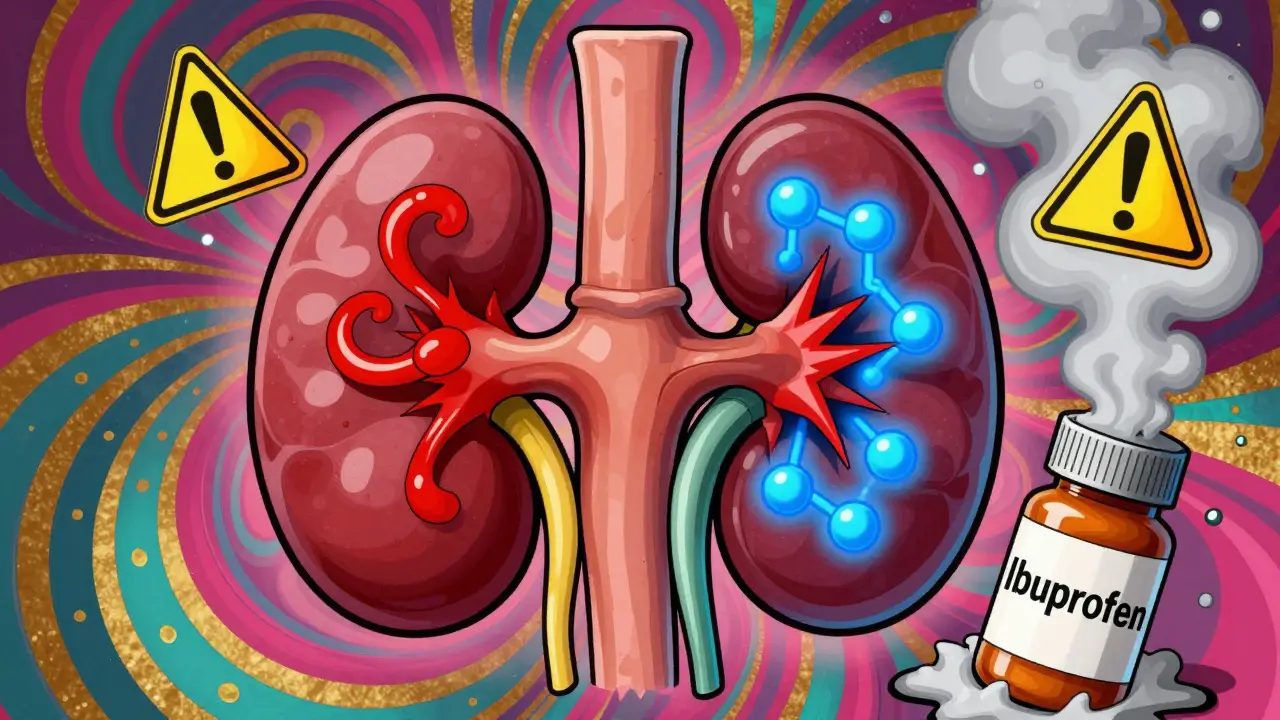
Lithium leaves your body through your kidneys. Simple enough. But NSAIDs - like ibuprofen, naproxen, or indomethacin - interfere with how your kidneys handle lithium. They block enzymes called cyclooxygenase (COX), which normally help keep blood flowing smoothly through the kidneys. When that flow drops, your kidneys start holding onto lithium instead of flushing it out. Studies show this can spike lithium levels by 20% to over 60%, depending on the NSAID. Indomethacin? It’s the worst offender. Ibuprofen? Still risky. Aspirin and celecoxib? Less so, but not safe.
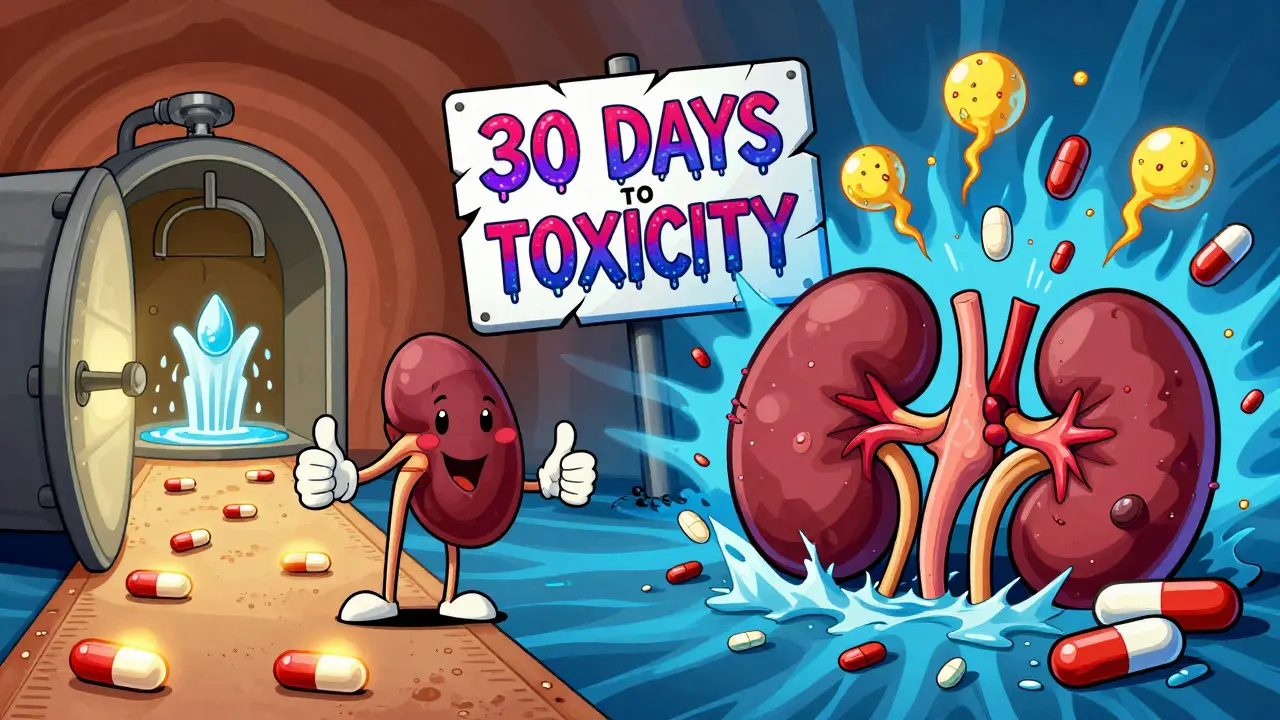
This isn’t theoretical. A 2023 study in JAMA Network Open tracked over 12,000 patients and found that those taking both lithium and an NSAID had a 3.2-fold higher risk of acute kidney injury. The highest risk? The first 30 days after starting the NSAID. Some patients crash within 72 hours.
Why Your Kidneys Are the First to Suffer
Lithium doesn’t just sit in your blood. It sneaks into kidney cells and disrupts their internal machinery - specifically, it triggers a buildup of beta-catenin, which damages the cells over time. NSAIDs? They cut off the blood supply to those same cells. Together, they’re like a one-two punch: one weakens the cell, the other starves it. This synergy is why the combination is far more dangerous than lithium with other painkillers.
Compare it to acetaminophen (Tylenol). It doesn’t touch kidney blood flow. Studies show it barely moves lithium levels - under 5% change. Opioids? They might raise lithium a bit, but mostly through dehydration, not direct kidney interference. NSAIDs? They’re the only class that directly hijacks the kidney’s lithium clearance system. That’s why experts call this one of the most predictable and dangerous drug interactions in all of medicine.
Who’s Most at Risk - And Why It’s Worse Than You Think
You might think, “I’m young and healthy. I’m fine.” But age, even mild kidney decline, or being on multiple medications changes everything.
Patients over 65? Their kidneys naturally filter less. Add an NSAID? Lithium levels can spike dangerously fast. A 2023 analysis of 478 nephrology clinics found that over half of all lithium-related kidney injuries happened in patients 65 and older.
And it’s not just the elderly. People with preexisting kidney disease - defined as an eGFR under 60 - face exponential risk. One study showed that even a small NSAID dose in someone with stage 2 kidney disease could push lithium into toxic range. And here’s the scary part: many don’t know they have kidney issues until it’s too late.
Real-world data from Reddit threads and case reports tell the same story. Over 70% of patients who reported lithium toxicity after taking NSAIDs described tremors, confusion, vomiting, or hospitalization. Nearly a third said their doctor - a primary care provider, not a psychiatrist - prescribed the NSAID without knowing about the lithium interaction. That’s not negligence. It’s systemic.
What the Guidelines Say - And Why They’re Often Ignored
The American Society of Nephrology, the American Psychiatric Association, and the European Psychiatric Association all agree: avoid NSAIDs if you’re on lithium. If you absolutely must use one, it should be for less than 7 days, with daily fluid intake of at least 3 liters, and lithium levels checked every 2-3 days.
But here’s the gap: a 2021 audit found only 62% of psychiatrists included NSAID warnings in patient handouts. Compare that to 99% who warn about diuretics - another known lithium risk. Why the difference? Because NSAIDs are sold over the counter. People don’t think of them as “meds.” They think of them as pain relievers, like aspirin.
Electronic health records have alerts for this interaction. But in 95% of U.S. systems, they only pop up as a warning - not a block. And as one FDA scientist pointed out, even those alerts only reduce risky prescribing by 35%. That means two out of three lithium users still get NSAIDs without a safety net.
What to Use Instead - And How to Stay Safe
If you’re on lithium and need pain relief, your options are limited - but they exist.
- Acetaminophen (Tylenol) is the first choice. Max dose: 3,000 mg per day. Higher doses can hurt your liver - so don’t overdo it.
- Tramadol is a second-line option. It’s a weak opioid, but doesn’t affect kidney function the way NSAIDs do. Start low - 25 mg daily - and increase slowly under supervision.
- Physical therapy, heat packs, or nerve blocks may help chronic pain without drugs at all.
If an NSAID is unavoidable - say, after a sudden injury - talk to your psychiatrist before taking even one pill. Get your lithium level checked before, and again 48-72 hours after. Your dose may need to be lowered by 25-50%. Drink 3 liters of water a day. Avoid caffeine and alcohol. And never take NSAIDs for more than 3-5 days without direct medical oversight.
The Hidden Danger: It Doesn’t Stop When You Stop the NSAID
Here’s something most people don’t know: the interaction doesn’t vanish when you stop the NSAID. Prostaglandin suppression lasts 7-10 days. That means your lithium levels can stay high - or even keep climbing - for over a week after your last pill. So if you took ibuprofen for a week and then stopped, you’re still at risk. Don’t assume safety just because you’re off the drug.
What’s Changing - And What’s Not
The FDA updated lithium’s labeling in 2021 to include a black box warning about NSAIDs. The European Medicines Agency now recommends electronic prescribing systems block NSAID orders for lithium users unless a nephrologist signs off. Some health systems are catching up. Kaiser Permanente cut co-prescribing by over 60% with mandatory alerts and education. But the Veterans Health Administration? Only saw a 15% drop. That’s the problem: progress is patchy.
Meanwhile, a new drug in phase 2 trials - a prostaglandin E1 analog - shows promise. Early results suggest it can keep kidney blood flow stable during NSAID use without affecting lithium clearance. It’s not available yet. But it’s a sign that the medical community finally sees this as a solvable crisis.
Final Reality Check
Lithium is one of the most effective drugs we have for preventing suicide in bipolar disorder. It reduces suicide risk by 44% - far more than any alternative. That’s why we keep using it. But that also means we can’t afford to ignore its risks.
Every year, over $48 million is spent in the U.S. on hospitalizations caused by lithium-NSAID interactions. That’s not just money. It’s lives. It’s permanent kidney damage. It’s people who thought a simple painkiller was harmless.
If you’re on lithium, don’t take NSAIDs without talking to your psychiatrist. Not once. Not “just this time.” And if you’re a provider - don’t assume someone else warned them. Check the med list. Ask the question. Because this isn’t a rare edge case. It’s a routine, preventable disaster waiting to happen.
Joe Grushkin
February 14, 2026 AT 16:19Virginia Kimball
February 15, 2026 AT 09:11Chiruvella Pardha Krishna
February 15, 2026 AT 22:18Sarah Barrett
February 17, 2026 AT 18:04Kaye Alcaraz
February 18, 2026 AT 02:18Erica Banatao Darilag
February 18, 2026 AT 15:33Charlotte Dacre
February 20, 2026 AT 08:42Esha Pathak
February 22, 2026 AT 05:04Mike Hammer
February 23, 2026 AT 08:21Daniel Dover
February 24, 2026 AT 09:42