
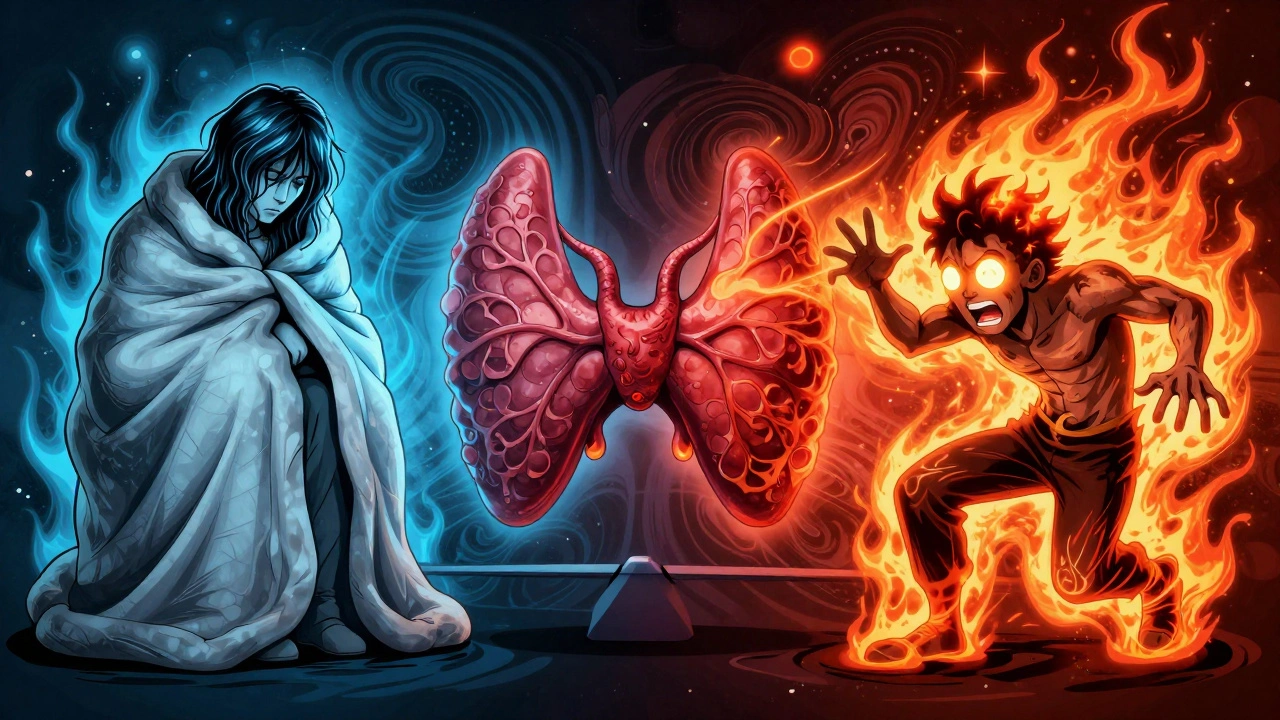
When your thyroid goes off track, your whole body feels it. You might feel exhausted one day and wired the next. You could gain weight even when eating less, or lose it without trying. Your skin gets dry, your heart races, or you’re always cold. These aren’t just random quirks-they’re signs your thyroid is out of balance. And the two most common ways it goes wrong are hypothyroidism and hyperthyroidism. They sound similar, but they’re opposites-and knowing the difference can save you months of confusion and unnecessary tests.
What’s Actually Happening in Your Body?
Your thyroid is a small butterfly-shaped gland at the base of your neck. It makes two main hormones: T4 and T3. These hormones tell your cells how fast to work-whether to burn energy quickly or slow down. Think of it like a thermostat for your metabolism. In hypothyroidism, your thyroid doesn’t make enough hormones. Your body slows down. In hyperthyroidism, it makes too much. Your body hits the gas pedal. Both conditions are real, common, and treatable-but they need completely different approaches.Symptoms: Slow Down vs. Speed Up
The symptoms of these two conditions are like night and day. With hypothyroidism, you might feel like you’re running on low battery:- Constant fatigue, even after a full night’s sleep
- Weight gain of 10 to 30 pounds without changing your diet
- Feeling cold when others are comfortable
- Dry skin, brittle hair, or hair loss
- Constipation
- Depression or brain fog-people often say they can’t remember simple words
- Heavier or irregular periods
Studies show 87% of people with hypothyroidism report cold intolerance. Nearly 78% have dry skin. And in one survey of 1,200 patients on Reddit’s thyroid forum, 78% said brain fog was their worst symptom-even when their blood tests looked normal.
Now flip it for hyperthyroidism. You feel like your body won’t shut off:
- Rapid heartbeat-often over 100 beats per minute, even at rest
- Unexplained weight loss despite eating more
- Feeling hot, sweating more than usual
- Nervousness, anxiety, or panic attacks
- Trembling hands
- Frequent bowel movements or diarrhea
- Lighter or missed periods
Ninety-two percent of hyperthyroid patients have a fast heart rate. Eighty-nine percent feel overheated. One patient described her heart hitting 140 bpm while sitting down-she thought she was having a heart attack. It was her thyroid.
What Causes Each Condition?
Hypothyroidism is most often caused by Hashimoto’s thyroiditis-an autoimmune disease where your immune system attacks your thyroid. It accounts for about 90% of cases. Other causes include thyroid surgery, radiation treatment, or certain medications. Hyperthyroidism is usually triggered by Graves’ disease, another autoimmune condition. In this case, your immune system sends signals that make your thyroid overproduce hormones. Graves’ disease causes about 70-80% of hyperthyroid cases. It can also lead to bulging eyes-a telltale sign. Other causes include toxic nodules or an enlarged thyroid with multiple overactive spots.How Doctors Diagnose It
You can’t guess this one by symptoms alone. Many people with hypothyroidism are told they’re just “stressed” or “getting older.” Hyperthyroidism is often mistaken for anxiety or a heart problem. The only reliable way is a blood test. Doctors start with TSH-thyroid-stimulating hormone. This is made by your pituitary gland and tells your thyroid to work harder.- In hypothyroidism, TSH is high (above 4.5 mIU/L) because your brain is screaming at your thyroid to produce more.
- In hyperthyroidism, TSH is low (below 0.4 mIU/L) because your brain sees too much hormone and shuts the signal off.
Then they check free T4 and sometimes free T3. If TSH is abnormal, these confirm whether your thyroid is under- or over-producing.
The American Thyroid Association says TSH testing is 98% accurate as a first screen. If your TSH is normal, you likely don’t have either condition. But if you have symptoms and normal TSH? Keep pushing. Some people still feel awful even with “normal” labs.
Treatment: One Pill vs. Multiple Paths
Hypothyroidism Treatment
This one’s straightforward. Almost everyone takes levothyroxine, a synthetic version of T4. The typical starting dose is 1.6 mcg per kilogram of body weight. For a 70kg person, that’s about 112 mcg daily.You take it on an empty stomach-30 to 60 minutes before breakfast. Coffee, calcium, iron, or soy can block absorption. About 15% of people, especially those with celiac disease, struggle with this. If you’re still tired after months on levothyroxine, ask about combination T3/T4 therapy. Some people have genetic differences that make it hard to convert T4 to active T3.
It takes 6 to 8 weeks to feel the full effect. Your doctor will retest your TSH every 6 to 8 weeks until it’s stable. Once it is, you’ll need blood tests once a year.
Over 95% of people feel normal again with the right dose. But missing doses? That’s the #1 reason treatment fails.
Hyperthyroidism Treatment
This is trickier. There are three main options:- Antithyroid drugs like methimazole or propylthiouracil. These block hormone production. Methimazole is usually first-line. You take it daily, often for 12 to 18 months. About 30-50% of people go into remission after stopping. But there’s a risk: liver damage (1 in 2,000) or a drop in white blood cells (1 in 500). Monthly blood tests are needed.
- Radioactive iodine (RAI). You swallow a pill. The radiation destroys overactive thyroid cells. It’s simple, effective, and permanent. But 80% of people end up with hypothyroidism afterward. That means lifelong levothyroxine. It’s safe for most adults, but not during pregnancy.
- Surgery to remove part or all of the thyroid. Used if the gland is huge, if cancer is suspected, or if other treatments fail. Recovery takes a few weeks. You’ll need thyroid hormone replacement afterward.
Doctors now recommend earlier RAI for Graves’ disease-even in younger patients. The 2023 ATA guidelines say the benefits outweigh the risks. Many patients prefer this because it’s one-time and definitive.
Who’s Most at Risk?
Women are 5 to 8 times more likely to develop thyroid problems than men. One in eight women will develop a thyroid disorder in her lifetime.- Hypothyroidism risk rises with age. About 10% of women over 50 have it.
- Hyperthyroidism hits in two waves: ages 20-40 (Graves’ disease) and over 60 (toxic nodules).
- Family history matters. If a close relative has Hashimoto’s or Graves’, your risk goes up.
- Autoimmune conditions like type 1 diabetes or lupus increase your chances.
And here’s something many don’t know: elderly patients with hyperthyroidism often don’t act like typical cases. They might have no anxiety, no fast heartbeat, no weight loss. Instead, they feel depressed, tired, or confused. Doctors call it “apathetic thyrotoxicosis.” It’s misdiagnosed as dementia 40% of the time.
What About Pregnancy?
Thyroid health is critical during pregnancy. Untreated hypothyroidism raises the risk of miscarriage, preterm birth, and developmental delays in babies. Hyperthyroidism can cause preeclampsia, heart failure, or low birth weight.Levothyroxine is safe during pregnancy and often needs higher doses as the pregnancy progresses. Your doctor will monitor TSH every 4 weeks.
For hyperthyroidism, methimazole is preferred in the second and third trimesters. Propylthiouracil is used in the first trimester because it carries a small risk of severe liver injury later on. The FDA warns about this risk: 1 in 5,000 cases.
Real Challenges Patients Face
Even with treatment, things aren’t always smooth.- Many hypothyroid patients say their labs are “normal,” but they still feel awful. Why? Because TSH doesn’t tell the whole story. Some people need T3 added, or their dose needs fine-tuning.
- Medication timing matters. Taking levothyroxine with coffee, calcium, or iron ruins absorption. One study found 45% of patients skip the empty stomach rule because it’s inconvenient.
- After radioactive iodine, many patients are shocked to become hypothyroid. They thought treatment would “fix” them-but it replaced one problem with another.
- Hyperthyroidism can trigger thyroid storm-a rare but deadly surge of hormones. It’s an emergency. Symptoms: fever, confusion, fast heart rate, vomiting. Mortality is 10-20% if not treated fast.
What’s New in 2025?
The field is moving toward personalization.- Genetic testing for deiodinase enzyme variants is becoming more common. These enzymes convert T4 to T3. If you have a variant, you might need T3 added to your treatment.
- A new drug called resmetirom showed 65% symptom improvement in phase II trials for thyroid hormone resistance. It’s not for regular hypothyroidism yet, but it could help a small group who don’t respond to standard therapy.
- AI tools are helping doctors spot patterns in symptoms and labs faster. One system improved diagnosis accuracy by 22% in clinical trials.
Levothyroxine isn’t going anywhere. It’s still the gold standard. But the future is about matching treatment to your biology-not just your TSH number.
Bottom Line
Hypothyroidism and hyperthyroidism are two sides of the same coin. One slows you down. The other speeds you up. Both can be hidden behind vague symptoms. But they’re not normal. And they’re not your fault.If you’ve been feeling off for months-tired, heavy, anxious, or just not yourself-ask for a TSH test. It’s cheap, simple, and life-changing. Don’t wait for a crisis. Don’t let a doctor brush you off. You deserve to feel like yourself again.
And if you’re already diagnosed? Stick with your treatment. Take your pills. Get your blood tests. Your thyroid isn’t broken-it’s just out of balance. And with the right care, it can be fixed.
Can you have hypothyroidism with normal TSH levels?
Yes. Some people have normal TSH but still experience symptoms like fatigue, brain fog, or weight gain. This can happen if your body has trouble converting T4 to active T3, or if you have an autoimmune condition affecting tissues directly. In these cases, doctors may check free T3 and reverse T3 levels, or consider combination therapy with T3. However, treatment isn’t recommended unless TSH is above 10 mIU/L, according to Harvard Medical School guidelines, to avoid overtreating mild cases.
Is radioactive iodine treatment safe?
Yes, for most adults. Radioactive iodine (RAI) is one of the most effective treatments for hyperthyroidism, especially Graves’ disease. It destroys overactive thyroid cells and usually leads to permanent hypothyroidism, which is then easily managed with daily levothyroxine. The radiation stays in your body for a few days and is mostly cleared through urine. Precautions include avoiding close contact with children or pregnant women for a short time after treatment. The risk of cancer from RAI is extremely low and not proven in large studies.
Why do I still feel tired on levothyroxine?
Many patients feel this way. The most common reason is that the dose isn’t quite right-or it’s being taken incorrectly. Levothyroxine must be taken on an empty stomach, 30-60 minutes before food or coffee. Calcium, iron, and soy can block absorption. Some people have genetic differences that make it hard to convert T4 to T3. In those cases, adding a small amount of T3 (liothyronine) can help. Also, other issues like low iron, vitamin D deficiency, or sleep apnea can mimic thyroid symptoms.
Can hyperthyroidism go away on its own?
Very rarely. In a small number of cases, especially with subacute thyroiditis, symptoms may improve without treatment after a few months. But Graves’ disease and toxic nodules don’t resolve on their own. Left untreated, hyperthyroidism can lead to heart problems, bone loss, or thyroid storm-a life-threatening emergency. Treatment is almost always necessary.
Does thyroid medication cause weight gain?
Levothyroxine itself doesn’t cause weight gain. In fact, it often helps you lose weight if you were previously hypothyroid. But if you’re on too high a dose, you might lose muscle or experience anxiety and rapid metabolism, which can lead to rebound weight gain later. On the other hand, if your dose is too low, you’ll remain hypothyroid and continue gaining weight. Weight changes are usually a sign your dose needs adjustment-not a side effect of the drug.
How often should I get my thyroid checked?
Once your dose is stable and you feel well, annual TSH testing is enough. If you’re newly diagnosed, pregnant, or changing medications, you’ll need tests every 6 to 8 weeks until stable. After radioactive iodine, check TSH every 3 months for the first year, then annually. Always get tested if you notice new symptoms like fatigue, weight changes, or heart palpitations.
Kylee Gregory
December 6, 2025 AT 05:00It's wild how two conditions can be so opposite yet get lumped together. I used to think thyroid stuff was just about weight, but this broke it down like a roadmap. The part about TSH not being the whole story? That's been my life. I felt like garbage for years, labs were 'normal,' and no one listened. Finally found a doctor who checked free T3 and reverse T3. Life changed.
Also, the bit about levothyroxine absorption? So many people don't know coffee kills it. I used to take mine with breakfast. No wonder I was still tired.
Chris Brown
December 7, 2025 AT 21:56While the article presents a clinically conventional narrative, one must question the institutional reliance on TSH as the sole diagnostic metric. The pharmaceutical-industrial complex has long benefited from the perpetuation of synthetic hormone replacement as a first-line solution, ignoring the root causes of autoimmune dysregulation. Levothyroxine is not a cure-it is a chemical bandage. The real issue lies in environmental toxins, gut permeability, and the systemic suppression of immune homeostasis. Yet these are never addressed in mainstream guidelines.
Jennifer Patrician
December 8, 2025 AT 12:00They don't want you to know this but the thyroid is a surveillance tool. The CDC and big pharma push RAI and levothyroxine because it's profitable. Radioactive iodine? That's not treatment-it's a slow poison designed to keep you dependent. They don't tell you that fluoride in water and non-stick pans destroy your thyroid. And the 'normal' TSH range? It was widened in 2002 to make millions look healthy. Look up the 2003 AMA meeting minutes. They admitted it.
Also, why is everyone taking synthetic hormones when nature gave us desiccated thyroid? Because it's not patentable.
Mellissa Landrum
December 9, 2025 AT 04:58omg i thought i was just lazy but turns out i had hypothyroidism for 5 years and no doc ever tested me right. i was on levo for 2 years and still so tired. then i found out my t3 was trash and my doc added liothyronine and i felt like a new person. also dont drink coffee right after your pill. i did that for years. duh.
also rai is a scam. i saw a girl turn into a zombie after it. now she's on meds forever. why not fix the cause??
Mark Curry
December 10, 2025 AT 09:45Yeah, this is solid. I had both sides-started with hyper, then RAI, now hypothyroid. It’s not the end of the world, but it’s a lifestyle shift. The thing no one says? It’s not just about the pill. Sleep, stress, iron levels… they all matter. Took me 3 years to figure that out. I’m okay now. Just take it slow. 🤝
aditya dixit
December 11, 2025 AT 12:24This is one of the clearest explanations I’ve read on thyroid disorders. The distinction between hypothyroidism and hyperthyroidism is often muddled, even by medical professionals. I’ve treated several patients in India with apathetic thyrotoxicosis-elderly, presenting with depression and fatigue, misdiagnosed as dementia. A simple TSH test changed everything.
Also, the point about medication timing is critical. Many patients take it with tea, milk, or breakfast. Absorption drops by up to 50%. A simple change, massive impact.
Mark Ziegenbein
December 12, 2025 AT 19:18It is frankly astonishing that the medical establishment continues to treat a complex endocrine disorder with such reductive, mechanistic, and economically incentivized protocols. The notion that a single synthetic hormone-levothyroxine-can restore homeostasis in a system as intricately regulated as the hypothalamic-pituitary-thyroid axis is not merely simplistic, it is intellectually bankrupt. The reliance on TSH as a surrogate marker ignores the nuanced reality of tissue-level thyroid hormone activity, deiodinase polymorphisms, and the profound influence of cortisol, leptin, and estrogen on peripheral conversion. We are treating a symphony with a single tuning fork.
And yet, we continue to prescribe, retest, and pat ourselves on the back for 'normalizing' labs while patients remain exhausted, cold, and emotionally fractured. This is not medicine. This is algorithmic compliance dressed in white coats.
Ada Maklagina
December 13, 2025 AT 10:06My mom had Graves’ and got RAI. Now she’s on levo. She says she feels better than she has in 20 years. So… it works. Not magic, but it fixes the problem. Stop overcomplicating it.
Harry Nguyen
December 14, 2025 AT 02:54Of course the FDA and AMA say RAI is safe. They get paid by the drug companies that make levothyroxine. Who benefits when you’re on lifelong meds? Not you. Not your health. The system wins. And they call it 'treatment.'
Meanwhile, in Europe, they use antithyroid drugs longer. Why? Because they’re not trying to turn you into a permanent hypothyroid product.
Wake up.
Stephanie Bodde
December 15, 2025 AT 02:11Just wanted to say thank you for writing this. I was diagnosed with Hashimoto’s last year and felt so alone. This helped me understand what’s going on-and I finally told my doctor I wanted my T3 checked. She agreed. I’m on T3 now and I’m crying typing this because I finally feel like me again. 💛