

Pharmacovigilance Efficiency Calculator
Input Parameters
Analysis Results
Imagine a patient takes a new medication and experiences a rare side effect. In the past, this information might sit in a doctor’s notes or a social media post, unnoticed by regulators for months or even years. Today, Artificial Intelligence is transforming how we monitor drug safety by analyzing millions of data points in real-time to detect problems before they become widespread crises. This isn't science fiction; it's the current reality of pharmacovigilance.
The way we keep medicines safe has changed dramatically. We are moving away from waiting for people to report issues after they happen, toward predicting and preventing those issues before they affect large groups. This shift is driven by advanced tools that can read medical records, scan insurance claims, and even look at online forums to find hidden patterns. If you work in healthcare, pharma, or just care about your own health, understanding these changes helps you see why modern medicine is safer than ever-and where the challenges still lie.
From Reactive Reporting to Proactive Prevention
Traditionally, drug safety relied on manual reporting. Patients or doctors would fill out forms when something went wrong. These reports were then reviewed by humans who looked for trends. It was slow, limited, and often missed subtle signals. According to recent industry analysis, only about 5% to 10% of available safety data was actually reviewed manually because there was simply too much information for human teams to process efficiently.
Pharmacovigilance is the science and activities relating to the detection, assessment, understanding, and prevention of adverse effects or any other drug-related problems. With AI, this definition expands. Systems now analyze 100% of incoming data streams continuously. Instead of waiting weeks to spot a trend, algorithms can flag potential risks in hours. For example, if a specific combination of medications starts causing unusual liver enzyme spikes across different hospitals, an AI system can connect those dots instantly, regardless of whether the patients are in New York, London, or Tokyo.
This proactive approach means safety monitoring is no longer just about compliance-it’s about patient protection. By catching signals early, pharmaceutical companies and regulators can issue warnings, update labels, or even withdraw drugs faster than ever before. The goal is simple: prevent harm rather than just documenting it.
How AI Actually Finds Hidden Risks
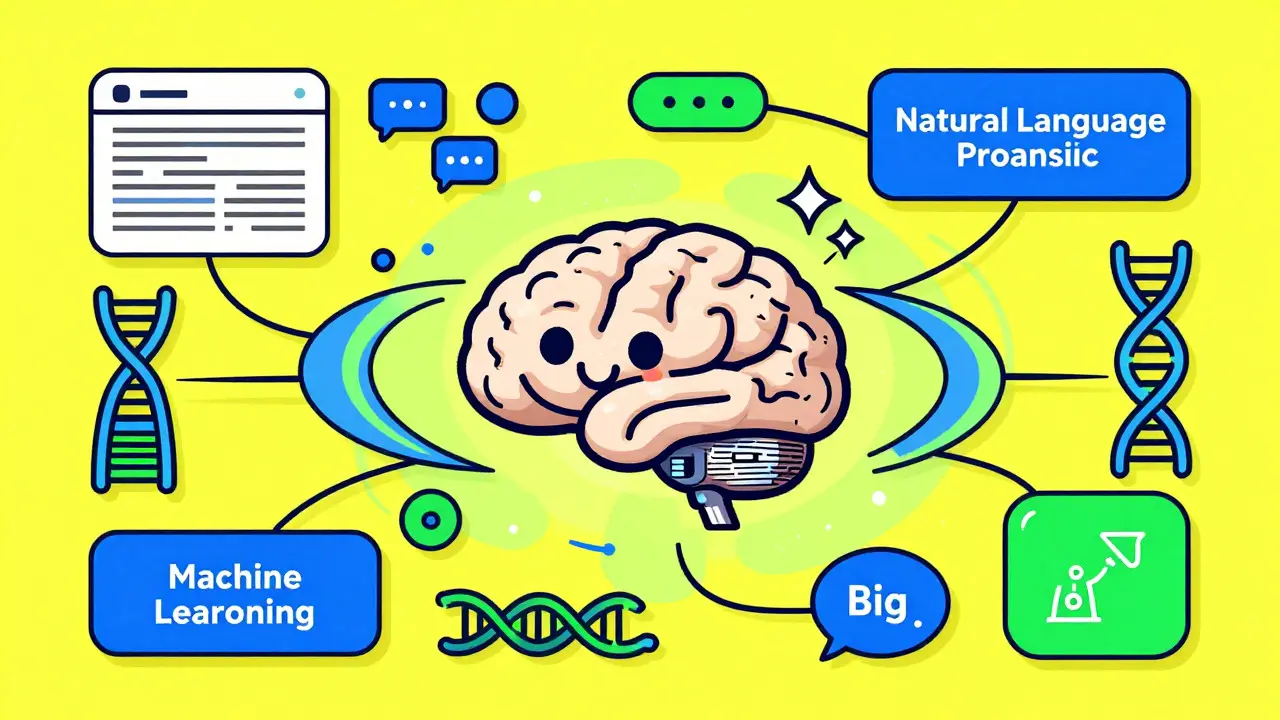
So, how does the technology work? It’s not magic; it’s a combination of sophisticated techniques working together. The core engine relies on three main pillars: Natural Language Processing (NLP), Machine Learning (ML), and Big Data Integration.
First, let’s talk about Natural Language Processing, which is a branch of artificial intelligence that helps computers understand, interpret, and manipulate human language. Most medical data isn’t in neat spreadsheets. It’s in free-text doctor’s notes, discharge summaries, and patient diaries. NLP algorithms scan this unstructured text to extract key information. Recent studies show these tools can achieve nearly 90% accuracy in identifying adverse events from complex medical narratives. They recognize phrases like "patient reported severe dizziness" or "liver function tests abnormal" and tag them for further review.
Next comes Machine Learning, which is a type of artificial intelligence that enables systems to learn and improve from experience without being explicitly programmed. Once the data is extracted, ML models look for patterns. Supervised learning models are trained on historical data where outcomes are known. They learn what a "safe" profile looks like versus a "risky" one. More advanced systems use reinforcement learning, where the algorithm improves its detection skills based on continuous feedback from safety experts. If a human reviewer confirms a signal, the model adjusts its weights to catch similar cases more accurately next time.
Finally, all this power needs fuel: data. AI systems integrate information from Electronic Health Records (EHRs), insurance claims, genomic databases, and even social media platforms. This creates a multi-dimensional view of patient health. For instance, while EHRs tell us what happened in the hospital, social media might reveal how patients feel about their medication adherence at home. Combining these sources gives a fuller picture of drug safety.
Real-World Impact: Case Studies and Success Stories
Theory is great, but results matter. Let’s look at some concrete examples of AI making a difference in drug safety.
One standout example is the FDA Sentinel System, which is an active post-market surveillance tool developed by the U.S. Food and Drug Administration to assess signals of safety concerns regarding medical products. Since its full-scale implementation, the Sentinel System has conducted over 250 safety analyses. It recently evaluated safety signals for 17 new molecular entities within just six months of their market approval-a task that would have been impossible using traditional methods. This speed allows regulators to make informed decisions quickly, protecting public health without delaying access to life-saving treatments.
Another compelling case involves GlaxoSmithKline. In May 2025, they published a study showing how their AI system identified a previously unrecognized interaction between a new anticoagulant and a common antifungal medication. The alert came just three weeks after the product launched. By acting fast, they prevented an estimated 200 to 300 serious adverse events. That’s hundreds of people who didn’t end up in the emergency room because an algorithm spotted a pattern humans hadn’t seen yet.
These aren’t isolated incidents. Across the industry, 68% of the top 50 pharmaceutical companies had implemented some form of AI in their pharmacovigilance processes by early 2025. The impact is measurable: many organizations report a 40% reduction in the time spent processing individual safety cases. This frees up human experts to focus on complex judgments rather than data entry.
Challenges and Limitations You Should Know
Despite the hype, AI isn’t perfect. In fact, relying on it blindly can introduce new risks. Understanding these limitations is crucial for anyone involved in drug safety.
One major issue is bias. AI models are only as good as the data they’re trained on. If certain populations-such as low-income communities, rural residents, or marginalized groups-are underrepresented in electronic health records, the AI might miss safety signals affecting those groups. A 2025 analysis in *Frontiers* highlighted cases where social risk factors like housing instability were routinely underreported in clinical documentation. When AI ignores these gaps, it can distort safety assessments, leading to false confidence in a drug’s safety profile for vulnerable patients.
Then there’s the "black box" problem. Many advanced neural networks operate in ways that are difficult for humans to interpret. A safety officer might get an alert saying "high risk detected," but the algorithm doesn’t explain exactly why. This lack of transparency makes it hard to trust the system fully. Regulatory bodies like the European Medicines Agency (EMA) have emphasized the need for "transparency, reproducibility, and human oversight" in AI-assisted decision-making. Without clear explanations, professionals hesitate to act on AI-generated signals.
Integration is another hurdle. Connecting AI tools with legacy pharmacovigilance systems often takes 6 to 9 months of customization work. Data quality varies wildly across sources, requiring significant cleaning and standardization before analysis can begin. Some organizations spend up to 45% of their implementation time just fixing messy data. Plus, regulatory uncertainty remains. While frameworks are evolving, rules around validating AI-driven signals are still being written, creating a cautious environment for adoption.
Comparison: Traditional vs. AI-Driven Pharmacovigilance
| Feature | Traditional Methods | AI-Driven Systems |
|---|---|---|
| Data Coverage | 5-10% of available data reviewed manually | 100% of data analyzed continuously |
| Signal Detection Speed | Weeks to months | Hours to days |
| Data Sources | Spontaneous reports, clinical trials | EHRs, social media, claims, genomics, literature |
| Human Role | Primary analyzer and detector | Oversight, interpretation, and validation |
| Bias Risk | Low (human judgment) | Potentially high (if training data is skewed) |
| Implementation Time | Minimal (existing workflows) | 6-18 months (integration and training) |
What’s Next? The Future of Drug Safety Technology
The landscape is shifting rapidly. We’re seeing a move from simple correlation to causal inference. Early AI tools could say "Drug A and Side Effect B happen together." Newer models aim to answer "Does Drug A cause Side Effect B?" Techniques like counterfactual modeling help distinguish coincidence from causation, promising a 60% improvement in accuracy by 2027 according to some projections.
We’re also integrating wearable device data. Smartwatches and fitness trackers capture real-time physiological data, revealing adherence patterns and subtle health changes that patients might not report otherwise. This adds another layer of depth to safety monitoring.
Regulatory bodies are adapting too. The FDA’s Emerging Drug Safety Technology Program (EDSTP) is testing AI for real-time signal detection across millions of patient records. The CIOMS Working Group XIV released draft guidelines proposing a risk-based approach to AI validation, meaning tools used for critical safety decisions will face stricter scrutiny.
For professionals, this means a changing skill set. Data literacy is becoming essential. Organizations are investing heavily in training, with many providing 40 to 60 hours of specialized education for pharmacovigilance staff. The future isn’t about replacing humans; it’s about augmenting them. As one FDA commissioner noted, "AI won’t replace pharmacovigilance professionals, but professionals who use AI will replace those who don’t."
Is AI completely replacing human pharmacovigilance specialists?
No, AI is not replacing humans; it is augmenting them. While AI handles data extraction, pattern recognition, and initial signal detection, human experts remain essential for interpreting complex cases, assessing causality, and making final regulatory decisions. The role is shifting from manual data processing to strategic oversight and validation.
How accurate are AI systems in detecting adverse drug reactions?
Accuracy varies depending on the tool and data quality, but recent studies show Natural Language Processing (NLP) algorithms can achieve approximately 89.7% accuracy in extracting adverse events from free-text reports. Machine learning models for signal detection have shown improvements of over 20% compared to traditional statistical methods, though they require rigorous validation against historical data.
What are the biggest risks of using AI in drug safety?
The primary risks include algorithmic bias, where underrepresented populations may be overlooked due to gaps in training data, and the "black box" problem, where lack of transparency makes it difficult to trust or validate AI-generated signals. Additionally, integration challenges with legacy systems and data privacy concerns pose significant operational hurdles.
How long does it take to implement an AI pharmacovigilance system?
Implementation typically takes between 12 to 18 months. This timeline includes data source integration, model selection, extensive data cleansing (which can consume up to 45% of the project time), and validation against historical safety data. Full system integration with existing databases often requires 6 to 9 months of customization.
Which regulatory bodies are leading the way in AI drug safety standards?
The U.S. Food and Drug Administration (FDA) and the European Medicines Agency (EMA) are currently leading the development of AI-specific frameworks. The FDA established its Emerging Drug Safety Technology Program (EDSTP) in 2023, while the EMA issued guidance in March 2025 emphasizing transparency and human oversight. Both agencies are actively piloting AI tools for real-world evidence generation.