
Ever wonder why some pills cost hundreds of dollars a month while others for the same condition cost just a few dollars? It’s not because one is better. It’s because brand-name drugs with no generic alternatives are still locked in by legal and technical barriers that keep competition out. This isn’t rare. Around 25% of top-selling brand-name drugs still have no generic version, even after their patents expire. And for patients, that means paying 3 to 6 times more - sometimes over $10,000 a year - for the exact same medicine.
Patents Aren’t the Whole Story
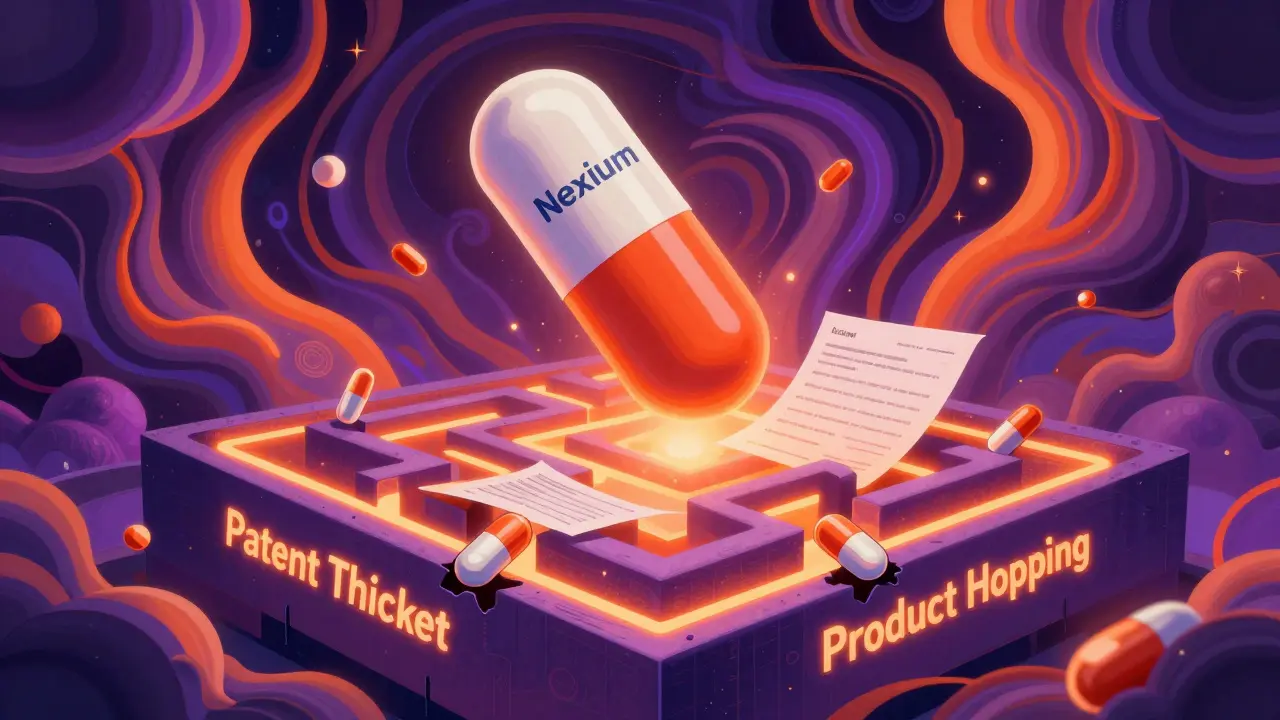
Most people think generic drugs appear as soon as a patent runs out. That’s not true. The original patent for a drug usually lasts 20 years from the date it’s filed. But by the time the drug gets approved by the FDA, several years have already passed. That leaves maybe 7 to 12 years of real market exclusivity before generics can enter. That’s why companies don’t just rely on one patent. They stack them. Take Nexium (a proton pump inhibitor used for acid reflux). Its main patent expired in 2001. But AstraZeneca kept filing new patents - for different dosages, delivery methods, even the shape of the pill. Each new patent reset the clock. By the time generics finally arrived in 2014, the company had squeezed out 13 extra years of monopoly pricing. This trick is called “product hopping,” and it’s used across the industry.Complex Drugs Can’t Be Copied Easily
Not all drugs are made the same. Simple pills - like atorvastatin (the generic version of Lipitor) - are easy to replicate. They’re made of one chemical compound, mixed with a few inert ingredients. A generic manufacturer can buy the active ingredient, press it into a tablet, and test it for bioequivalence. Done in months. But some drugs are far more complicated. Take Premarin (a hormone therapy made from pregnant mares’ urine). It contains over a dozen estrogen compounds - many of which aren’t even fully identified. You can’t just copy the recipe. You’d need to replicate the biological process of a mare’s body, which isn’t possible. That’s why, decades after its patent expired, there’s still no true generic version. Even harder are biologics (complex drugs made from living cells, like Humira or Enbrel). These aren’t chemicals - they’re proteins grown in labs. You can’t make an exact copy. You can only make a “biosimilar” - a close match. And to get FDA approval, you need to run full clinical trials, not just lab tests. That’s why the first biosimilar for Humira (a rheumatoid arthritis drug) didn’t hit the U.S. market until 2023 - seven years after its patent expired.Delivery Systems Are Locked Down
A drug isn’t just its active ingredient. How it’s delivered matters too. Take Advair Diskus (an asthma inhaler). The active ingredients - fluticasone and salmeterol - are known. But the device? It’s a precision-engineered inhaler that delivers the exact dose every time. Generic manufacturers can’t just copy the powder. They have to replicate the entire delivery system - the valve, the casing, the airflow mechanics. The FDA requires them to prove it works the same. That takes years of testing. And many companies protect these devices with separate patents, making it harder for generics to even start. Same goes for Prozac Weekly (an extended-release antidepressant). The capsule releases the drug slowly over a week. Change the coating by a fraction of a millimeter, and the release profile changes. That can mean the difference between effective treatment and dangerous side effects. So the FDA demands extra studies. Few generic companies are willing to spend the time and money.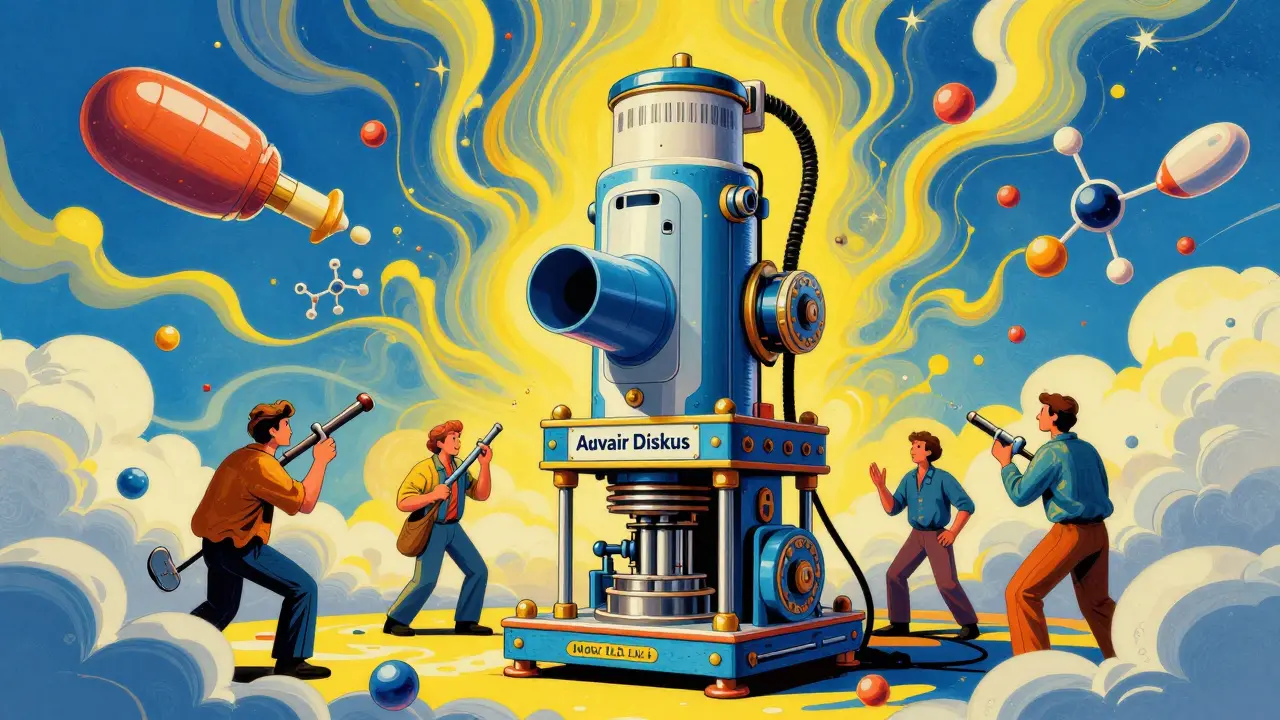
Patent Thickets and Pay-for-Delay Deals
Pharmaceutical companies don’t just file patents. They file dozens - covering everything from the molecule to the manufacturing process to the color of the pill. This is called a “patent thicket.” It’s like building a maze around the drug. Generic companies have to navigate every single patent before they can even apply for approval. And sometimes, the brand-name company doesn’t wait. They pay the generic maker to stay away. This is called a “pay-for-delay” deal. Between 1999 and 2012, over 297 of these agreements were made. The FTC estimates they cost consumers $3.5 billion a year. In one case, a brand-name drug maker paid a generic company $20 million to delay launching a cheaper version for 18 months. That’s legal - for now.Why It Matters for Patients
The cost difference isn’t theoretical. Take Gleevec (a leukemia drug). Before its patent expired in 2016, patients paid $14,500 a month. After generics arrived? $850. That’s a 94% drop. One patient on Reddit said she went from skipping meals to afford her medicine to buying groceries again. But not all drugs have that luxury. EpiPen (an epinephrine auto-injector) has been priced at over $600 for years, even though its patent expired in 2015. Mylan kept changing the design - new color, new needle, new packaging - and got new patents each time. The FDA still approved it as the same product. So generics couldn’t enter. And for patients with chronic conditions - epilepsy, thyroid disease, bipolar disorder - switching to a generic isn’t always safe. Even tiny differences in how a drug is absorbed can cause seizures or mood crashes. That’s why some doctors and patients stick with the brand, even if it costs more.
What’s Changing?
There’s hope. The CREATES Act (passed in 2019) now forces brand-name companies to sell samples to generic makers. Before, they’d refuse - claiming safety - to delay testing. That’s illegal now. The FDA is also speeding up reviews for complex generics. In 2022, approvals for these drugs jumped 27% compared to 2021. And by 2025, we’ll see over 75 biosimilars on the market - up from 32 in 2022. But some drugs will never have generics. Insulin formulations, orphan drugs for rare diseases, ultra-complex biologics - these are too hard, too expensive, too risky to copy. Experts estimate that by 2030, about 5% of all medications will still have no true generic alternative.What You Can Do
If you’re paying a lot for a brand-name drug, ask your pharmacist. They have access to the FDA’s Orange Book (a public database of drug patents and exclusivity periods). It shows whether a patent has really expired or if it’s just a legal trick. Talk to your doctor. Sometimes, a different drug - even if it’s not the same - can work just as well. A 2021 study found that 68% of patients on the non-generic antidepressant Viibryd were successfully switched to sertraline, a cheap generic, with no loss in effectiveness. And if you’re on Medicare or private insurance, check your plan’s formulary. Some insurers cover brand-name drugs only if you’ve tried the generic first - or if there isn’t one. The system isn’t broken. It’s designed this way. But awareness - and pressure - are changing it. Slowly.Why don’t all brand-name drugs have generics after the patent expires?
Many factors delay or block generic entry: patent thickets (multiple overlapping patents), complex drug formulations (like biologics or multi-component hormones), proprietary delivery systems (inhalers, patches), and legal tactics like pay-for-delay deals. Even after a patent expires, generic manufacturers must prove bioequivalence - which can take years for complex drugs. Some drugs, like Premarin, can’t be copied at all because their ingredients aren’t fully understood.
Are generic drugs as effective as brand-name drugs?
For most drugs, yes. The FDA requires generics to have the same active ingredient, strength, dosage form, and route of administration as the brand. They must also be within 80%-125% bioequivalent - meaning they work the same way in the body. But for drugs with narrow therapeutic windows - like epilepsy or thyroid medications - even small differences can matter. Some patients report different effects with generics, though studies show this is rare and often due to placebo effect or psychological factors.
How long does it take for a generic to appear after a patent expires?
It varies. For simple pills, generics can appear within months. For complex drugs - biologics, inhalers, extended-release formulations - it can take 5 to 10 years. Legal battles, manufacturing challenges, and patent extensions often delay entry. The first biosimilar for Humira, for example, didn’t reach the market until 7 years after its patent expired.
What’s the difference between a generic and a biosimilar?
Generics are exact copies of small-molecule drugs made from chemicals. Biosimilars are highly similar - but not identical - versions of biologic drugs made from living cells. Because biologics are complex, biosimilars can’t be exact copies. They require more testing and clinical trials to get approved. The FDA has a separate approval pathway for biosimilars, and they’re not automatically interchangeable with the original.
Can I ask my doctor for a cheaper alternative if my drug has no generic?
Yes, absolutely. Many drugs have therapeutic equivalents - different medications that treat the same condition with similar effectiveness. For example, if you’re taking Viibryd (which had no generic), your doctor might switch you to sertraline, a widely available generic antidepressant. Pharmacists often help identify these alternatives. Always discuss cost concerns with your provider - there’s usually a way to reduce expenses without sacrificing care.
Jessica Klaar
February 8, 2026 AT 14:42I’ve been on a biologic for rheumatoid arthritis for six years now. When Humira’s biosimilar finally came out, my copay dropped from $450 to $85. I cried. Not because I’m emotional-because this system is absurd. People think generics are just ‘copycats,’ but when your life depends on consistent dosing, you don’t want to gamble on a 12% bioequivalence swing. I’m not anti-innovation-I’m pro-access.
And yes, I know Premarin can’t be copied. But why does it still cost $1,200/month when the raw materials are literally horse urine? That’s not science. That’s greed dressed up as biology.
Tori Thenazi
February 9, 2026 AT 04:28Okay, but… have you ever considered that maybe… the FDA isn’t really ‘blocking’ generics… maybe they’re just… being careful? Like… what if the ‘generic’ version of your asthma inhaler… actually causes lung damage? I mean… think about it. The original company spent billions testing safety. The generics? They just… copy the powder. What if the valve doesn’t open at 2.3 psi? What if the patient gets 10% less drug? And then… they die? And then… the lawsuit? And then… the FDA gets blamed? So… they delay. Not to protect profits… but to protect YOUR life. Just saying.
Also, I heard the guy who invented EpiPen used to be a CIA operative. Coincidence? I think not.
Jonah Mann
February 10, 2026 AT 07:12sooo… i read this whole thing and like… i thought generics were just cheaper versions? turns out they’re like… not even the same thing? like… if your drug has a special delivery system, the generic has to be the exact same? how is that even possible? i mean… i can’t even make a copy of my phone charger without it catching fire. how are people supposed to copy a medical device that’s been patented for 15 years? and why does the FDA care about the COLOR of the pill? that’s not even medicine. that’s branding. like… if i made a blue pill instead of a purple one, does that change how my thyroid works? no. but they still make us test it. this whole system is a joke. also, i think i spelled bioequivalence wrong. sorry.
Tricia O'Sullivan
February 11, 2026 AT 17:37Thank you for this thorough and meticulously referenced analysis. The structural barriers to generic entry are not merely economic-they are regulatory, technical, and, in many cases, ethically indefensible. I find particularly troubling the persistence of pay-for-delay agreements under the guise of ‘market stability.’ In Ireland, we have implemented price transparency mandates and mandatory sample sharing, which have significantly reduced delays. The U.S. system, by contrast, appears to prioritize shareholder value over patient welfare. I would welcome a policy dialogue on harmonizing biosimilar approval pathways across OECD nations.
Brandon Osborne
February 11, 2026 AT 22:07THIS IS WHY AMERICA IS DYING. YOU THINK YOU’RE PAYING FOR MEDICINE? NO. YOU’RE PAYING FOR LAWYERS. FOR PATENT ATTORNEYS. FOR CORPORATE EXECUTIVES WHO BUY ALEXANDER HAMILTON’S GRAVE AND SIT ON IT LIKE A THRONE. I HAVE A FRIEND WHO DIDN’T TAKE HER EPINEPHRINE BECAUSE SHE COULDN’T AFFORD IT. SHE HAD A SEIZURE. SHE LOST HER JOB. NOW SHE’S ON DISABILITY. AND THE COMPANY? THEY MADE $2 BILLION LAST QUARTER. THEY HAVE A PRIVATE JET. THEY HAVE A BIRTHDAY PARTY FOR THEIR CEO’S CAT. I’M NOT A CONSPIRACY THEORIST. I’M A SURVIVOR. AND I’M NOT SHUTTING UP UNTIL THEY BURN THE PATENT OFFICE DOWN.
Patrick Jarillon
February 13, 2026 AT 20:06Wait a minute. You’re telling me the FDA approves drugs based on ‘bioequivalence’? That’s a scam. Bioequivalence is a made-up number. There’s no such thing as ‘80%-125%’ in human biology. Your body doesn’t care about percentages-it cares about results. And if your generic thyroid med makes you jittery? That’s not placebo. That’s your body screaming. Also-why do you think they let generics into the market for Lipitor but not for insulin? Because insulin is a monopoly. And who owns the insulin patents? Big Pharma? Nah. It’s the Federal Reserve. They control the money supply. And if people can buy cheap insulin? They stop buying dollars. That’s why it’s still $300 a vial. This isn’t medicine. It’s monetary policy.
Kathryn Lenn
February 14, 2026 AT 18:54Oh wow. A 94% price drop on Gleevec? How touching. Let me guess-the generic was made in China and shipped in a box labeled ‘DO NOT EAT.’
And let’s not forget the real story: every time a generic enters, the brand-name company just rebrands. ‘Gleevec’ becomes ‘Gleevec Plus’ with a new pill shape. Then they patent the new shape. Then they raise the price. Then they sue the generic for ‘infringing the spirit of the original.’
Meanwhile, I’m over here paying $1,800 for a 30-day supply of a drug that’s been around since 1997. And you’re telling me this is innovation? Honey. This is a Ponzi scheme with a stethoscope.
John Watts
February 15, 2026 AT 16:19Hey everyone-this is a big deal, and I want you to know you’re not alone. I’ve been helping patients navigate this mess for over a decade. If you’re struggling with cost, reach out. There are patient assistance programs. There are nonprofit pharmacies. There are pharmacists who will call your insurance for you. I’ve seen people go from $12,000 a year to $180. It’s possible. It takes work. But it’s worth it.
And if you’re a doctor? Talk to your patients. Don’t assume they can afford it. Ask. Really ask. And if you’re a patient? Ask for the Orange Book. It’s public. It’s free. And it’s your right.
You’ve got this. We’ve got this. Let’s keep pushing.
Angie Datuin
February 17, 2026 AT 12:12Interesting. I never realized how much of this was about delivery systems. I just thought generics were cheaper pills. Now I get why my inhaler still costs $500 even though the drug’s been generic for years. Weird.
THANGAVEL PARASAKTHI
February 18, 2026 AT 02:53in india we have cheap generics for everything-insulin, heparin, even cancer drugs. why? because we dont care about patents. we care about lives. my aunt took a generic version of Herceptin for breast cancer. cost: $30/month. in usa: $10,000. same drug. same company. same lab. just different country. capitalism is not science. it’s a game. and the players are not us.
Frank Baumann
February 18, 2026 AT 16:33Let me tell you what really happens. You think the FDA is the gatekeeper? Nah. It’s the law firms. The big pharma companies hire 15 different law firms. Each one files a different patent. One on the coating. One on the packaging. One on the font used on the label. One on the color of the pill under UV light. Then they sue the generic company for infringing on all 17 patents simultaneously. The generic company? They can’t afford to fight. So they fold. And the brand keeps its monopoly. And the FDA? They sit there nodding like, ‘Oh, yes, we see the patents. Very thorough. Very legal.’
And meanwhile, I’m sitting here with a 17-year-old daughter on a $2,000/month drug that’s been around since 1992. Her name is Lily. She’s not a patent. She’s a person. And this system is killing her. Slowly. Quietly. Legally.
Scott Conner
February 20, 2026 AT 14:28so wait-so if i get a generic for my antidepressant and i feel weird, is it because the drug is different or because i think it’s different? like… is it all in my head? i’ve been on the same brand for 5 years. i switched to generic last year. now i feel kinda… off. not bad. just… different. like my thoughts are slower. is that real? or am i just being paranoid? also i think i spelled paranoid wrong.
Susan Kwan
February 21, 2026 AT 06:47Of course the FDA approves ‘biosimilars.’ They don’t have to prove they’re identical. Just ‘similar enough.’ So what happens when a patient has a severe reaction to a biosimilar? Who’s liable? The manufacturer? The doctor? The patient who ‘didn’t know’? This isn’t medicine. It’s a liability minefield with a side of placebo.
Random Guy
February 22, 2026 AT 18:00so like… if i make a pill that looks exactly like the brand but the lettering is 0.5mm off… is that illegal? because i think i just did that. in my garage. with a 3d printer. and i sold it to my neighbor. he’s fine. i think. i hope. i’m not a pharmacist. i’m just a guy who doesn’t like paying $800 for a bottle of pills that cost 2 cents to make.
Tasha Lake
February 23, 2026 AT 17:37From a pharmacoeconomic standpoint, the primary impediment to generic penetration in complex therapeutics is not regulatory delay per se-it’s the high marginal cost of bioequivalence validation, particularly for multi-component, non-linear pharmacokinetic agents. The FDA’s ANDA pathway, while robust for small molecules, lacks scalability for biologics due to structural heterogeneity and batch-to-batch variability. Consequently, the cost of market entry exceeds projected ROI for most generics manufacturers, resulting in a de facto oligopoly. This is not a failure of innovation-it’s a failure of economic incentive structure. Policy intervention must realign risk-reward calculus through accelerated pathway incentives and risk-sharing models.
Jessica Klaar
February 24, 2026 AT 10:07That’s what I’m talking about. I’ve seen patients switch from brand to generic and have seizures. Not because the generic was bad-but because their body had adapted to a specific absorption rate over years. You can’t just swap them like batteries. That’s why some doctors are hesitant. Not because they’re in the pocket of Big Pharma. Because they’ve seen what happens when you change the game on a fragile system.
But that doesn’t mean we shouldn’t fix it. We need better transition protocols. We need mandatory monitoring. We need education. Not just ‘take the cheaper one.’