
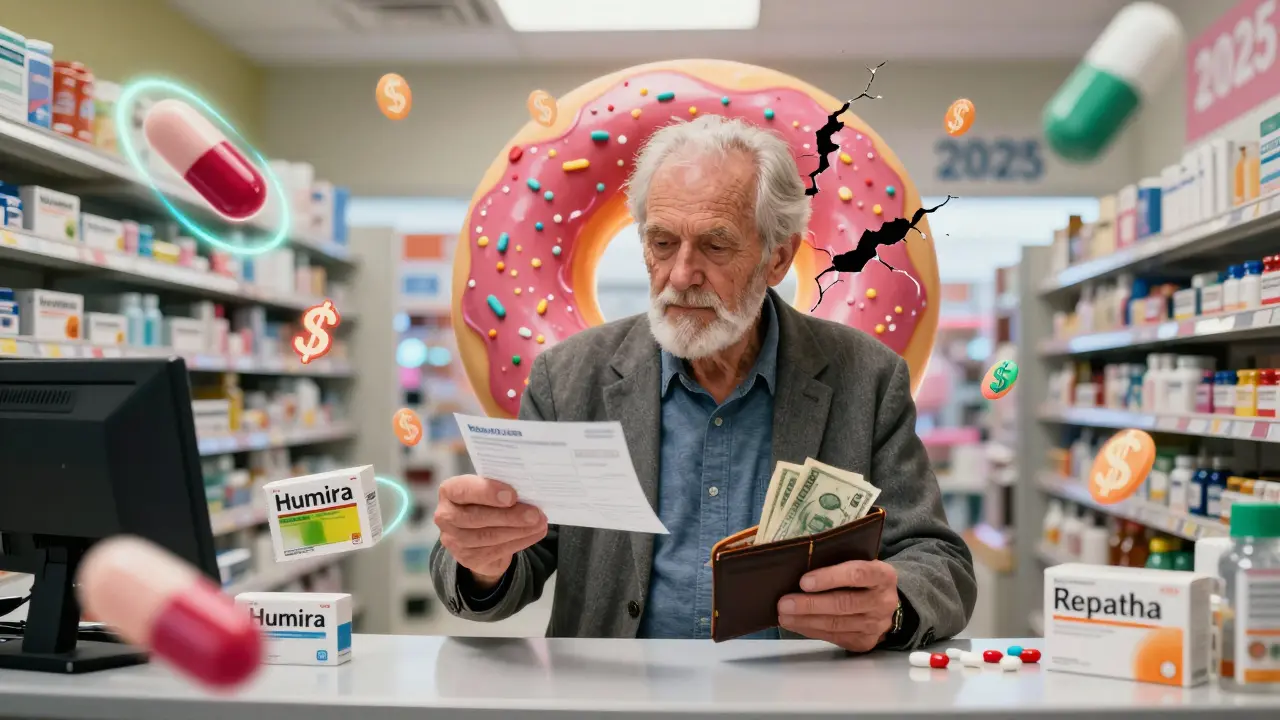
By the end of 2024, the Medicare Part D coverage gap - commonly called the donut hole - will disappear forever. But until January 1, 2025, millions of seniors are still stuck in it. If you’re taking expensive medications right now, you could be paying 25% of your drug costs out of pocket, with no help from your plan beyond that. And if you’re on brand-name drugs like Humira or Repatha, that can mean hundreds or even over a thousand dollars a month. This isn’t theoretical. People are skipping doses, splitting pills, and choosing between medicine and groceries. You don’t have to be one of them.
What the Donut Hole Actually Means in 2024
The donut hole isn’t a mystery. It’s a phase in your Medicare Part D plan where you pay more for prescriptions after you and your plan have spent a certain amount on covered drugs. In 2024, that trigger is $5,030 in total drug costs - including what you paid, what your plan paid, and what manufacturers paid in discounts. Once you hit that number, you enter the coverage gap.Here’s the catch: even though you’re in the donut hole, you’re not paying 100%. You pay 25% of the cost for both brand-name and generic drugs. But that 25% doesn’t mean your plan is covering the rest. For brand-name drugs, the drugmaker gives you a 70% discount, and your plan pays 5%. For generics, your plan pays 75%. That means if you’re on a $1,000 brand-name drug, you pay $250, the manufacturer gives you $700 off, and your plan pays $50. None of that $700 discount counts toward your out-of-pocket spending - only your $250 does.
That’s why people on expensive brand-name drugs reach catastrophic coverage faster. You only need to spend about $3,300 out of pocket to get there. If you’re on generics, you might spend $6,000 before hitting the next phase. And once you hit $8,000 in total out-of-pocket spending (including manufacturer discounts), you move into catastrophic coverage - where you pay just 5% of your drug costs for the rest of the year.
How the Donut Hole Is Disappearing in 2025
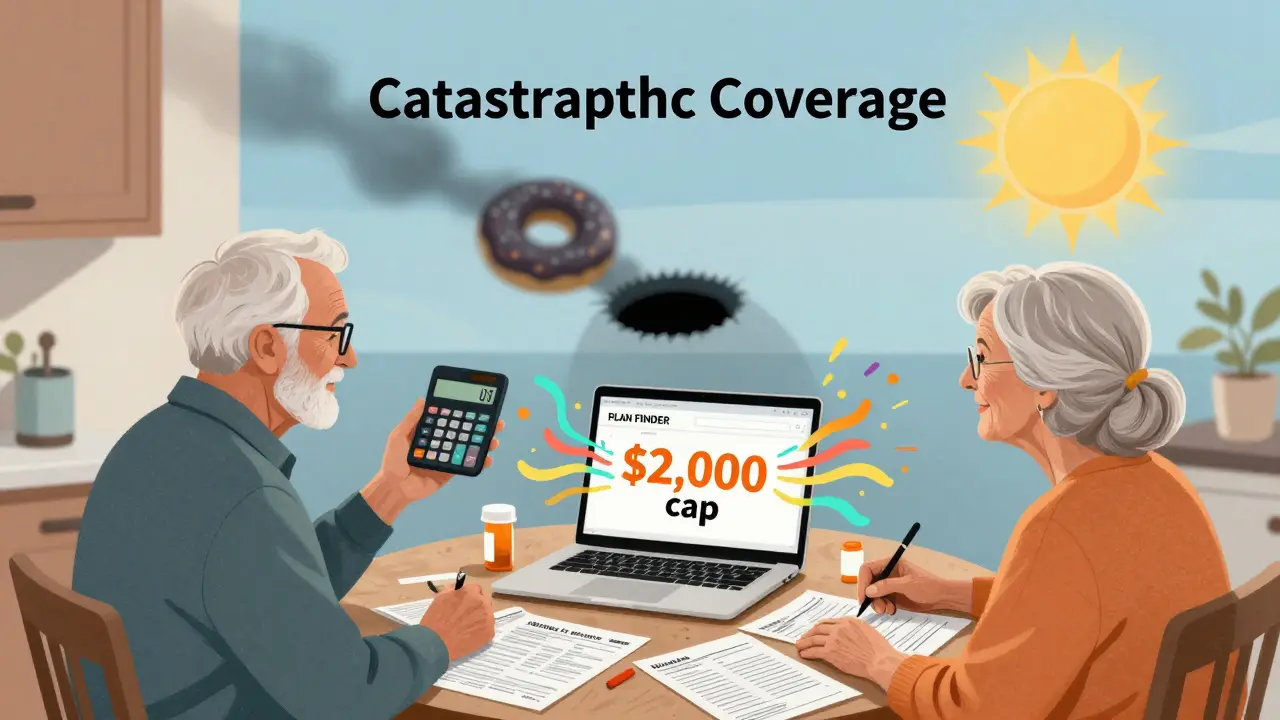
Starting January 1, 2025, the donut hole is gone. The Inflation Reduction Act created a hard cap: you’ll pay no more than $2,000 out of pocket for all your Part D drugs in a year. After that, your medications are free. No more guessing. No more surprises. No more choosing between insulin and rent.But here’s what’s changing behind the scenes: the manufacturer discounts you get now won’t count toward your $2,000 cap. Instead, drugmakers will pay a smaller discount - 10% during initial coverage and 20% during catastrophic coverage. That means your plan will cover more of the cost earlier, and you’ll hit the $2,000 limit faster. For most people, this is a win. But if you’re on high-cost brand-name drugs and rely on those 70% discounts to get out of the donut hole, you might see your premiums rise slightly in 2025. The average monthly premium is projected to drop to $34.70, but your individual cost depends on your plan and drugs.
Five Proven Ways to Lower Your Costs Before 2025
Even with the donut hole ending soon, you still need to get through 2024 without financial damage. Here’s how to protect yourself right now.
- Check your drug tier - Your plan puts every drug into a tier. Tier 1 is cheapest (usually generics), Tier 3 or 4 is expensive (often brand-name). If your drug is in a higher tier, ask your doctor if a lower-tier alternative works. A 2023 GoodRx analysis showed switching from brand to generic can save $1,200-$2,500 a year. For example, switching from Lipitor to atorvastatin saves $1,800 annually.
- Use manufacturer patient assistance programs - Many drugmakers offer free or deeply discounted medications for people who qualify. Amgen’s program for Repatha cuts the cost from $560 to $5 a month. AbbVie helps with Humira. You don’t need to be poor - many programs accept incomes up to $100,000 for a family. Visit NeedyMeds.org or the drugmaker’s website. A 2023 study found these programs reduce out-of-pocket costs by 63-92%.
- Get 90-day supplies - Many Part D plans offer lower copays for 90-day prescriptions through mail-order pharmacies. You might save 15-25% compared to 30-day fills. If you take a daily pill, this isn’t just convenient - it’s cheaper. And if you’re near the donut hole, spreading out your refills can delay hitting the gap until later in the year.
- Apply for Extra Help - If your income is below $21,590 (individual) or $29,160 (couple) in 2024, you may qualify for the Low-Income Subsidy. This program pays your Part D premiums, eliminates your deductible, and removes the donut hole entirely. In 2023, 12.6 million people got it. Apply at SSA.gov or call 1-800-772-1213. Even if you think you don’t qualify, check - many people miss out because they assume they earn too much.
- Compare plans with Medicare Plan Finder - Your plan might not be the cheapest for your drugs. The Medicare Plan Finder tool lets you enter your exact medications and see which plan has the lowest total cost. The National Council on Aging found that people who shop around save $1,047 a year on average. Don’t wait until Open Enrollment - check now. Plans change every year, and your current one might not be the best for 2025.
What to Do If You’re Already in the Donut Hole
If you’ve already hit the coverage gap, don’t panic. You’re not alone. Nearly 24% of Part D enrollees reached the donut hole in 2022. The key is to act fast.
First, call your pharmacy. Ask if they’re aware of any manufacturer coupons or discount cards that work with your plan. Some pharmacies automatically apply them. If not, ask for a paper coupon. Second, contact your doctor. Tell them you’re in the donut hole and ask if there’s a cheaper alternative or a 30-day sample they can give you to tide you over. Third, call your plan’s customer service. Ask if they offer any emergency assistance or cost-sharing programs. Some plans have funds set aside for people who hit the gap unexpectedly.
And don’t stop taking your meds. Skipping doses leads to hospitalizations - which cost far more than your prescriptions. If you’re forced to cut back, reach out to organizations like the Medicare Rights Center or AARP. They offer free counseling and can help you apply for aid.
Why So Many People Don’t Know About These Options
AARP’s 2023 survey found that 74% of beneficiaries who entered the donut hole didn’t know about cost-saving tools until after they were already in it. That’s because Medicare doesn’t send out warnings. Your plan won’t call you. Your doctor probably doesn’t know your exact drug costs. The system is designed to be confusing - and that’s by design.
The Medicare Interactive forum has thousands of stories from people who thought they were covered, only to get hit with a $1,200 bill for a single prescription. One woman on Reddit said she took her husband’s rheumatoid arthritis medication for two weeks, then couldn’t afford to refill it. He ended up in the ER. That’s the real cost of the donut hole - not just money, but health, dignity, and peace of mind.
That’s why education matters. Use the National Committee to Preserve Social Security and Medicare’s free online calculator. Enter your drugs, your plan, and your income. It tells you exactly when you’ll hit the donut hole and how much you’ll pay. You can’t manage what you don’t measure.

What Comes After the Donut Hole
By 2025, the donut hole will be a footnote in Medicare history. The $2,000 cap will be a lifeline for millions. But the transition won’t be perfect. Some seniors might see premium increases. Others might find their favorite drugs no longer covered at the same tier. That’s why you need to review your Annual Notice of Change - the document your plan mails in September 2024. It will tell you exactly how your plan is changing for 2025.
Don’t assume your plan stays the same. Even if your drugs are covered, the copay might go up. The pharmacy network might shrink. The mail-order option might disappear. Check your plan’s 2025 details now. If you’re on a Medicare Advantage plan, your drug coverage might be bundled differently. Call your insurer and ask: “How will the $2,000 cap affect my out-of-pocket costs for my medications?”
The end of the donut hole is a victory - but only if you’re ready for it. The system won’t change for you. You have to change for the system.
Final Checklist: Your Action Plan Before December 31, 2024
- ✅ List all your medications and their current monthly cost
- ✅ Check your plan’s formulary to see which tier each drug is in
- ✅ Visit NeedyMeds.org or each drugmaker’s website for patient assistance
- ✅ Apply for Extra Help if your income is under $21,590 (individual)
- ✅ Switch to 90-day supplies if you take daily meds
- ✅ Use the Medicare Plan Finder to compare plans for 2025
- ✅ Call your doctor and ask: “Is there a cheaper alternative?”
- ✅ Save your 2024 drug spending records - you’ll need them for 2025
The donut hole is disappearing. But until then, you’re not powerless. You have tools. You have options. Use them before it’s too late.
Katherine Carlock
January 13, 2026 AT 03:42I was in the donut hole last year with my insulin and honestly thought I was gonna lose my house. Found out my pharmacy was hiding a manufacturer coupon I didn’t even know existed - cut my bill from $450 to $35 a month. If you’re struggling, just call your pharmacy and ask ‘is there a coupon I’m not seeing?’ They don’t always tell you. 🙏
Sona Chandra
January 14, 2026 AT 00:54THIS IS WHY AMERICA IS BROKE. WHY DO DRUG COMPANIES GET TO CHARGE $1000 FOR A PILLS THAT COST $2 TO MAKE? IT’S THEFT. AND NOW THE GOVERNMENT IS JUST GIVING THEM MORE MONEY TO KEEP DOING IT? I’M SO MAD I COULD SCREAM.
Jennifer Phelps
January 14, 2026 AT 23:39so i just checked my plan and turns out i hit the gap in july and didn’t even know it my copay went from $20 to $180 for my blood pressure med and no one told me anything like at all i’m just now learning this is a thing
beth cordell
January 15, 2026 AT 02:36OMG THANK YOU FOR THIS POST 🥹 I just applied for Extra Help today after reading your checklist - got approved in 10 minutes!! My Humira went from $700 to $0 💸 I cried in the pharmacy. America, you’re not broken if you ask for help. 🤍
Lauren Warner
January 15, 2026 AT 05:32Let’s be real - the $2,000 cap is just a political gimmick. The drugmakers will raise list prices to compensate, and your premiums will go up. The system is rigged. You think you’re saving money now? Wait until 2025 when your plan drops your meds from tier 2 to tier 4 because the ‘discount’ they’re getting from manufacturers is now smaller. This isn’t reform - it’s rearranging deck chairs on the Titanic.
Jose Mecanico
January 15, 2026 AT 23:45My mom used NeedyMeds last year for her cholesterol med - got it for $5/month. I didn’t even know those programs existed until she showed me. If you’re on brand-name drugs, don’t just accept the price. Google ‘[drug name] + patient assistance program’. It takes 20 minutes and could save your life.
Alex Fortwengler
January 16, 2026 AT 13:5990% of people in the donut hole are too lazy to call their pharmacy or look up coupons. I’ve seen it. People just whine on Reddit instead of doing 5 minutes of work. The system’s not broken - you’re just dumb. Also, Medicare’s gonna raise premiums in 2025 to cover all these ‘free’ drugs. You think you’re winning? You’re just paying later.
jordan shiyangeni
January 17, 2026 AT 14:09It’s not just about the donut hole - it’s about the entire pharmaceutical-industrial complex’s collusion with Medicare to obscure pricing transparency. The 70% manufacturer discount you’re receiving is not a gift - it’s a tax write-off disguised as charity, and it actively distorts the market by inflating list prices so that the discount appears larger than it is. You’re being manipulated into believing you’re getting a deal when in reality, you’re paying more upfront to subsidize a system designed to maximize corporate profits under the guise of social welfare. The $2,000 cap is a bandage on a severed artery - and the fact that you’re celebrating it proves how thoroughly you’ve been conditioned to accept mediocrity as progress.
Abner San Diego
January 18, 2026 AT 02:44Why are we even talking about this? The government should just make all prescriptions free. If we can give billionaires tax breaks, we can give seniors their meds. This is America - not a damn spreadsheet. And if you’re still trying to ‘optimize’ your plan or ‘find coupons’ - you’re part of the problem. People are dying because they can’t afford insulin. Stop optimizing. Start demanding.