
Tramadol Seizure Risk Calculator
How Your Risk is Calculated
This calculator assesses your individual risk of seizures when taking tramadol based on four key factors:
- Antidepressant type (CYP2D6 inhibitors increase risk)
- Age (over 65 is high risk)
- History of seizures or epilepsy
- Kidney function (creatinine clearance below 60 mL/min)
Your risk is determined by counting how many of these high-risk factors apply to you.
Risk Assessment
Your Results
Enter your information above to see your risk assessment.
Tramadol is a painkiller many people take without realizing how dangerous it can be - especially when combined with other common medications. Unlike other opioids, tramadol doesn’t just work on opioid receptors. It also messes with serotonin and norepinephrine in the brain. That dual action helps with pain, but it also makes seizures a real and underreported risk - even at normal doses. If you’re taking tramadol, or someone you care about is, knowing who’s most at risk could prevent a life-changing event.
Who Gets Seizures from Tramadol?
Not everyone who takes tramadol will have a seizure. But some people are far more likely to. Research shows that the biggest risk factors aren’t just about how much you take - they’re about who you are and what else you’re on.
One of the clearest red flags is a history of seizures or epilepsy. People with prior seizure disorders are nearly four times more likely to have another seizure when they start tramadol. In one study of over 160 emergency room patients who overdosed on tramadol, those with epilepsy had a 3.71 times higher chance of seizing than those without. That’s not a small increase - it’s a warning sign that should stop most doctors from prescribing tramadol in the first place.
The Hidden Danger: Antidepressants and Tramadol
The most surprising and dangerous interaction isn’t with alcohol or street drugs - it’s with antidepressants many people take daily. Tramadol is broken down in the liver by an enzyme called CYP2D6. Some antidepressants - especially SSRIs like fluoxetine (Prozac) and paroxetine (Paxil), and older tricyclics like amitriptyline - block that enzyme.
When CYP2D6 is blocked, tramadol doesn’t turn into its active pain-relieving form. Instead, the unmetabolized tramadol builds up in the body. And that buildup lowers your seizure threshold. It’s not about being addicted. It’s not about taking too much. It’s about your body’s chemistry being disrupted by a common, often harmless-seeming combo.
A landmark 2023 study tracked 70,000 older adults on Medicare. Those taking tramadol with a CYP2D6-inhibiting antidepressant had a 9% higher seizure rate than those taking tramadol with antidepressants that don’t interfere. That might sound small, but in a population of millions, that’s thousands of preventable seizures every year. And here’s the kicker: it didn’t matter whether they started the antidepressant first or the tramadol first. The risk was there either way.
Age Matters - Especially Over 65
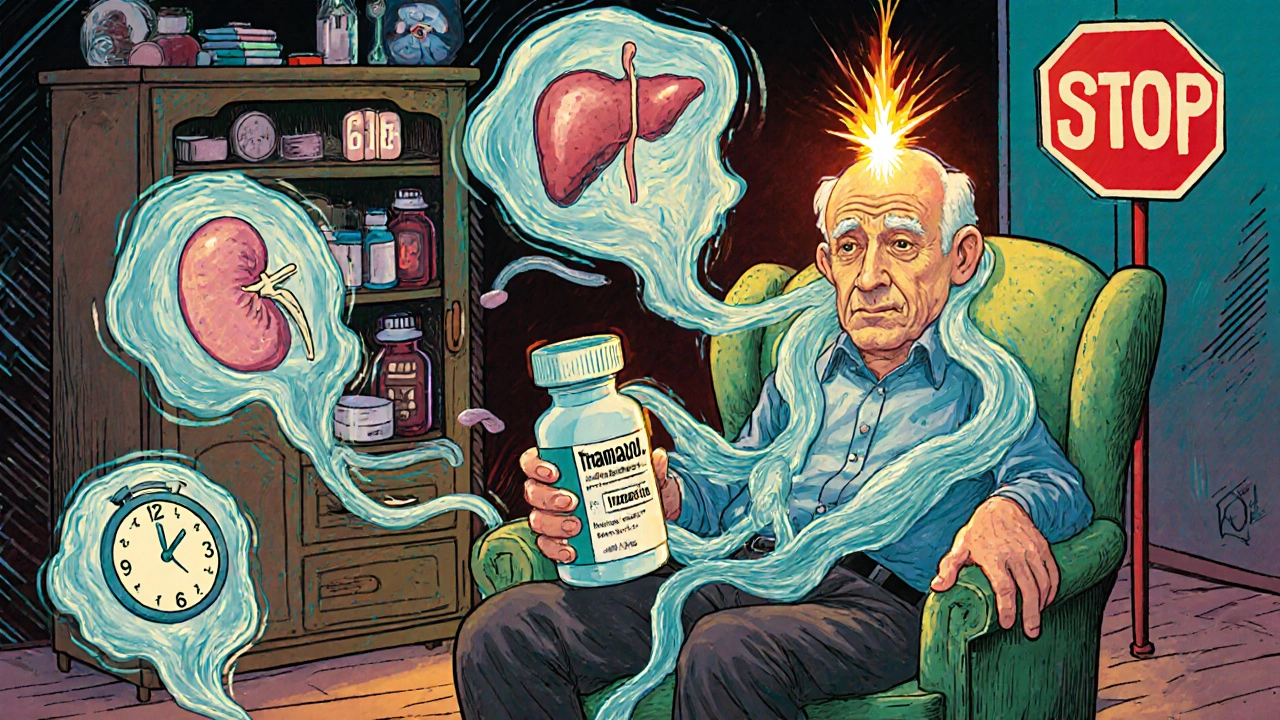
Older adults are especially vulnerable. Their livers don’t process drugs as efficiently. Their kidneys clear them slower. Many are on multiple medications. And yet, tramadol is still commonly prescribed to seniors for arthritis, back pain, or post-surgery discomfort.
The American Geriatrics Society now lists tramadol as a potentially inappropriate medication for people over 65 - not because it doesn’t work, but because the risks outweigh the benefits in most cases. The FDA updated its guidelines in 2022 to recommend a max daily dose of 300mg for older adults, down from 400mg, specifically because of seizure risk. But many doctors still don’t know this, and patients aren’t warned.
And it’s not just about dose. People over 65 are more likely to be on antidepressants. About 1 in 4 seniors take an SSRI or TCA. That’s a perfect storm.
Dose Isn’t Everything - But It Still Counts
Yes, higher doses increase risk. But the relationship isn’t linear. One study found that people who had multiple seizures after taking tramadol had taken a median of 2,800mg - far above the 400mg daily limit. But even people taking 850mg - still within the recommended range - had single seizures.
What’s more, blood levels of tramadol didn’t predict seizures at all. Two people could take the same dose, have the same blood level, and only one seizes. That’s because genetics, liver function, and drug interactions matter more than the number on the bottle.
One patient in a case report took 250mg IV - a single dose - and seized. Another, with kidney problems, took 300mg daily and seized. Dose matters, but it’s not the whole story.
Other High-Risk Groups
Young adult males are another group showing up in emergency data. In one study, 85% of tramadol-intoxicated patients who seized were male, with a median age of 23. That points to recreational misuse - often combining tramadol with alcohol or stimulants. But even without misuse, young people with undiagnosed seizure disorders or genetic variations in CYP2D6 can be at risk.
People with kidney problems are also vulnerable. If your creatinine clearance is below 60 mL/min, your body can’t clear tramadol fast enough. The FDA says to cut the dose by 25% if clearance is between 30-60, and avoid it entirely if it’s below 30. Yet many doctors skip kidney tests entirely.
Those with a history of alcohol or drug withdrawal, head injuries, or metabolic disorders are also at higher risk. These conditions make the brain more excitable - and tramadol pushes it over the edge.
What Should You Do?
If you’re on tramadol and an antidepressant, don’t panic - but do talk to your doctor. Ask: Is this antidepressant a CYP2D6 inhibitor? Fluoxetine, paroxetine, bupropion, and amitriptyline are. Citalopram and escitalopram are not. If you’re on a risky combo, switching the antidepressant might be safer than stopping the painkiller.
If you’ve ever had a seizure - even one years ago - tell your doctor before starting tramadol. If you’re over 65, ask if there’s a safer pain option. Acetaminophen, NSAIDs (if your kidneys are okay), or physical therapy might be better choices.
Never increase your tramadol dose on your own. If the pain isn’t controlled, talk to your doctor - don’t just take another pill. And if you’re taking tramadol for chronic pain, ask for a review every 3 months. Risks build over time.
What Are the Alternatives?
Tramadol isn’t the only opioid painkiller. But most others - like oxycodone or hydrocodone - don’t carry the same seizure risk with antidepressants. A 2023 study showed hydrocodone had no increased seizure risk when taken with CYP2D6 inhibitors. That’s important.
For non-opioid options, acetaminophen (Tylenol) is usually safe. NSAIDs like ibuprofen or naproxen work for many types of pain - unless you have kidney or stomach issues. For nerve pain, gabapentin or pregabalin are often better than tramadol. And for chronic pain, non-drug options like physical therapy, acupuncture, or cognitive behavioral therapy can reduce reliance on pills altogether.
The bottom line: tramadol has a place, but it’s shrinking. For most older adults and those on antidepressants, the risks are too high.
What If You’ve Already Had a Seizure?
If you’ve had a seizure after taking tramadol, you’re at high risk for another one - even if you never take it again. Your brain has been altered. Most neurologists will recommend lifelong anti-seizure medication after a first unprovoked seizure linked to a drug like this.
And you should never take tramadol again. Not even once. The chance of recurrence is too high. Tell every doctor you see - even dentists - that you’ve had a tramadol-induced seizure. It’s not just a side effect. It’s a medical history that changes your treatment forever.
One Reddit user, 32 years old, wrote: "My neurologist didn’t mention the seizure risk when adding tramadol to my sertraline. I had my first seizure. Now I’m on lifelong anti-epileptics." That’s not rare. It’s preventable.
Final Takeaway
Tramadol isn’t the villain. But it’s not the safe, gentle painkiller many think it is. The people most at risk aren’t drug abusers - they’re your grandparents on antidepressants, your neighbor with chronic back pain, your friend with depression and arthritis. These are everyday people. And they’re being put at risk by a prescription that’s too often prescribed without enough warning.
If you’re taking tramadol, ask three questions:
- Am I on an antidepressant that blocks CYP2D6?
- Do I have a history of seizures or epilepsy?
- Am I over 65 or have kidney problems?
If you answered yes to any of these, talk to your doctor today. There are safer ways to manage pain. You don’t have to risk a seizure to feel better.
Ashley Miller
November 19, 2025 AT 17:33Oh wow, so the government and Big Pharma just *happened* to forget to warn people about this? Right. And I bet the FDA’s ‘guidelines’ were written after a lunch of tacos and corporate bribes. Tramadol’s been quietly turning grandma’s into seizure puppets for years, and now they slap a ‘300mg max’ on it like that fixes anything. They’ll never pull it off the market - too profitable. Meanwhile, your pharmacist’s got a 10% commission on every script. Wake up, sheeple.
Sherri Naslund
November 21, 2025 AT 09:56ok but like… what if you just dont believe in medicine at all? like i think the brain seizures are just your soul trying to escape the capitalist machine. tramadol is just the trigger, not the cause. also i took it once with my tea and i saw a dragon made of static. the docs said it was a seizure. i said no, that was my third eye opening. they gave me a pill for that too. now im on 7 meds and still see dragons. the system wins again.
Martin Rodrigue
November 22, 2025 AT 09:58While the article presents a compelling clinical overview, it is imperative to note that the cited 2023 Medicare study’s hazard ratio of 1.09 for seizure incidence must be contextualized within the broader pharmacokinetic literature. The CYP2D6 polymorphism prevalence varies significantly across ethnic populations - for instance, poor metabolizers constitute approximately 7% of Caucasians but only 1% of East Asians. This suggests that the risk profile is not uniformly distributed, and blanket recommendations may inadvertently stigmatize patients who are genetically protected. Furthermore, the assertion that tramadol is ‘potentially inappropriate’ for those over 65 contradicts recent meta-analyses showing comparable safety to NSAIDs in low-dose, short-term use among frail elderly with contraindications to NSAID use. Clinical judgment, not algorithmic avoidance, remains paramount.
Mary Follero
November 24, 2025 AT 00:42Thank you for this. I’m a nurse and I’ve seen too many seniors get tramadol prescribed like it’s Advil. I had a patient, 78, on sertraline and tramadol for back pain - had a seizure during a routine checkup. No history of seizures. No overdose. Just the combo. We switched her to gabapentin and acetaminophen and she’s been fine for 18 months now. Please, if you’re on antidepressants, ask your doctor: ‘Is this the safest pain option?’ If they look confused, get a second opinion. You deserve to be safe, not just treated.
Lauren Hale
November 25, 2025 AT 13:56I’m 69 and on escitalopram for anxiety. My doc put me on tramadol after my hip surgery - and I didn’t even know there was a risk. I read this article and went back to them. We switched to celecoxib and physical therapy. No seizures. No drama. Just pain that’s manageable. I wish I’d known this sooner. If you’re older, on meds, or just feel like something’s off - don’t wait. Ask. Push. Advocate. Your brain is worth it.
Greg Knight
November 25, 2025 AT 13:59Hey, I get it - you’re scared. I was too. My mom got tramadol after her knee surgery, was on fluoxetine, and had a seizure in the middle of the night. We didn’t know why. Turns out, it was the combo. She’s okay now, but it changed everything. I want you to know: you’re not alone. And you’re not crazy for being worried. Talk to your doctor. Bring this article. Ask for alternatives. There are so many. You don’t have to suffer in silence. And if they dismiss you? Find someone who won’t. Your life matters more than a quick script.
Hannah Machiorlete
November 26, 2025 AT 10:29so i took tramadol once with my zoloft because i was in pain and i thought ‘eh its fine’ and then i had a seizure in the shower and my boyfriend had to drag me out and i peed myself and now i have to take keppra for life and my therapist says i have trauma from the seizure and i just wanted to sleep and now i cant even take ibuprofen without feeling guilty like i’m betraying my body or something
Kenneth Meyer
November 28, 2025 AT 09:11There’s a deeper question here: why do we treat pain as a problem to be solved with chemicals, rather than a signal to be understood? Tramadol’s seizure risk is a symptom of a system that prioritizes convenience over care. We’ve turned the body into a machine with error codes - pop a pill, reset the system. But the brain isn’t a circuit board. It’s a living, evolving network. When we flood it with dual-action drugs without understanding the individual’s neurochemistry, we’re not healing - we’re gambling. The real tragedy isn’t the seizure. It’s that we didn’t ask why the pain was there in the first place.
Donald Sanchez
November 29, 2025 AT 08:39bro this is wild 😳 i took tramadol for my back and i was on prozac and i thought i was just trippin’ when i felt my body lock up but it was a seizure?? legit?? now i’m scared to take tylenol 😭 i just want to chill but my spine is screaming. anyone else have this?? also my doc said ‘it’s rare’ but like… 9% is not rare if you’re the one seizing 😭
Abdula'aziz Muhammad Nasir
December 1, 2025 AT 03:04In my practice in Lagos, we rarely prescribe tramadol to elderly patients - not because we don’t understand pain, but because we know the risks. Many patients here are on multiple medications, and access to lab tests is limited. We choose acetaminophen, physical therapy, or even traditional herbal remedies with known safety profiles. The Western model of polypharmacy is not always the best model. We must adapt our care to our context. Tramadol may be convenient, but convenience is not the same as care.
Tara Stelluti
December 1, 2025 AT 04:56so like… i had a seizure on tramadol and now my ex says it’s ‘my fault’ for being ‘so dramatic’ and my mom says i should’ve ‘just taken the pill’ and my doctor won’t return my calls and now i’m on 3 meds and i can’t drive and my cat hates me and i just wanted to stop hurting… why does everyone act like this is normal??
Brad Samuels
December 2, 2025 AT 09:33I’m a chronic pain patient and I’ve been on tramadol for 4 years. I never had a seizure, but I did have a panic attack after reading this. I’m not scared of the drug - I’m scared of being abandoned by my care team if I ask to switch. I’m grateful for this post. It’s not fear-mongering. It’s truth-telling. To my doctors: listen to your patients. We’re not exaggerating. We’re surviving. And we need partners, not just prescribers.