
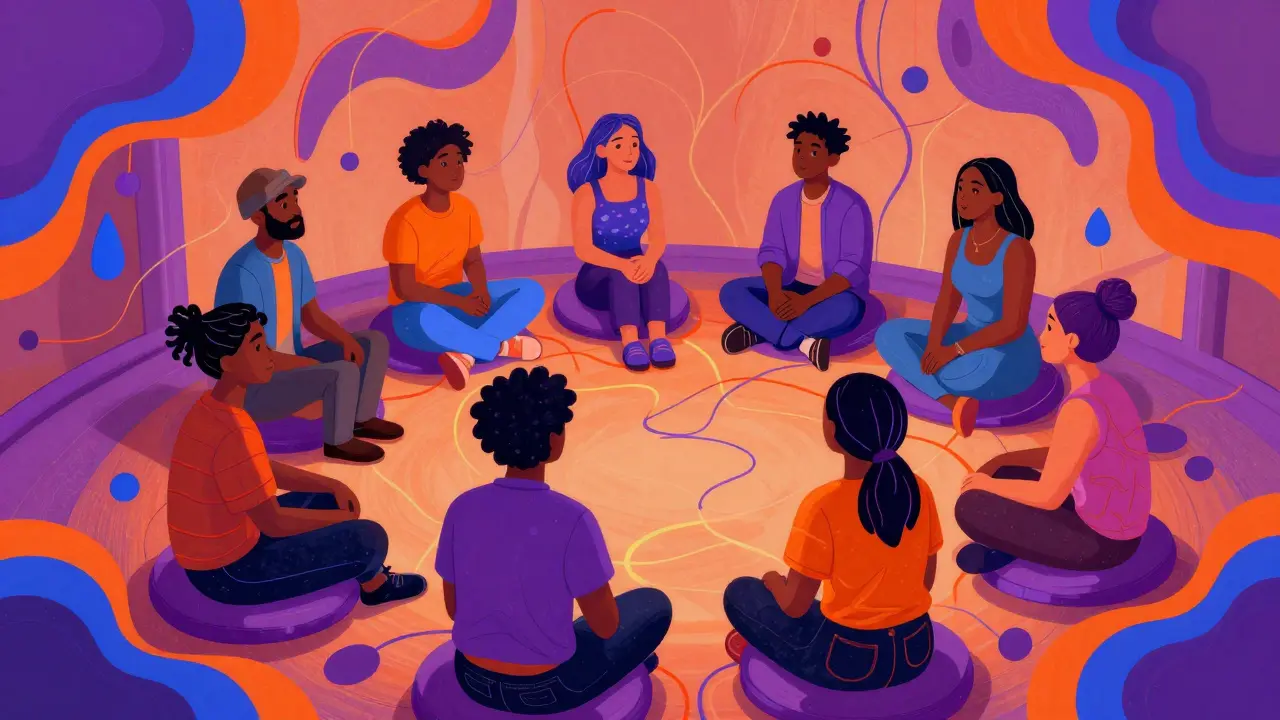
Switching from a brand-name drug to a generic version often feels like a gamble. You might wonder if it actually works the same way or if you're sacrificing quality for a lower price. This hesitation is common, but it's also where patient support groups is organized communities where people exchange real-world experiences to address concerns about medication efficacy and costs come into play. While doctors provide the medical facts, these groups provide the emotional and practical reassurance needed to make the switch with confidence.
Why experience-sharing beats a brochure
If you've ever been handed a glossy pamphlet at a clinic, you know they provide facts but rarely address the fear of "feeling different" after a medication change. Support groups fill this gap by offering bidirectional communication. Instead of just receiving information, you contribute your own story, which creates a sense of shared validation.
The impact is measurable. Data from the FDA shows that personalized experience-sharing increases generic acceptance by 32% compared to standard informational materials. For many, especially those in rural areas or disadvantaged populations, these groups are the primary source of trust. In some cases, trust in generics has risen by 40% after participating in culturally tailored support networks.
Understanding the "science" of generics through peers
One of the biggest hurdles is understanding bioequivalence . In simple terms, this is the requirement that a generic drug must deliver the same amount of active ingredient into the bloodstream at the same rate as the brand-name version. The FDA requires generics to demonstrate a bioequivalence range of 80-125% to be approved.
In a support group, this complex regulatory jargon gets translated into relatable terms. A member might explain, "I was worried about my blood pressure medication, but I checked the bioequivalence standards and my readings stayed exactly the same after the switch." This peer-to-peer translation bridges the gap between scientific evidence and a patient's gut feeling. When people see others managing chronic conditions like hypertension or diabetes successfully with generics, their own confidence grows.
| Feature | Informational Brochures | Patient Support Groups |
|---|---|---|
| Communication Style | One-way (Passive) | Two-way (Interactive) |
| Primary Focus | Clinical Facts | Emotional & Practical Experience |
| Trust Level | Moderate/Low | High (Peer-based) |
| Impact on Acceptance | Baseline | +32% Increase |
The real-world benefit: Better adherence and lower costs
The most significant outcome of these groups isn't just a change in opinion-it's a change in health. When the fear of generics is removed, patients are more likely to stay on their medication. Research indicates that patients who start on generic drugs show 15-20% higher medication adherence rates because the out-of-pocket costs are significantly lower.
Consider the financial side. In 2022, generics accounted for 90% of prescriptions filled but only 12% of total spending. This massive price difference means that switching can save patients hundreds of dollars a month. For example, some diabetes support groups have helped members switch to biosimilar insulin alternatives, saving individuals an average of $327 monthly. When a support group helps someone realize they can afford their life-saving medication without financial stress, the health outcomes improve naturally.

Navigating the risks of unmoderated groups
Not all support groups are created equal. The biggest risk is the spread of misinformation. A study found that 34% of online discussions about generics contained inaccurate claims regarding efficacy. This is often due to the "nocebo effect," where a patient feels a drug isn't working simply because they expect it to be inferior, even when objective medical tests show no difference.
To avoid these pitfalls, look for groups that incorporate healthcare professionals. The American College of Physicians reports that 78% of the most effective groups include doctors or pharmacists to validate shared experiences. A verified group will often cross-reference personal stories with peer-reviewed studies, such as those published in JAMA, to ensure that a "bad experience" is actually a side effect and not just a coincidental symptom of the disease progressing.

How to find and use a support group effectively
If you're looking for a community to help you navigate a medication change, you have several options. Online platforms like PatientsLikeMe or specific Facebook groups provide immediate access, while community health centers often host in-person workshops.
To get the most value, try these steps:
- Seek out "Buddy Systems": Some structured groups pair new members with experienced users who have already made the switch to generics.
- Verify Claims: When a member mentions a specific side effect, ask if a pharmacist or doctor in the group has verified that information.
- Track Your Own Data: Use the group's encouragement to keep a log of your symptoms and readings during the transition period.
- Use Discussion Guides: Some groups provide conversation starters to help you talk to your doctor about generic substitution.
The future of patient-led medication management
We are moving toward a world where patient experience is treated as "real-world evidence." The FDA has already launched the Patient Experience Metrics program to formalize how insights from these groups inform regulatory decisions. We're also seeing a shift where hospital systems are integrating support group referrals directly into their chronic disease management protocols.
As digital health tools evolve, expect to see these communities linked directly to your health records. This could allow your doctor to see that you've found a supportive community that eases your anxiety about a new generic prescription, making the clinical transition much smoother.
Are generic drugs really as effective as brand-name ones?
Yes. To be approved, generics must demonstrate bioequivalence, meaning they provide the same active ingredient at the same rate and extent as the brand-name drug. FDA standards require them to fall within a tight 80-125% range of the original drug's performance.
Why do some people feel differently after switching to a generic?
This is often attributed to the nocebo effect-a psychological phenomenon where negative expectations cause a person to experience perceived side effects. While the active ingredient is the same, inactive ingredients (fillers/binders) can vary, which may affect some sensitive individuals, but therapeutic efficacy remains the same.
How can I tell if a support group is reliable?
Look for groups that are moderated by healthcare professionals, such as pharmacists or physicians. Reliable groups will typically reference clinical studies and provide guidelines on how to discuss medication changes with a primary care provider rather than simply telling you to stop or start a drug.
Do support groups actually help with medication adherence?
Yes. By reducing the anxiety associated with switching to generics and lowering the financial burden, support groups help patients stay consistent with their treatment. FDA research indicates that patients on generics often have 15-20% higher adherence rates due to reduced costs.
What is the difference between a support group and a Patient Advocacy Group (PAG)?
PAGs generally focus on systemic change, such as lobbying for new laws, funding research, or changing healthcare policy. Support groups are more community-focused, concentrating on the day-to-day lived experience of patients and providing peer-to-peer emotional and practical help.
Robin Walton
April 10, 2026 AT 12:21It's honestly such a relief to see people talking about the emotional side of this. A lot of us just feel stranded when the pharmacy tells us the brand we've used for years is suddenly too expensive and we have to pivot to something that looks completely different in the bottle.
Doug DeMarco
April 11, 2026 AT 16:14Spot on! 🚀 Finding a community that actually gets the struggle makes a world of difference. I've been in a few groups for my blood pressure meds and it's way better than reading a sterile pamphlet. Keep sharing your stories, everyone! 😊
Simon Jenkins
April 12, 2026 AT 13:06Please, let's not pretend that a "buddy system" is a substitute for actual medical rigor. The sheer audacity of suggesting that a random person on Facebook is a viable source of pharmaceutical guidance is practically comedic. I find it absolutely tragic that we've devolved to a point where a peer's anecdote carries more weight than the clinical precision of a double-blind study. It's a farce, a complete and utter farce, to prioritize "emotional reassurance" over the cold, hard, indisputable facts of pharmacology. I can't believe we're even debating this as if it's a legitimate strategy for health management. Truly, the state of modern healthcare is a nightmare of mediocrity where the lowest common denominator is celebrated as a "community leader." It's frankly insulting to anyone with a basic understanding of chemistry.
Will Gray
April 14, 2026 AT 01:50The FDA standards are a joke. They tell you it's 80-125% bioequivalent but who's actually checking the factories overseas? This is all just a way for the government to push cheaper, lower-quality substitutes on the American people while the big pharma lobbyists laugh all the way to the bank. Don't trust the "verified groups" because they're probably funded by the same people making the drugs.
Thabo Leshoro
April 15, 2026 AT 22:54The bioequivalence part is so tricky...!!! I remember my first switch and I was terrified...!!! It really helps when someone explains the PK/PD profiles in a way that doesn't feel like a textbook...!!!
Camille Sebello
April 16, 2026 AT 04:35What's your dosage...?? Which generic are you using...??
Emily Wheeler
April 17, 2026 AT 01:42I've always felt that the communal aspect of healing is just as vital as the chemical aspect, and when we consider how the nocebo effect operates, it really highlights the profound intersection between our mental state and our physiological responses, which is why these support groups serve as such a beautiful bridge for those of us who struggle with the anxiety of change in a medical landscape that often feels cold and impersonal.
Peter Meyerssen
April 18, 2026 AT 13:42The dialectic between brand and generic is basically a socio-economic construct 🙄. It's all about the perceived value versus the actual utility of the molecule. Total ontological shift. ✨
Victor Parker
April 19, 2026 AT 14:53Total scam! 🤡 They just want us on the cheap stuff so they can keep the good meds for the elites. Wake up people! 🙄
Franklin Anthony
April 21, 2026 AT 12:44the truth is the money trail always leads to the same place and we just accept it because we're told to trust the system
danny Gaming
April 21, 2026 AT 20:39typical gov propaganda trying to tell us generics are safe when the quality control is nonexistent lmao
kalpana Nepal
April 23, 2026 AT 19:14My country has its own way of making medicines and they are the best. We do not need these Western rules.
Danny Wilks
April 25, 2026 AT 05:54I've spent a fair amount of time observing how different cultures handle the transition to generic medications, and it's fascinating to see how the level of trust in local community leaders often outweighs the clinical data provided by centralized health authorities, though the long-term outcomes generally remain consistent regardless of the initial psychological hurdle.
Sarina Montano
April 26, 2026 AT 01:46The way the nocebo effect is described here is such a vivid illustration of the mind-body connection. It's almost like a psychological ghost haunting the patient, making them feel phantom symptoms just because the pill is a different shade of white. I've seen people practically spiral into a panic over a filler change that has zero impact on the active ingredient's efficacy.
Ryan Hogg
April 26, 2026 AT 09:14I just feel so overwhelmed by all this. Every time I try to switch and save money, I end up worrying for weeks that I'm making a mistake and it just drains everything out of me.