
Statin Muscle Pain Risk Calculator
Your Risk Assessment
This tool estimates your risk of developing muscle pain while taking statins based on your personal health profile.
Note: This is not medical advice. Consult your doctor for personalized guidance.
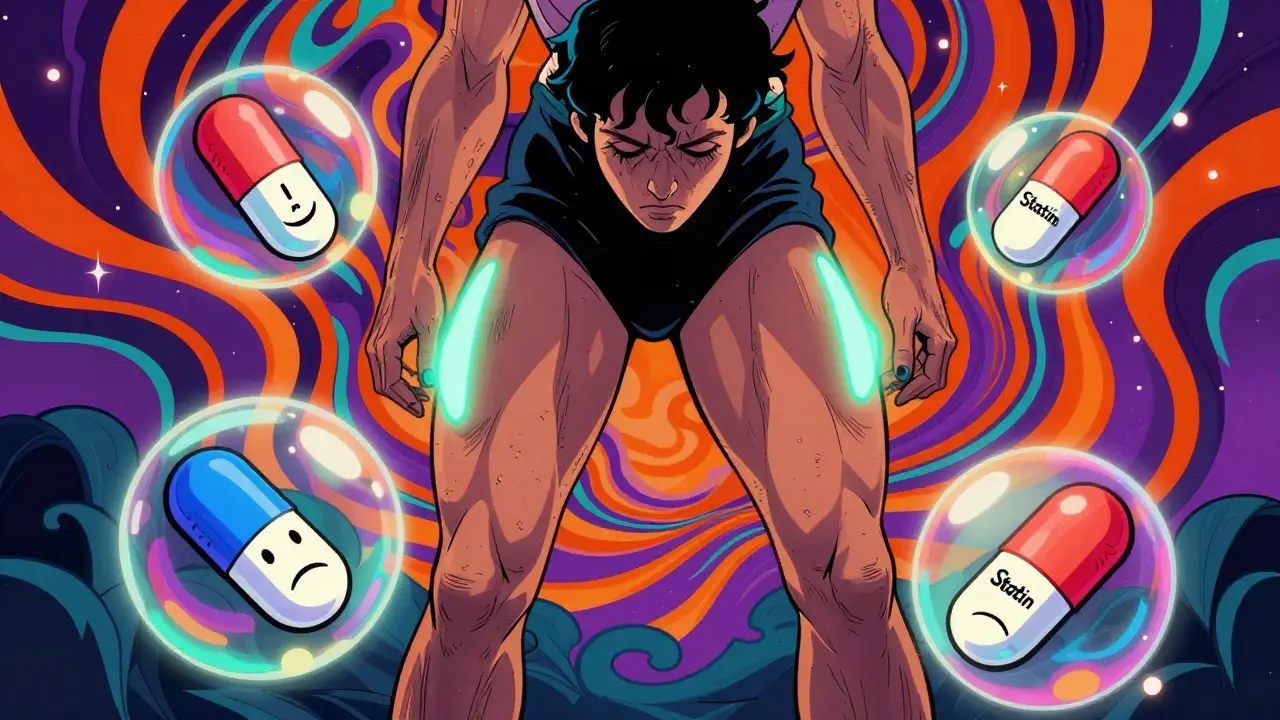
Millions of people take statins every year to lower their cholesterol and protect their heart. But for a lot of them, the biggest problem isn’t the disease-it’s the muscle aches. You start the pill, feel fine for a few weeks, then suddenly your thighs feel heavy, your calves ache when you walk, or your shoulders just won’t stop hurting. It’s not just in your head. But it might not be the statin either.
How Common Is Statin Muscle Pain?
Doctors will tell you muscle pain from statins is rare-about 5% of people. But if you ask patients, you’ll hear a different story. Up to 30% say they’ve had muscle discomfort. Why the gap?
Part of it is how studies are done. In clinical trials, people are carefully monitored. They don’t know if they’re taking the real drug or a sugar pill. In real life, you read the leaflet, hear stories online, and your brain starts looking for pain. That’s called the nocebo effect. One study found people who were warned about muscle aches were 40% more likely to report them-even when they were on a placebo.
Still, that doesn’t mean the pain isn’t real. About 15-20% of statin users do experience actual muscle soreness, especially women, older adults, and people with smaller body frames. It usually shows up within the first few months, often after a dose increase.
What Does Statin Muscle Pain Feel Like?
It’s not a sharp, sudden pain like a pulled muscle. It’s deeper. Constant. Like your legs are made of lead. You might feel:
- General soreness in both thighs, calves, or shoulders
- Weakness when climbing stairs or standing up from a chair
- A dull ache that doesn’t go away with rest
It’s usually symmetric-both sides feel the same. If one knee hurts and the other doesn’t, it’s probably not the statin.
The worst-case scenario is rhabdomyolysis-a rare but serious breakdown of muscle tissue. It happens in fewer than 5 out of every million people taking statins. Signs include dark urine, extreme weakness, and severe pain. If you have these, stop the medication and get help right away.
Who’s More Likely to Get Muscle Pain?
It’s not random. Some people are at higher risk:
- Women-especially those over 65 or with small frames (under 100 lbs)
- People over 80
- Those with thyroid problems, kidney disease, or liver issues
- People taking other meds like fibrates, cyclosporine, or certain antibiotics
- Those on high-dose statins like atorvastatin 40-80 mg or rosuvastatin 20-40 mg
Thyroid problems are a big one. Undiagnosed hypothyroidism can double your chance of muscle pain on statins. If you’re having symptoms, ask your doctor to check your thyroid levels.
What Should You Do If You Have Muscle Aches?
Don’t just quit. Stopping statins without talking to your doctor increases your risk of heart attack or stroke by 25-50% over the next two years. Here’s what to do instead:
- Call your doctor. Don’t wait. Describe the pain-where it is, how long it’s lasted, if it’s getting worse.
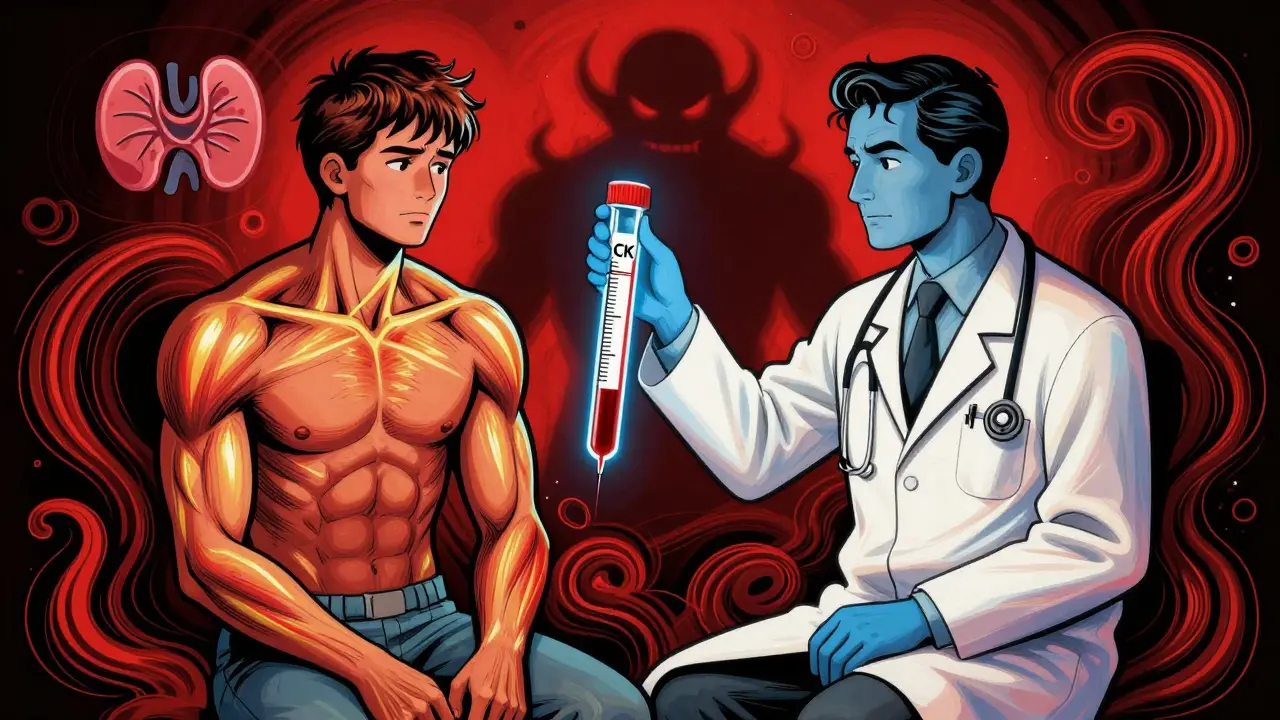
- Get a blood test for creatine kinase (CK). This enzyme leaks from damaged muscle. If it’s more than 5 times the normal level, your doctor will likely pause the statin. If it’s over 10 times, it’s urgent.
- Take a short break-4 to 6 weeks. Sometimes, just stepping away lets your muscles recover.
- Restart at a lower dose. Many people can tolerate a smaller amount of the same statin.
- Switch to a different statin. Pravastatin and fluvastatin are less likely to cause muscle pain. Rosuvastatin and atorvastatin carry higher risk.
One study found that 60% of people who switched statins had no more muscle issues. It’s not a gamble-it’s a proven strategy.
What About Coenzyme Q10?
You’ve probably seen ads for CoQ10 supplements to fix statin muscle pain. The theory is that statins lower CoQ10, which your muscles need for energy. Sounds logical, right?
But the science doesn’t back it up. A major review in the Journal of the American College of Cardiology found no real benefit over placebo. Another study showed a 30% improvement in some people-but only in 45% of those taking it. That’s not reliable. It might help a few, but don’t count on it.
If you want to try it, fine. But don’t skip the medical steps. CoQ10 won’t fix an underlying problem.
What If Nothing Works?
If you’ve tried lower doses, different statins, and still have pain, there are non-statin options:
- Ezetimibe-a pill that blocks cholesterol absorption in the gut. It lowers LDL by about 15-20%. Often used with a low-dose statin.
- PCSK9 inhibitors-injections like alirocumab or evolocumab. They can cut LDL by 50-60%. But they cost around $5,000 a year. Most insurance won’t cover them unless you’ve tried everything else.
These aren’t perfect. They’re more expensive, need injections, and aren’t for everyone. But for some, they’re the only way to protect their heart without muscle pain.
Why Sticking With Statins Matters
Let’s be clear: statins save lives. In large studies, they reduce heart attacks and strokes by 25-35%. For every 1 mmol/L drop in LDL, major vascular events drop by nearly 30%. That’s huge.
Even if you have mild muscle pain, the risk of stopping far outweighs the discomfort. Most people who stick with statins-even with some aches-live longer and have fewer heart problems.
The key is working with your doctor to find a solution that lets you stay on treatment. It’s not about giving up the pill. It’s about finding the right one.

What’s New in Research?
Scientists are getting smarter about this. The 2022 EUROMUSCULAR study created a clear diagnostic path: check symptoms, test CK, do a rechallenge. It got the right diagnosis 85% of the time.
The STRENGTH trial is testing whether taking statins every other day or twice a week still protects the heart-and causes fewer muscle problems. Early results show a 40% drop in pain with intermittent dosing. If this holds up, it could change how we prescribe statins for sensitive patients.
The American Heart Association says it plainly: for almost everyone, the benefits of statins far outweigh the risks. Muscle pain is frustrating, but it’s rarely dangerous. And it’s almost always manageable.
Bottom Line
If you’re on a statin and have muscle aches:
- Don’t panic. Don’t quit.
- Don’t assume it’s the pill. It might not be.
- Do get your CK levels checked.
- Do talk to your doctor about switching or lowering the dose.
- Do consider thyroid function and other meds you’re taking.
- Do remember: protecting your heart matters more than temporary discomfort.
There’s almost always a way forward. You don’t have to choose between aching muscles and a broken heart. With the right approach, you can have both.
Can statins cause permanent muscle damage?
In almost all cases, no. Muscle pain from statins goes away once you stop or switch the medication. The only exception is rhabdomyolysis, which is extremely rare. Even then, with prompt treatment, full recovery is typical. There’s no evidence statins cause lasting muscle damage in the vast majority of people.
Why do women report muscle pain more than men?
Women are more likely to be older when they start statins, have smaller body size, and are more likely to have conditions like hypothyroidism or kidney issues-all of which raise risk. They also report symptoms more openly, which may reflect both biological differences and social factors in how pain is expressed and recorded.
How long does it take for muscle pain to go away after stopping statins?
For most people, symptoms improve within 2 to 4 weeks after stopping the statin. In some cases, it takes up to 6 weeks, especially if the pain was severe. If pain persists beyond 6 weeks after stopping, it’s likely not caused by the statin, and another cause should be investigated.
Can I take a statin every other day to avoid muscle pain?
Yes, for some people. Early data from the STRENGTH trial shows that intermittent dosing (like every other day or twice a week) can reduce muscle pain by about 40% while still keeping LDL levels under control. But this should only be done under a doctor’s supervision-never self-adjust your dose.
Are natural remedies like turmeric or fish oil helpful for statin muscle pain?
There’s no solid evidence that turmeric, fish oil, or other supplements relieve statin-related muscle pain. While they may help with general inflammation, they don’t target the specific mechanism behind statin-induced discomfort. Don’t rely on them instead of medical advice.
If I had muscle pain with one statin, will I get it with another?
Not necessarily. About 60% of people who switch to a different statin find their muscle pain disappears. Pravastatin and fluvastatin are least likely to cause problems. Even if you reacted to atorvastatin or rosuvastatin, another option may work fine.
Can statins cause muscle pain even if my CK levels are normal?
Yes. Most statin-related muscle pain is myalgia, which means pain without elevated CK. CK only rises in more serious cases like myositis or rhabdomyolysis. Normal CK doesn’t rule out statin-related discomfort-it just means there’s no significant muscle damage.
Should I get genetic testing to see if I’m at risk for statin side effects?
Not routinely. While some genes (like SLCO1B1) are linked to higher statin risk, testing isn’t standard practice yet. Doctors rely on clinical factors-age, weight, other meds, thyroid levels-because they’re more reliable and accessible. Genetic testing might help in rare, complex cases, but it’s not needed for most people.
Next Steps
If you’re experiencing muscle aches and are on a statin:
- Write down when the pain started, where it is, and how bad it is on a scale of 1 to 10.
- Make a list of all other medications and supplements you take.
- Ask your doctor for a CK test and a thyroid panel.
- Don’t accept "just live with it" as an answer. There are options.
- Remember: your heart health is worth fighting for-and you don’t have to do it alone.
Hilary Miller
January 22, 2026 AT 10:02shivani acharya
January 23, 2026 AT 03:34Patrick Roth
January 23, 2026 AT 10:11Lauren Wall
January 24, 2026 AT 02:37arun mehta
January 25, 2026 AT 14:53Jasmine Bryant
January 26, 2026 AT 08:52Keith Helm
January 27, 2026 AT 23:32Malik Ronquillo
January 28, 2026 AT 08:21Tatiana Bandurina
January 29, 2026 AT 01:05Philip House
January 30, 2026 AT 04:03Brenda King
January 30, 2026 AT 15:39Margaret Khaemba
January 31, 2026 AT 18:16Alec Amiri
February 1, 2026 AT 20:55Mike P
February 2, 2026 AT 07:10Sarvesh CK
February 2, 2026 AT 14:23