

Getting prescription drugs shouldn’t mean choosing between rent and refills. For millions of Americans, government medication assistance programs are the only thing standing between them and going without life-saving medicines. But here’s the problem: medication assistance programs aren’t the same from state to state. What works in New Jersey might not help you in Texas. And if you’re not sure where to start, you’re not alone.
What Exactly Are State Medication Assistance Programs?
State Pharmaceutical Assistance Programs, or SPAPs, are run by individual states to help people pay for prescription drugs. They’re not federal programs - they’re local solutions to a national problem. These programs mostly target seniors, people with disabilities, and those with low incomes who can’t afford their meds even with Medicare Part D.
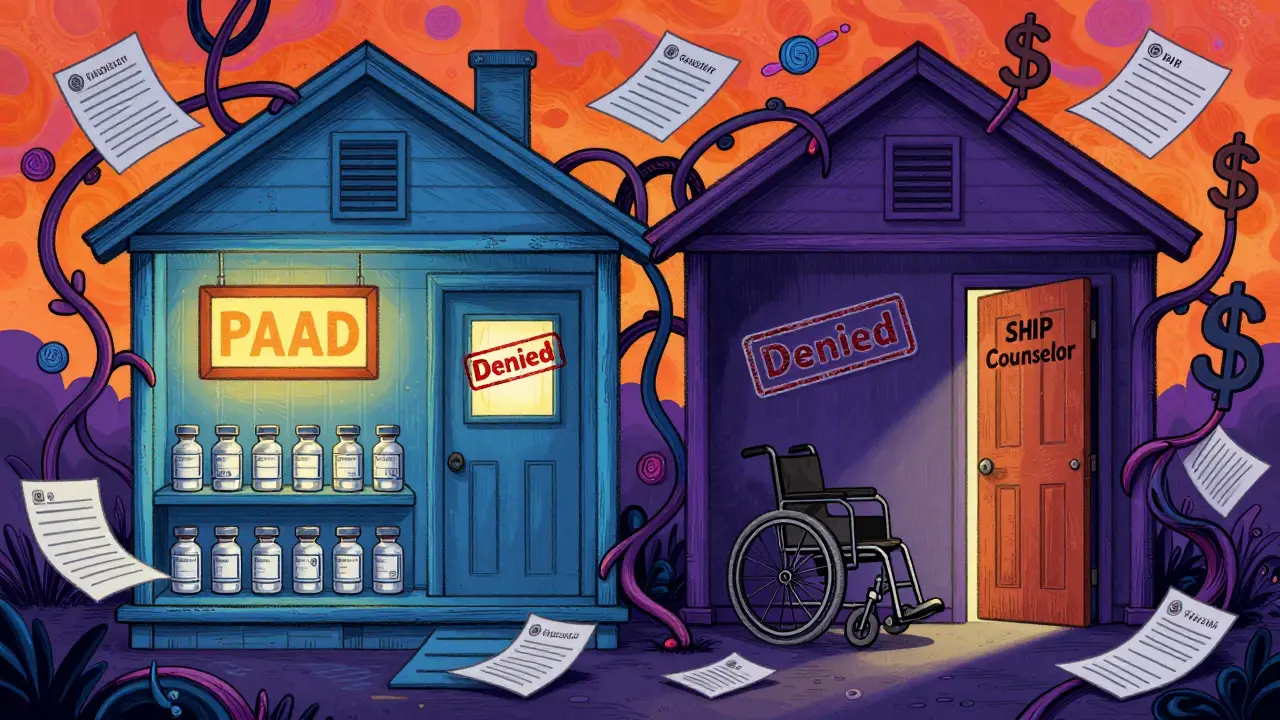
Think of them as a second layer of help. Medicare Extra Help covers the basics, but SPAPs often fill the gaps: paying Part D premiums, covering drugs not on Medicare’s formulary, or slashing co-pays. In New Jersey, the PAAD program has been around since 1967 - longer than Medicare itself. It pays $5 for generics and $7 for brand-name drugs. That’s it. No hidden fees. No surprise bills.
But not every state has a program like that. Wyoming’s SPAP budget is just $15 million. Pennsylvania’s PACE program spends over $215 million. The difference isn’t just money - it’s what’s covered, who qualifies, and how easy it is to get help.
Medicare Extra Help: The Federal Safety Net
If you’re on Medicare and have limited income, you might qualify for Extra Help - a federal program that cuts your Part D costs to near zero. In 2025, if you’re single and make less than $23,475 a year with under $17,600 in resources (like savings or investments), you’re eligible. For couples, the limits are $31,725 in income and $35,130 in resources.
What does that mean in real dollars? You pay $0 for premiums and deductibles. Generics cost $4.90 per prescription. Brand-name drugs? Just $12.15. That’s a massive drop from 2024’s $7.50 and $15.30 co-pays. And if you don’t have a drug plan, Extra Help automatically enrolls you in one.
Here’s the catch: you have to apply. It’s not automatic. Even if you get Supplemental Security Income (SSI) or Medicaid, you still need to fill out the SSA-1020 form. The average wait time? 90 days. That’s three months of paying full price for insulin, blood pressure meds, or heart pills.
And here’s what most people don’t know: if you’re approved for Extra Help, you can now switch your Medicare drug plan once a month in 2025. That’s new. Before, you were stuck for a whole year.
How State Programs Differ - Real Examples
Not all SPAPs are created equal. Let’s look at three states with very different approaches.
- New Jersey (PAAD): You must be on Medicare Part D. PAAD pays your premium if it’s $34.70 or less per month. Then it caps your co-pays at $5/$7. It covers insulin, needles for MS treatments, and 95% of common prescriptions. But if your doctor prescribes a drug not on PAAD’s list? You’re stuck in a 6- to 8-week appeals process.
- Pennsylvania (PACE): This one’s more generous. PACE pays your Part D premium AND covers drugs Medicare won’t - like certain cancer meds or rare disease treatments. Income limits are higher: $27,470 for individuals, $36,900 for couples. But you have to apply for Extra Help first. Then PACE pays the rest. Total processing time? Up to 120 days.
- California (Medi-Cal Rx): California adds 127 specialty drugs to its formulary that Medicare Part D doesn’t cover. That includes expensive biologics for rheumatoid arthritis, multiple sclerosis, and hepatitis C. But income limits are strict, and you have to be enrolled in Medi-Cal (Medicaid) to qualify.
The inconsistency is the biggest problem. If you move from Pennsylvania to Florida, your coverage might vanish overnight. A 2024 Medicare Rights Center study found that 63% of people who relocated between states lost access to meds during the transition. No one warns you.
Who’s Getting Left Behind?
Even with these programs, 28% of Medicare beneficiaries still say they struggle to afford their prescriptions. Why?
First, the income limits don’t match reality. In California or New York, $17,600 in savings might be all you have after selling your house and moving into an apartment. But the federal government still counts it as “too much.” Dr. Aaron Kesselheim from Harvard says this rule excludes people who are clearly struggling.
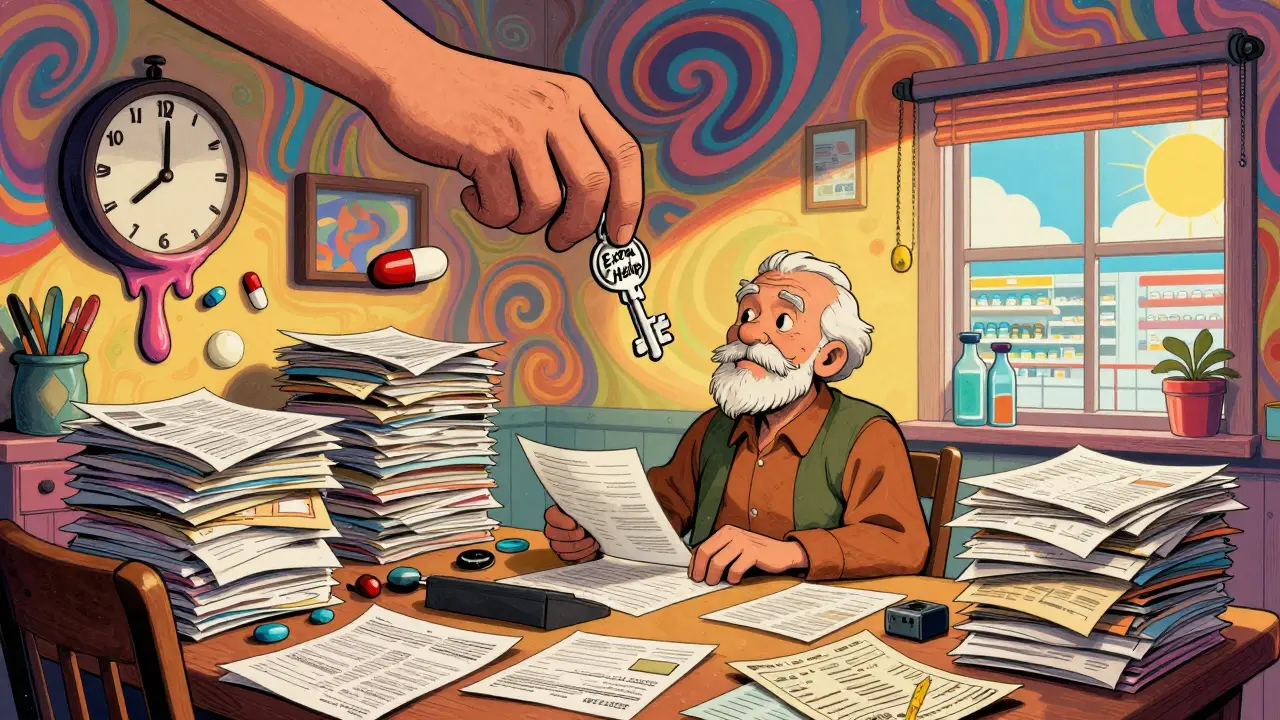
Second, the paperwork is brutal. The average applicant spends 8.5 hours filling out forms. You need tax returns, bank statements, medical bills, proof of residence. If you’re 78 and have memory issues? Good luck.
And third, not everyone knows they qualify. Only 42% of eligible people enroll. That’s nearly 6 in 10 people missing out. Why? Confusion. Fear. Too many programs. Too many rules.
What Changed in 2025?
The Inflation Reduction Act made big changes - and they’re already helping.
- There’s now a $2,000 annual cap on out-of-pocket drug costs for everyone on Medicare Part D. That’s down from $7,050. If you hit that cap, your drugs are free for the rest of the year.
- Extra Help income and resource limits rose 3.9% in 2025 - the biggest jump in five years.
- States like California, Texas, and Florida are expanding their SPAPs to cover more specialty drugs. By 2027, 12 more states plan to launch or grow their programs.
But there’s a dark side. Specialty drug prices are rising 12.3% a year. State budgets are only growing 4-6%. Seven states could run out of money by 2026. That means formularies could shrink. Prior authorizations could get tougher. More denials.
How to Apply - Step by Step
If you think you qualify, here’s how to get help - fast.
- Check your income and resources. Use the 2025 limits: $23,475/$17,600 for individuals, $31,725/$35,130 for couples.
- Apply for Extra Help first. Go to ssa.gov/benefits/medicare/prescriptionhelp or call 1-800-772-1213. Fill out the SSA-1020 form. Bring your Social Security card, tax return, and bank statements.
- Then check your state’s SPAP. Visit your state’s health department website. Search for “Pharmaceutical Assistance Program.” Or call 211 - it’s a free national helpline that connects you to local help.
- Use SHIP. Every state has a State Health Insurance Assistance Program (SHIP). They have 14,000 free counselors. They’ll walk you through the forms. No charge. No sales pitch. Find yours at shiphelp.org.
- Don’t wait. Processing takes 30-120 days. If you need meds now, ask your pharmacy if they offer patient assistance from drugmakers. Most big pharma companies have free drug programs.
Real Stories - What People Are Saying
On Reddit, a user in New Jersey wrote: “PAAD saved me over $400 a month on my diabetes meds. The $5 copay? I can handle that.”
But another person on the Medicare Rights Center forum shared: “I paid $872 out of pocket while waiting for Extra Help to process. I had to skip my heart meds for two weeks.”
And in a Facebook group for PAAD users: “The $7 copay is fine - but when they switch me to a new drug not on the list, I go without for two months. No one tells you that.”
These aren’t outliers. They’re the reality.
What to Do If You’re Denied
Denials happen. Maybe your income was listed wrong. Maybe you missed a document. Don’t give up.
- Request a written explanation. By law, they must give it to you.
- Appeal within 60 days. SHIP counselors can help you draft the appeal letter.
- Ask your doctor to write a letter of medical necessity. That often turns the tide.
- If you’re still stuck, contact your state’s ombudsman office. They’re there to fight for you.
Final Thoughts - You’re Not Alone
Medication assistance programs aren’t perfect. They’re messy, uneven, and sometimes slow. But they’re the only reason millions of people are still alive today.
If you or someone you love is struggling to pay for prescriptions, don’t wait until you’re out of pills. Start now. Call 211. Visit SHIP. Apply for Extra Help. Even if you get denied the first time, try again. The rules change. The money moves. Someone, somewhere, is trying to help you.
You don’t need to be an expert. You just need to take the first step.
Caitlin Foster
December 29, 2025 AT 09:52Okay but let’s be real - if you’re still paying $12 for brand-name meds in 2025, you’re doing it wrong. I got my insulin for $0 after 3 months of paperwork and a SHIP counselor who basically adopted me. Stop suffering in silence. Just. Apply.
Liz Tanner
December 30, 2025 AT 14:39My grandma got denied Extra Help because her $18k in savings counted as ‘too much’ - even though she sold her house to move into a studio apartment. The system is designed to fail people who are just barely hanging on. They don’t want to help the working poor. They want to help the invisible.
Babe Addict
December 30, 2025 AT 16:54SPAPs are a Band-Aid on a hemorrhage. The real issue is that Big Pharma’s pricing model is predatory capitalism disguised as innovation. You think $5 co-pays are good? Try telling that to the 40% of diabetics who ration insulin because their ‘free’ plan has a $1,200 deductible. This isn’t assistance - it’s performative welfare.
Raushan Richardson
January 1, 2026 AT 01:59Just wanted to say thank you for this post. I’m a caregiver for my mom with MS, and we’ve been lost in this maze for years. I didn’t even know about SHIP until last month - now she’s getting her injectables covered. You’re right - you just need to take the first step. I’m sharing this with every group I’m in.
Robyn Hays
January 2, 2026 AT 06:15It’s wild how one state can be a lifeline and the next a death sentence. My aunt moved from PA to FL and lost her cancer med coverage overnight. She cried for three days. No one told her to call 211. No one told her to fight. And now? She’s on a clinical trial because she can’t afford the drug that kept her alive for 7 years. This isn’t healthcare. It’s a lottery.
Alex Lopez
January 3, 2026 AT 16:53As a former CMS policy analyst (yes, I’ve seen the spreadsheets), the 2025 cap on out-of-pocket costs is statistically insignificant when 87% of specialty drugs are still priced above $10k/year. The real reform? Nationalize the formulary. End state-by-state fragmentation. Or keep pretending $5 co-pays are a victory while seniors die in waiting rooms.
Elizabeth Ganak
January 4, 2026 AT 08:38i live in india but my brother is in texas and he just got approved for extra help after 4 months. he said the form was like 17 pages and they lost his tax doc twice. he cried. i cried. we just want him to live. thank you for writing this.
Nicola George
January 5, 2026 AT 13:11Oh wow. So we’re celebrating $5 co-pays like it’s the moon landing? Meanwhile, the same states cutting SPAP budgets are giving tax breaks to pharma CEOs who make $12M a year. This isn’t broken - it’s designed. You think this is about helping people? Nah. It’s about making sure the poor don’t die in public.
John Barron
January 6, 2026 AT 17:45Let me drop some truth bombs 🧨: The real reason 58% of eligible people don’t enroll? They’re tired. Tired of being treated like criminals for needing help. Tired of being told they’re ‘not poor enough’ when they’re choosing between insulin and groceries. Tired of being told to ‘apply’ like it’s a game. The system doesn’t want you to win. It wants you to quit.
And don’t get me started on the 6-8 week appeals process. That’s not bureaucracy. That’s a death sentence with a clipboard.
My cousin died waiting for PAAD to approve her chemo drug. She was 52. The letter came 3 days after her funeral.
You don’t need a PhD to see this. You just need a heart.
Anna Weitz
January 7, 2026 AT 20:50It’s not about the money it’s about the control the system is designed to make you feel small so you don’t question why your life is priced at $872 a month
Jane Lucas
January 8, 2026 AT 22:06my mom just got approved for medi-cal rx after 5 tries. she forgot to sign one page and they sent it back 3 times. i cried. she said ‘i’m too old for this’ but we did it. thank you for telling people how to do this. i’m sharing this with everyone.
Elizabeth Alvarez
January 9, 2026 AT 02:43Have you ever wondered why the government pushes these state-by-state programs? It’s not incompetence - it’s intentional. The same people who run these programs are the ones who own the pharmaceutical lobbying firms. They want confusion. They want delays. They want you to give up. That’s how they keep prices high. The ‘$2000 cap’? A distraction. The real goal is to make you believe you’re getting help while they quietly phase out coverage. Look at the funding trends - SPAPs are shrinking. The clock is ticking. They’re setting you up for collapse.
Todd Scott
January 10, 2026 AT 21:13As someone who’s worked in public health across 7 states, I can tell you: the real heroes aren’t the bureaucrats. They’re the SHIP counselors. The 211 operators. The pharmacy techs who slip you an extra month’s supply when they see you crying. These programs are broken - but the people? They’re warriors. Don’t underestimate them. Call 211. Ask for SHIP. They’ll fight for you even when the system won’t.
Andrew Gurung
January 11, 2026 AT 18:28Wow. Just… wow. You wrote a 2000-word essay on Medicaid and called it ‘helpful.’ Let me tell you something, peasant - if you needed help, you wouldn’t be reading this. You’d be dead. The fact that you’re still alive means you’re not *that* poor. Maybe stop whining and get a second job? Or better yet - don’t get old. 🤷♂️💊
Janice Holmes
January 13, 2026 AT 14:52MY GRANDMA’S INSULIN WAS DENIED BECAUSE SHE USED A PENCIL INSTEAD OF A PEN ON FORM 12B 🤯
SHE’S 81. SHE HAS TYPICAL HAND TREMORS. SHE’S NOT A TECHNOCRAT. SHE’S A HUMAN BEING.
THEY SENT HER A LETTER IN 12-POINT FONT WITH NO BOLD TEXT. NO EXPLANATION. JUST ‘DENIED.’
I TOOK A PHOTO OF HER HAND WRITING THE FORM - HER FINGERS WERE BLOODY.
THEY DIDN’T CALL HER BACK FOR 9 WEEKS.
SHE HAD TO SKIP DOSES.
SHE HAD A STROKE.
THEY WON’T EVEN APOLOGIZE.
THIS ISN’T A SYSTEM. IT’S A CRIME.