
GLP-1 Agonist Pancreatitis Risk Calculator
This tool calculates your individual pancreatitis risk when using GLP-1 agonists based on your specific health factors. Remember, the absolute risk is generally low (0.1-0.4%), but varies by individual factors.
When you start a GLP-1 agonist like semaglutide or liraglutide for weight loss or diabetes, you’re signing up for real benefits: better blood sugar control, significant weight loss, and lower heart disease risk. But buried in the fine print of the prescription label is a warning: acute pancreatitis. It sounds scary. And for good reason. But is the risk real? And if it is, what should you actually do about it?
Let’s cut through the noise. There’s no simple answer. Some studies say GLP-1 agonists double your chance of pancreatitis. Others say they lower it. One major trial found users had 9 times higher risk than people on bupropion-naltrexone. Another, with nearly a million patients, found no increase at all. So what’s going on? The truth is, the risk isn’t the same for everyone. And knowing who’s at risk changes everything.
How GLP-1 Agonists Work - And Why Pancreatitis Is a Theoretical Concern
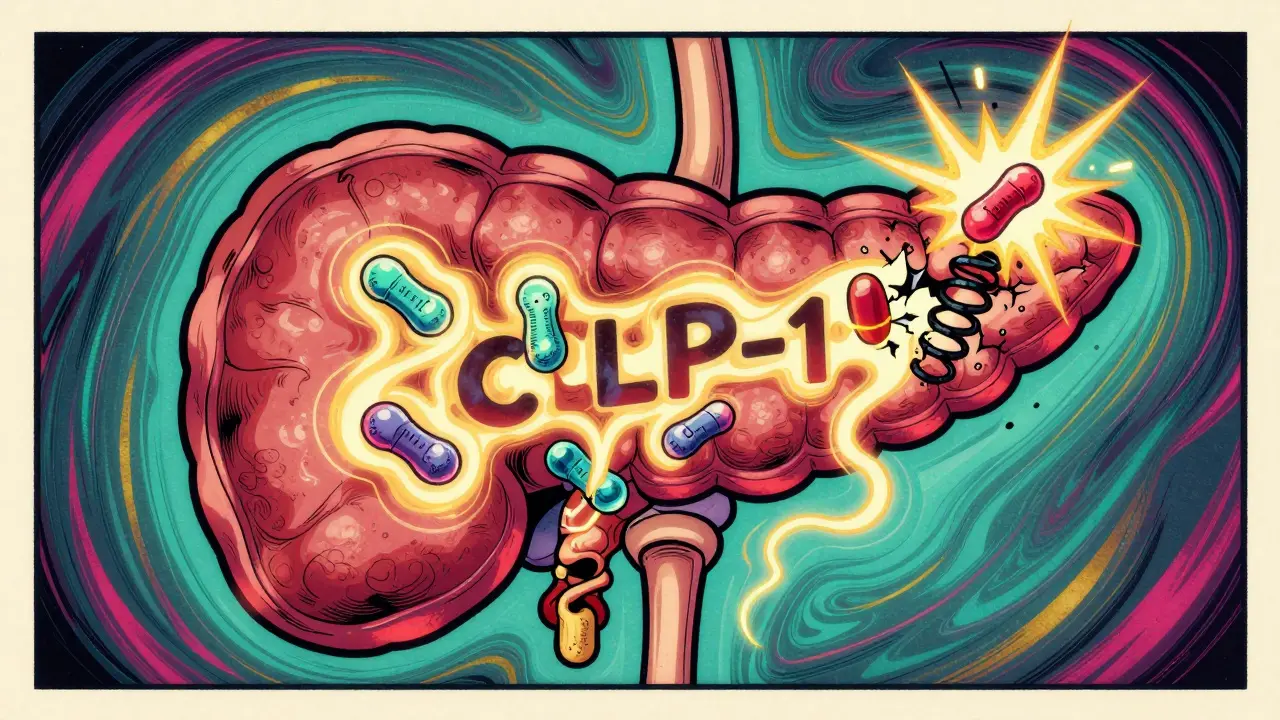
GLP-1 agonists mimic a natural hormone your gut makes after eating. This hormone tells your pancreas to release insulin when blood sugar rises, slows down stomach emptying so you feel full longer, and reduces appetite in your brain. That’s why they work so well for weight loss and diabetes. But here’s the catch: your pancreas has GLP-1 receptors too. When you flood the system with a synthetic version of this hormone, it’s possible you’re overstimulating cells that regulate digestive enzymes.
Think of it like turning up the volume on a speaker too high - eventually, something might crack. In theory, this overstimulation could cause enzymes to activate inside the pancreas instead of in the gut, leading to inflammation. That’s pancreatitis. The drugs also slow gastric emptying by 30-50%, which might cause pressure buildup in the pancreatic duct. Combine that with high triglycerides, alcohol use, or smoking, and you’ve got a recipe for trouble - for some people.
Not all GLP-1 agonists are the same. Exenatide is made from lizard venom. Liraglutide and semaglutide are modified human hormones. Semaglutide lasts a full week in your body. Tirzepatide even adds a GIP component. These differences matter. But right now, we don’t have clear data saying one is safer than another. So we monitor based on risk factors, not drug names.
The Evidence Is Split - Here’s What the Latest Studies Say
In May 2025, a study of nearly a million diabetic patients found GLP-1 agonist users had a 34% higher risk of acute pancreatitis within six months and a 44% higher risk of chronic pancreatitis over five years. That’s alarming. But then, in February 2025, another study of nearly a million patients found no increased risk - in fact, lifetime risk was slightly lower in GLP-1 users (0.3% vs. 0.4%).
Why the contradiction? One study looked at a general diabetic population. The other focused on obese patients on weight-loss doses. One used real-world data from insurance claims. The other used clinical trial data. And then there’s the JAMA study from 2023, which found GLP-1 users had 9 times higher pancreatitis risk than those on bupropion-naltrexone - but that study had only 4,144 GLP-1 users. Small sample. Big effect.
Meanwhile, a massive 2024 study from ENDO, using data from 127 million patients across 15 countries, found GLP-1 agonists might actually reduce recurrence of pancreatitis compared to SGLT2 inhibitors. That’s not just neutral - it’s protective. And the American College of Gastroenterology (ACG) now says: if you’ve had pancreatitis before, starting a GLP-1 agonist doesn’t make it more likely to come back.
So what’s the real risk? The absolute numbers are tiny. Even in the highest-risk studies, lifetime incidence is between 0.1% and 0.4%. That’s 1 to 4 in 1,000 people. For comparison, about 1 in 100 people will get pancreatitis in their lifetime anyway - mostly from gallstones or alcohol. So while the relative risk might sound scary, the actual chance of it happening to you is still very low.
Who’s Actually at Risk? The Real Red Flags
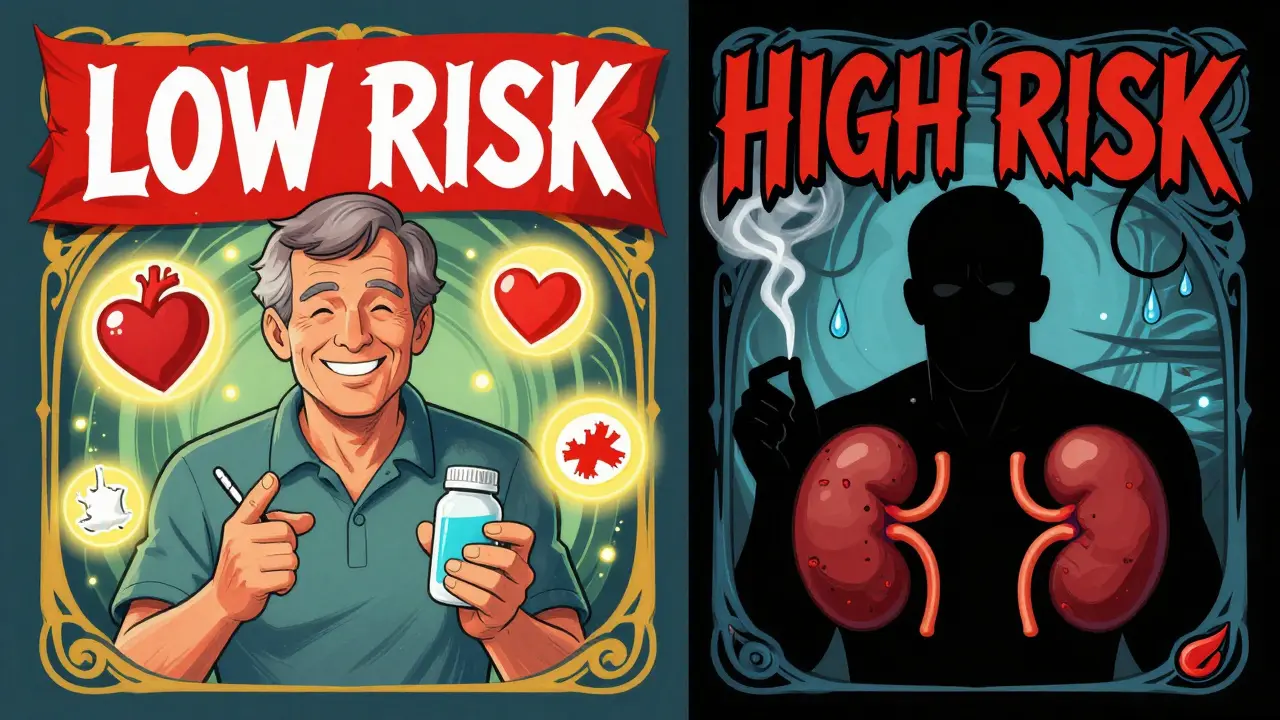
Not everyone needs to panic. The risk isn’t class-wide - it’s person-specific. Here’s who should be extra careful:
- People with a history of acute pancreatitis - though recent data suggests this doesn’t increase recurrence risk
- Those with chronic kidney disease stage 3 or worse - impaired clearance may lead to drug buildup
- People who smoke - smoking damages pancreatic tissue and reduces blood flow
- Patients with triglycerides over 500 mg/dL - high fat levels can trigger inflammation
- Those with alcohol use disorder - even moderate drinking raises baseline risk
Here’s something surprising: a BMI over 36 might actually be protective. Why? Researchers think higher fat mass may absorb or buffer the drug’s effect on pancreatic receptors. So obesity isn’t the problem - it might be part of the solution.
The biggest mistake? Assuming everyone’s at risk. If you’re a 55-year-old with type 2 diabetes, no past pancreatitis, normal triglycerides, and don’t drink or smoke - your risk is likely negligible. The benefits (heart protection, weight loss, fewer diabetes complications) far outweigh the theoretical risk.
What to Monitor - And When
Monitoring doesn’t mean endless blood tests. It means smart, targeted checks and knowing your symptoms.
Before starting: Get a baseline lipase and amylase test. Not everyone needs it - but if you have any of the risk factors above, do it. Also, make sure your triglycerides are under control.
During treatment: Learn the symptoms. Acute pancreatitis hits fast. It’s not a stomachache. It’s a sudden, severe pain in the upper abdomen - often so intense you can’t sit still. It usually spreads to your back. You’ll feel nauseous, maybe vomit. The pain gets worse after eating. If this happens, stop the drug and call your doctor immediately.
Testing frequency? Only if you’re high-risk. If you smoke, have high triglycerides, or kidney disease, get lipase checked every 3 months during the first year. Low-risk patients? Only test if symptoms appear. Don’t waste time and money on routine testing with no symptoms.
And remember: the FDA label says ‘Advise patients to seek medical attention if they experience symptoms of pancreatitis.’ That’s it. No mandatory labs. No blanket restrictions. It’s about awareness, not fear.
Alternatives - What Else Can You Take?
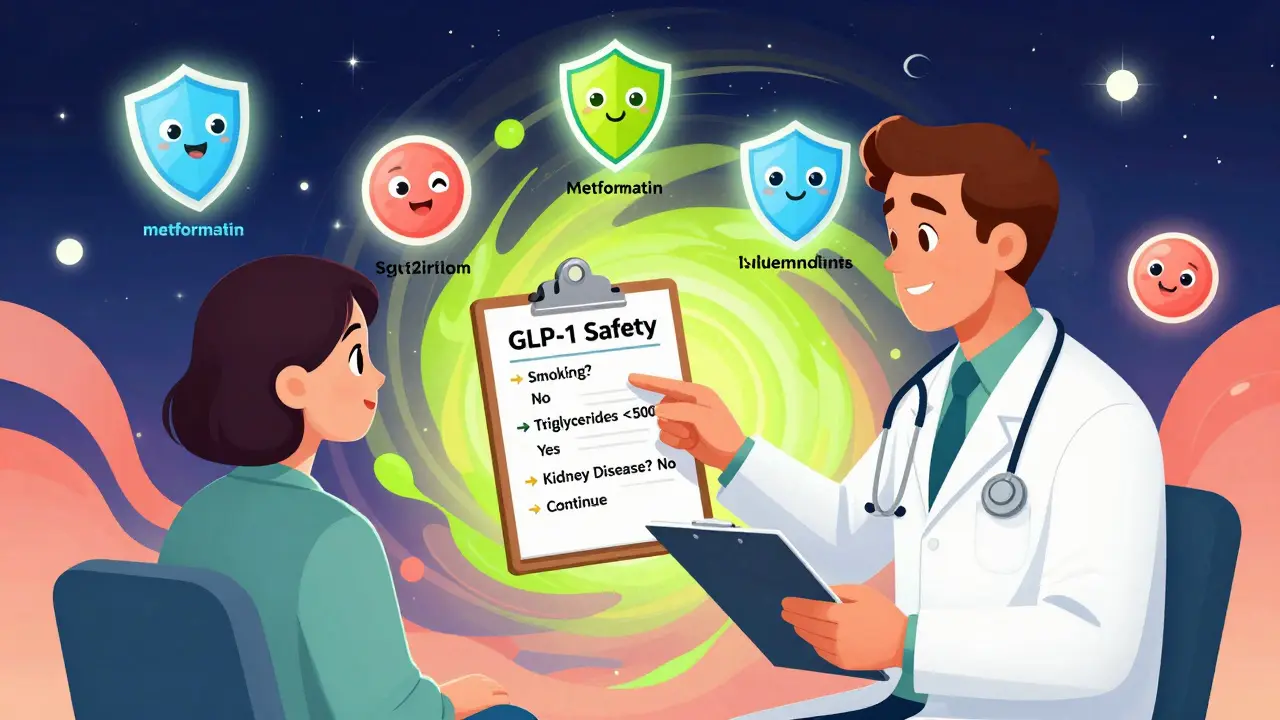
If you’re worried about pancreatitis, or you’ve had it before, here are your options:
- SGLT2 inhibitors (dapagliflozin, empagliflozin): These lower blood sugar by making your kidneys dump glucose. No pancreatitis risk. Some data even suggests they lower recurrence risk compared to GLP-1 agonists.
- Metformin: Still the first-line drug for type 2 diabetes. Pancreatitis risk? About 0.15 per 1,000 patient-years. Very low. Plus, it helps with weight and heart health.
- Sitagliptin (DPP-4 inhibitor): No increased risk found in large trials. But saxagliptin? It carries a black box warning. Avoid that one.
- Bupropion-naltrexone (Contrave): For weight loss only. The JAMA study showed 1/10th the pancreatitis risk of GLP-1 agonists. But it’s not for everyone - avoid if you have seizures, anorexia, or are on certain antidepressants.
- Orlistat (Xenical): Blocks fat absorption. Minimal pancreatic risk. But side effects? Oily stools, urgency, embarrassment. About 40% quit within a year.
- Tirzepatide (Mounjaro/Zepbound): It’s a GLP-1 + GIP agonist. Structurally similar. No evidence it’s safer. If you’re avoiding GLP-1s, skip this too.
Here’s the bottom line: if you’re using a GLP-1 agonist for weight loss and you’re not in a high-risk group, you’re probably fine. If you’re using it for diabetes and have heart or kidney disease, the benefits are overwhelming. The pancreatitis risk is real - but it’s rare, and it’s avoidable with smart monitoring.
What’s Next? The Future of GLP-1 Safety
The FDA is requiring post-marketing studies on tirzepatide’s pancreatic safety - results won’t come until 2027. Meanwhile, drugmakers are working on next-gen GLP-1 agonists with reduced pancreatic receptor binding. No drugs are in trials yet.
The real shift? From treating this as a class-wide danger to recognizing it as a patient-specific concern. Doctors are starting to ask: Do you smoke? What’s your triglyceride level? Have you had pancreatitis before? Not: Are you on a GLP-1?
The message isn’t to stop these drugs. It’s to use them wisely. If you’re low-risk, keep going. If you’re high-risk, talk to your doctor. Switch to metformin or an SGLT2 inhibitor. The alternatives exist. The data is evolving. And you’re not alone in this decision.
Do GLP-1 agonists cause pancreatitis?
Some studies show a small increased risk, others show no increase or even lower risk. The absolute risk is low - between 0.1% and 0.4% over a lifetime. The real issue is individual risk factors: smoking, high triglycerides, kidney disease, or alcohol use. For most people, the benefits outweigh the risk.
Should I stop my GLP-1 agonist if I’m worried about pancreatitis?
Don’t stop without talking to your doctor. If you have no risk factors - no history of pancreatitis, no smoking, normal triglycerides, no kidney disease - your risk is minimal. The cardiovascular and weight-loss benefits are substantial. If you’re high-risk, your doctor can help you switch to a safer alternative like metformin or an SGLT2 inhibitor.
What symptoms should I watch for?
Sudden, severe pain in the upper abdomen that radiates to your back. Nausea, vomiting, and pain that worsens after eating. These are classic signs of acute pancreatitis. If you experience them, stop the medication and seek medical help immediately. Don’t wait.
Are there safer alternatives to GLP-1 agonists?
Yes. For diabetes: metformin and SGLT2 inhibitors (like dapagliflozin) have very low pancreatitis risk. For weight loss: bupropion-naltrexone (Contrave) has significantly lower risk than GLP-1 agonists, though it has psychiatric contraindications. Orlistat is another option but often causes uncomfortable digestive side effects.
Does having had pancreatitis in the past mean I can’t use GLP-1 agonists?
No. Recent research from the American College of Gastroenterology found no evidence that prior pancreatitis increases recurrence risk when starting a GLP-1 agonist. If you’re otherwise healthy and need the drug for diabetes or weight management, it’s not a reason to avoid it.
Steven Pam
February 23, 2026 AT 18:17Timothy Haroutunian
February 24, 2026 AT 18:47Erin Pinheiro
February 25, 2026 AT 19:03Michael FItzpatrick
February 26, 2026 AT 01:44Brandice Valentino
February 26, 2026 AT 05:46Larry Zerpa
February 26, 2026 AT 06:24Nandini Wagh
February 27, 2026 AT 10:57tia novialiswati
February 28, 2026 AT 12:18Lillian Knezek
March 2, 2026 AT 02:12Maranda Najar
March 3, 2026 AT 04:05Christopher Brown
March 4, 2026 AT 23:35Sanjaykumar Rabari
March 5, 2026 AT 01:36Kenzie Goode
March 5, 2026 AT 07:25Dominic Punch
March 7, 2026 AT 00:15