
Giving medication through a feeding tube seems straightforward, but it is actually one of the most common areas for medical errors. When a drug isn't prepared correctly, it doesn't just mean the patient misses a dose; it can lead to a complete tube blockage, requiring a surgical replacement. The stakes are high because many medications are designed to be swallowed whole, and changing that delivery method can alter how a drug works or whether it reaches the bloodstream at all. If you are managing a tube at home or in a clinical setting, understanding the physics of medication administration is the only way to ensure safety and efficacy.
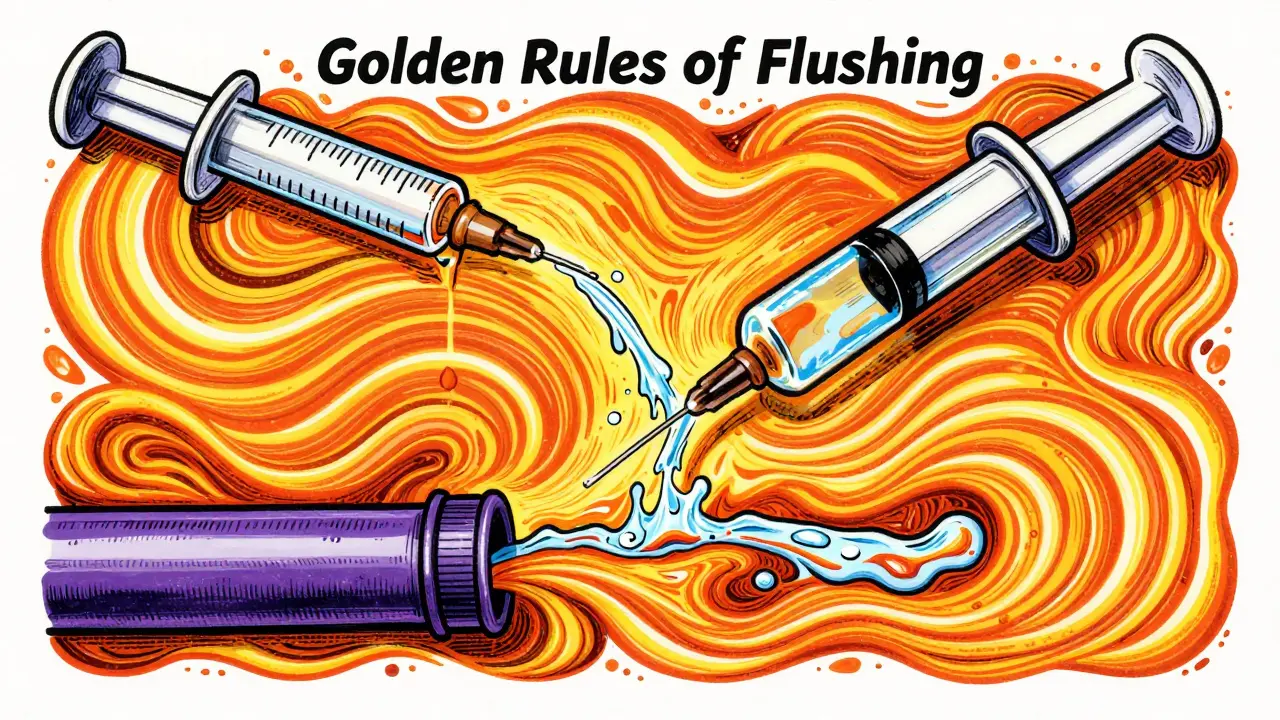
The Golden Rules of Tube Flushing
Flushing is not just about cleaning the tube; it's about ensuring the full dose of medication actually reaches the stomach. Because feeding tubes have a narrow internal diameter-often between 5 and 16 French (roughly 1.7 to 5.3 mm)-even a tiny amount of residue can cause a clog. The most dangerous mistake is using too little water, which allows medication to settle and harden on the tube walls.
To keep a tube patent, follow this standard flushing sequence:
- Before meds: Flush with 15-30 mL of water to clear any leftover formula.
- Between meds: If you are giving multiple drugs, flush with 15-30 mL of water between each one. This prevents different chemicals from reacting and forming a "precipitate" or solid clump inside the tube.
- After meds: Finish with another 15-30 mL flush. A good rule of thumb is to use at least 15 mL of water for every 10 mL of medication you administer.
If you are using a smaller tube (8 French or less), be even more vigilant. These are incredibly susceptible to blockages, and a "quick flush" is rarely enough to prevent a clog.
Understanding Medication Compatibility
Not every pill can be crushed. Some are designed to release medicine slowly over 24 hours, while others have a special coating to protect the stomach or prevent the drug from dissolving too early. When you crush these, you destroy the delivery mechanism, which can lead to a toxic dose hitting the system all at once or the drug being destroyed by stomach acid.
Here is how different formulations generally behave in enteral tubes:
| Formulation Type | Compatibility | Risk Level | Action |
|---|---|---|---|
| Immediate-Release Tablets | High | Low | Crush to fine powder, dissolve in water. |
| Liquid Formulations | Very High | Very Low | Preferred method; check for suspension. |
| Extended-Release (ER/XR) | Low | High | Do not crush. Seek liquid alternative. |
| Enteric-Coated | Very Low | Very High | Do not crush. Destroys drug efficacy. |
For example, Duloxetine is often sold in capsules containing enteric-coated pellets. If you open the capsule and try to force those pellets through a tube, they likely won't dissolve properly or could clog the line. On the other hand, products like Prevacid SoluTabs are designed to disperse evenly in water, making them much safer for tube use.
Red Flags: What Never to Put in a Tube
There are some medications where crushing is an absolute "no." This isn't just about the tube clogging; it's about safety for the person preparing the dose and the patient receiving it. Certain drugs, like Mycophenolate or Valganciclovir, can be toxic if inhaled as a powder during the crushing process.
You should also avoid bulk-forming laxatives, such as Psyllium. These are designed to thicken in the gut, and if they thicken inside a narrow feeding tube, they create an immediate, often permanent, obstruction.
Another critical error is mixing medication directly into the enteral nutrition formula. Unless a pharmacist has confirmed that the drug and the formula are compatible, doing this can cause the medication to bind to the nutrients, meaning the patient gets none of the drug, or it can cause the formula to curdle and block the tube.
The Interaction Between Feed and Meds
For years, the standard advice was to stop feeding for one or two hours before and after giving medications to avoid "drug-nutrient interactions." However, recent evidence has challenged this. The American Society for Parenteral and Enteral Nutrition (ASPEN) found that very few drugs actually require you to stop the pump.
The most notable exception is Levodopa, which is used for Parkinson's disease. This medication is significantly affected by the proteins in feeding formulas, so withholding feeds is clinically beneficial in this specific case. For most other drugs, the risk of causing hypoglycemia or malnutrition by stopping feeds outweighs the slight decrease in drug absorption.
Practical Steps for Safe Administration
To minimize the 15-20% of adverse events linked to enteral medication errors, follow a strict operational checklist. Don't rely on memory; use a physical process.
- Verify Placement: Before anything goes down the tube, confirm it is in the right spot. For nasogastric tubes, this means checking pH levels or confirming via X-ray. If the tube has shifted, any medication you give could end up in the lungs.
- Prepare Individually: Crush each tablet separately using a pill crusher. Do not crush multiple different medications together in one bowl, as this can lead to chemical reactions.
- Dissolve Completely: Use warm water if necessary to ensure no granules remain. If the liquid looks cloudy or has visible particles, it is not ready for the tube.
- Use a Separate Syringe: Use a clean syringe for each medication to avoid cross-contamination.
- Document Everything: Record the volume of water used for flushing and the exact method of preparation. If a tube clogs later, this documentation is the only way to figure out which drug caused the problem.
If you are switching a patient from a long-acting capsule to an immediate-release liquid, keep a close eye on them. For drugs with a narrow therapeutic index-like certain seizure medications-even a small change in how the drug is absorbed can lead to subtherapeutic levels or toxicity. Monitoring serum drug levels via blood tests is often necessary during these transitions.
What should I do if the tube becomes partially blocked?
Try flushing with warm water using a gentle pulsing motion with the syringe. Avoid pushing too hard, as this can rupture the tube. If warm water doesn't work, consult a healthcare provider about using a commercial unclogging kit. Never use a wire or thin object to poke through the tube, as you could puncture the tube wall.
Can I just open a capsule and put the beads in the tube?
Generally, no. Many beads are enteric-coated or extended-release. These are designed to pass through the stomach and dissolve in the intestines. If they are forced through a tube, they can easily clog the narrow lumen or fail to release the drug at the correct rate, leading to treatment failure.
Is it safe to mix medications together in one syringe?
It is not recommended. Different medications can interact chemically, forming solids called precipitates that will block the tube. The safest method is to administer each medication individually, flushing with water in between.
How much water is enough for a flush?
The standard is 15-30 mL of water before, between, and after medications. A precise rule to follow is using at least 15 mL of water for every 10 mL of medication administered. This ensures the entire dose is pushed through and the tube walls are cleared of residue.
Do I always have to stop the feeding pump for meds?
No. Current guidelines from ASPEN suggest that for most medications, stopping the pump is unnecessary. Levodopa is one of the few drugs that truly benefits from withholding feeds. Always check with a pharmacist for the specific drug in question.
Clint Humphreys
April 14, 2026 AT 14:58It is all very interesting how they tell us to follow these rules while the pharmaceutical giants keep pushing these complex delivery systems that basically guarantee a tube failure if you breathe wrong, and I cannot help but wonder if these specific "precipitates" they mention are just a convenient way to make us buy more expensive liquid versions of the same cheap chemicals they sell in tablets, because it just seems way too convenient that the solution to a clog is always more medical equipment and more expensive prescriptions from the same people who designed the problem in the first place, though I'm sure they'd tell you it's for your own safety in a very friendly manner while they count their profits.
Rim Linda
April 15, 2026 AT 06:44Omg I once tried to clear a clog and I literally started crying because it was so stressful!! 😭
The thought of surgical replacement is just too much for me to handle! 😱
Tabatha Pugh
April 15, 2026 AT 22:42Actually, most people forget that the pH check for NG tubes is completely useless if you're using certain medications that alter gastric acidity, so you're basically guessing where the tube is. I've seen so many nurses ignore the X-ray gold standard just to save time, which is exactly how you end up with aspiration pneumonia. Also, the distinction between immediate-release and extended-release isn't always clear on the packaging, so if you aren't checking the FDA database yourself, you're just gambling with the patient's life.
Shaylia Helland
April 16, 2026 AT 11:16i remember taking care of my uncle and it was such a long process just to get his meds in but seeing him get better made all those little flushes worth it and it really is a labor of love when you're sitting there with the syringes just hoping everything goes through smoothly without any issues because the stress of a blocked tube is something you just can't describe to someone who hasn't been there
Catherine Mailum
April 18, 2026 AT 02:49oh wow absolutely shocking that the medical industry thinks a 20% error rate is just a statistic
truly a miracle of modern science if we can't even figure out how to push liquid through a straw without a surgical intervention
Clare Elizabeth
April 19, 2026 AT 14:00you guys are doing such an amazing job taking care of your loved ones
keep pushing through and staying positive because your patience is making a huge difference in their recovery process
Anurag Moitra
April 20, 2026 AT 08:18The emphasis on the pharmacological compatibility of medications is quite pertinent. It is imperative that caregivers maintain a rigorous log of all administered fluids to prevent any ambiguity during a medical crisis.