

Why Public Programs Can't Replace Private Coverage
Imagine you pay for car insurance every month. Suddenly, the government tells you that you qualify for free rides instead. You'd probably switch immediately, right? That's exactly what Medicaid Substitution Rules are designed to prevent in the world of healthcare. These regulations exist to keep children's public health insurance strictly as a safety net rather than the primary source of coverage for kids who already have access to affordable private plans.
The core logic here is simple but powerful: taxpayers shouldn't subsidize what employers or individuals can afford themselves. Under these rules, programs like Medicaid and the Children's Health Insurance ProgramCHIP act as the payer of last resort. If a child is eligible for their parent's employer plan, that private coverage usually takes precedence over public benefits. The goal isn't just to save budget dollars; it's about maintaining the private insurance market while ensuring help goes only to those who truly need it.
Federal Mandates: What Every State Must Do
While states run their own Medicaid programs, the foundation of these substitution safeguards comes from Washington. Specifically, Section 2102(b)(3)(C) of the Social Security Act sets the non-negotiable baseline. Every single state operating a CHIP program has to prove they aren't letting public benefits displace private ones.
This requirement creates a few hard limits that states cannot ignore:
- Coverage Priority: States must verify if a child has other available insurance before granting full CHIP enrollment. You generally cannot bypass this step.
- Waiting Period Implementation: While states have choices here, the federal law requires them to have a mechanism in place. Some states choose a waiting period; others rely on different verification methods, but they must pick something.
- Transition Processes: Regulations require states to manage what happens when family income changes. If a family loses employer coverage mid-year, the public program must have a clear path to pick up the tab without leaving the child uninsured for months.
The Centers for Medicare & Medicaid ServicesCMS updated these operational details significantly in 2024. The new guidelines clarified that states need to establish data-sharing protocols that allow Medicaid and CHIP programs to talk to each other seamlessly. This ensures that if a child moves from one program to another based on eligibility shifts, the system doesn't accidentally duplicate payments or create coverage gaps.
The Optional Toolbox: How States Customize Rules
Once you understand the federal floor, the interesting part begins. States have significant freedom in how they enforce these rules. They aren't forced to use a hammer when a screwdriver fits. You'll see massive variation across the country in how agencies handle potential substitutions.
One of the most common optional tools is the Waiting Period. Under federal code, states can impose a waiting period of up to 90 days for a child seeking coverage if they recently dropped private insurance. This isn't punitive; it's designed to stop 'churning.' Churning happens when a family drops their employer plan to get 'free' public coverage, causing them to lose their relationship with the private insurer.
However, 90 days is a long time for a sick kid to wait for coverage. Because of this, many states add optional exemptions. For instance, some states waive the waiting period if the family lost their job involuntarily or if the cost of the private premium exceeds 9.12% of household income. According to reports from MACPAC (the Medicaid and CHIP Payment and Access Commission), 34 states actively use these waiting periods, while 16 states rely entirely on alternative checks like database monitoring to find hidden private coverage.

State Approaches: Database Monitoring vs. Surveys
How does a state agency actually find out if your child has insurance? It turns out there are two main camps in the United States, and the difference matters for the average applicant.
| Method | Primary Users | Process Speed | Accuracy Level |
|---|---|---|---|
| Database Monitoring | 28 States | Real-time / Fast | High |
| Household Surveys | 22 States | Semi-Annual / Slow | Moderate |
In states using database monitoring, the Medicaid agency connects directly to private insurance carrier databases. When you apply, the system queries major insurers automatically. It's efficient and usually catches things quickly. On the flip side, states relying on household surveys ask parents to report their status during re-enrollment every six months. While less intrusive initially, this method misses a lot. It assumes the parent knows everything or is honest about losing coverage, which leads to higher error rates.
Consider California or Texas. As large states, they utilize the 90-day waiting period option to discourage dropping employer plans. But even there, exceptions matter. A parent in Florida might get exempted from the wait because their employer reduced hours, whereas a neighbor in Pennsylvania might face the full delay depending on local interpretation of the 'involuntary loss' criteria.
The 2024 Modernization Update
For years, the system felt clunky. If a child qualified for Medicaid one month and CHIP the next, they could bounce back and forth, creating administrative headaches and sometimes leaving them uncovered. The 2024 rule finalized by CMS changed that dynamic. It pushed states to integrate their systems more closely. By October 2025, the requirement was fully implemented: states had to establish automatic transition protocols.
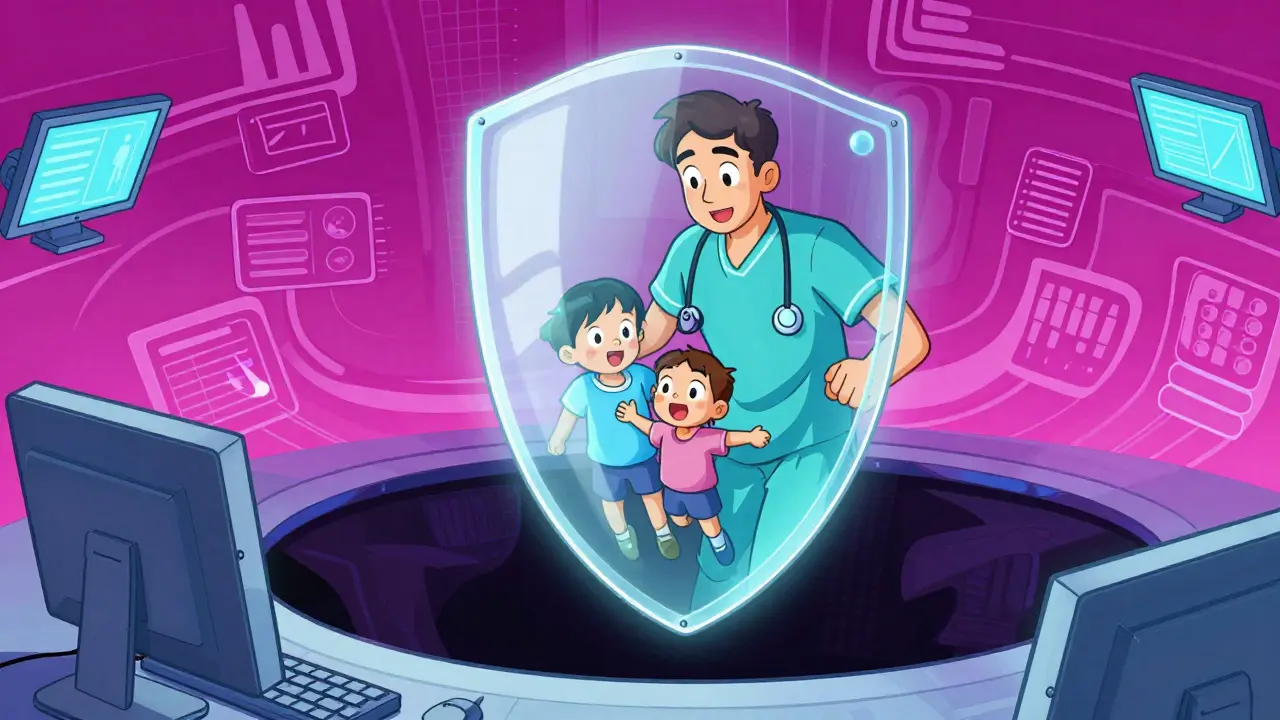
What does this look like on the ground? Before 2024, if your income dropped and you moved from CHIP to Medicaid, you often had to reapply completely. Now, many integrated systems recognize the change instantly. Data shows this has helped reduce 'enrollment gaps'-moments where a child technically qualifies for help but slips through the cracks due to paperwork delays. In places like Massachusetts and Oregon, which adopted advanced automated features early, these gaps dropped to under 8%. In contrast, states that lagged on digital integration still saw gap rates hover around 21%.
Real-Life Consequences for Families
Policies sound abstract until you meet the families affected. Consider the scenario of a warehouse worker in Ohio whose employer stops paying premiums after his hours were cut. Without flexible exemption rules, he would have waited 90 days to access public coverage for his daughter. Instead of immediate relief, the family faced a three-month window of zero care access.
Conversely, states like Minnesota developed 'Bridge Programs.' These initiatives share data between public and private insurers in real-time. If a family loses employer coverage, the public system lights up immediately. A case study from 2022 showed this reduced substitution-related gaps by 63%.
There is always a trade-off, though. A Texas administrator noted that without strict rules, they'd see parents drop good employer coverage for 'free' state coverage. That saves the family cash upfront but hurts the overall stability of the private insurance pool. The challenge remains balancing taxpayer protection with genuine access to care for vulnerable kids.
Future Trends and Enforcement
Looking ahead from our vantage point in 2026, the trend is undeniable: automation is winning. We are seeing fewer manual paper verifications and more seamless digital handshakes between programs. Experts project that by 2027, nearly all states will run automated matching systems, cutting manual verification times from weeks to seconds.
However, enforcement complexity grows with the market. Short-term limited-duration insurance plans grew by 78% between 2018 and 2023. These fluctuating private plans are harder for public databases to track. New rules now require states to account for this volatility when determining affordability and substitution eligibility. The ultimate goal remains steady: keep public funds targeted and private markets intact, without forcing a family to choose between health and financial ruin.
Does Medicaid replace my private insurance?
Generally, no. Medicaid acts as the payer of last resort. If you have accessible private insurance, that plan must pay first. Medicaid may cover services the private plan misses, but it won't take the place of your employer coverage unless it is unaffordable or unavailable.
How long is the CHIP waiting period?
States can set a waiting period of up to 90 days. This applies if you voluntarily dropped private coverage to enroll in CHIP. Exemptions often exist for job losses or premium costs that exceed a certain percentage of income.
Do all states follow the same rules?
They follow the same federal mandates regarding priority of payment, but implementation varies. Some states rely heavily on 90-day waiting periods, while others prioritize real-time database checks or offer more extensive hardship exemptions.
What happens if I lose my job?
If you lose your job, you typically qualify for an exemption to the waiting period. Most states recognize involuntary job loss as a valid reason to skip the 90-day delay and provide immediate coverage eligibility.
How do states know if I have private insurance?
Methods vary. Many states use electronic databases that query private insurers automatically. Others request proof of coverage annually or biannually via household surveys, which parents must complete during their renewal process.
Jordan Marx
March 26, 2026 AT 11:53The integration of CMS protocols is really shifting how states manage subsidy thresholds. We need to look closer at Section 2102(b)(3)(C) requirements. It creates a mandatory baseline for CHIP enrollment verification processes. Most agencies struggle with the data-sharing aspects initially. There is a distinct gap between federal mandates and local execution. States using database monitoring see higher accuracy rates overall. Household surveys introduce significant human error variables during re-enrollment. The waiting period implementation varies significantly across regions like Texas. California uses the full ninety-day buffer for voluntary drops. Florida exemptions seem more flexible regarding involuntary job loss scenarios. Administrative headaches often stem from income fluctuation triggers. Automated transition protocols help reduce enrollment gaps substantially. Massachusetts saw a drop in coverage interruptions with early adoption. Oregon lagged slightly behind in integrating digital handshakes effectively. By 2027 the trend points toward full automation of matching systems. This reduces manual verification times from weeks down to mere seconds.
I anticipate further regulation changes next fiscal year.
walker texaxsranger
March 27, 2026 AT 16:38they are tracking everything anyway databases share info without us knowing big brother is watching your premiums dont trust the automated systems they want control over who gets treated
its always about data collection first
Shawn Sauve
March 29, 2026 AT 14:10I understand the concern but the goal here is actually child safety during transitions :) we have to balance privacy with access to care for vulnerable families
lets keep the discussion constructive please
kendra 0712
March 31, 2026 AT 08:21This is SO amazing that they are finally fixing the gaps!! The bridge programs in Minnesota are such a huge win for families!!!
I am so excited about the future of healthcare access for everyone!!! Hope this keeps improving!!!
Monique Louise Hill
April 1, 2026 AT 17:35Children are innocent and deserve protection above all else 😢😡 It is morally wrong to make parents choose between food and coverage 💔💔👶
We need stricter protections for the little ones always ❤️🩹🙏
Devon Riley
April 3, 2026 AT 16:57You are absolutely right about prioritizing the children 🥺 It takes a village to ensure these safety nets hold 🙌
Keeping families stable is the most important part of this system 🤝
Sarah Klingenberg
April 4, 2026 AT 23:03It is fascinating to see how many different methods states use :) Some rely on checks while others use surveys totally different vibes
Just shows how complex policy gets depending on location)
Rachael Hammond
April 6, 2026 AT 09:51i thogt about fairness alot when reading this geverment systems can feel cold sometimes
the real question is whether the tech solves the human problem or just makes it faster to process mistakes
Eva Maes
April 6, 2026 AT 19:52The bureaucratic labyrinth continues to strangle efficient delivery mechanisms. This colorblind policy ignores the chaotic reality of working-class instability. Taxpayer protection sounds noble but feels like bloodletting disguised as savings.
Administrators play god with family survival timelines while counting pennies.
Tommy Nguyen
April 8, 2026 AT 13:33It really helps kids stay covered when these systems work properly.