
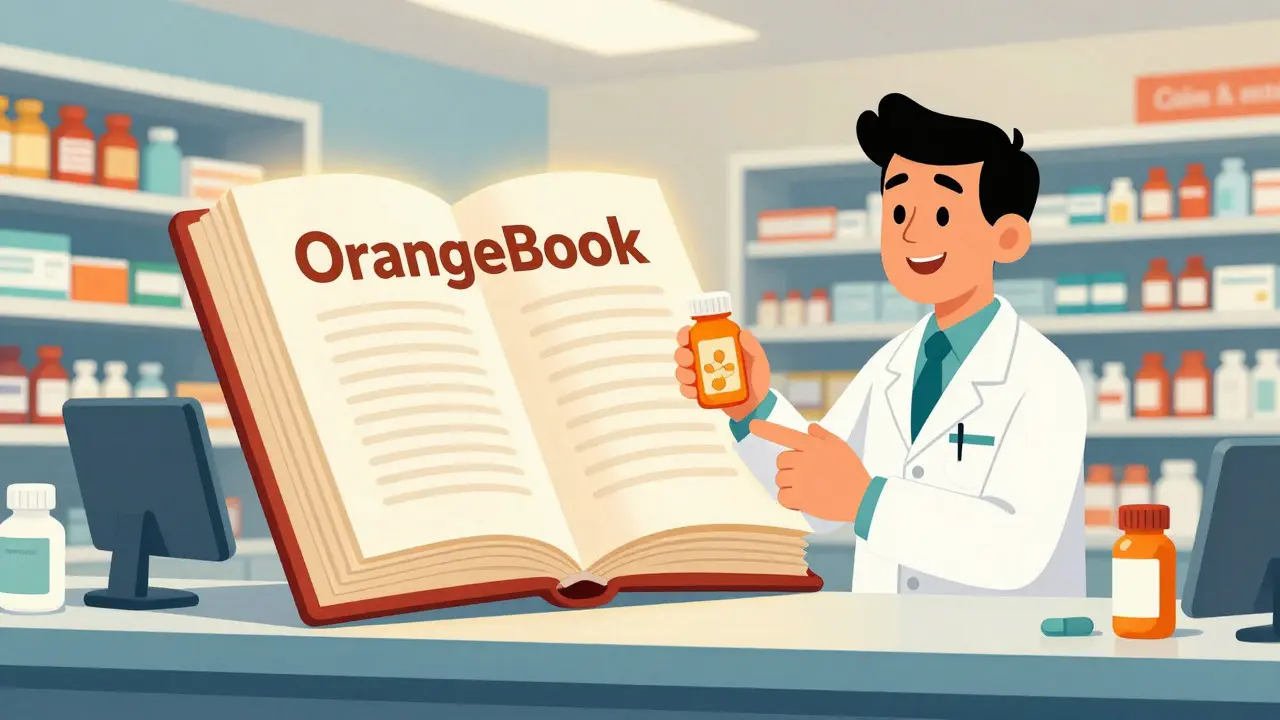
Ever wonder why your pharmacist swaps the brand-name pill you prescribed for a cheaper generic without asking? It’s not just about saving money. It’s because of a specific legal and scientific framework that tells them it’s safe to do so. That framework relies on FDA therapeutic equivalency codes. These alphanumeric labels determine whether a generic drug can legally replace its brand-name counterpart in the United States.
If you’ve ever picked up a prescription and noticed a different manufacturer name, or if you’re a healthcare provider trying to navigate complex dosage forms, understanding these codes is crucial. They aren't just bureaucratic tags; they are the gatekeepers of patient safety and cost savings. Let’s break down how this system works, what the letters actually mean, and how state laws tie into the FDA's decisions.
The Legal Backbone: Hatch-Waxman and the Orange Book
To understand substitutability, you have to look at where the rules come from. The modern generic drug market in the U.S. was born out of the Hatch-Waxman Amendments, formally known as the Drug Price Competition and Patent Term Restoration Act of 1984. Before this law, getting a generic approved was nearly impossible due to heavy regulatory hurdles. Hatch-Waxman created a streamlined pathway called the Abbreviated New Drug Application (ANDA).
This pathway allows generic manufacturers to skip some of the expensive clinical trials required for new drugs, provided they prove their product is bioequivalent to the original. To track which generics meet this standard, the FDA publishes the Orange Book, officially titled "Approved Drug Products with Therapeutic Equivalence Evaluations". First published in 1980 but significantly expanded after 1984, this book is the definitive reference for pharmacists and doctors. As of late 2023, it lists over 14,000 approved products. If a drug isn’t in the Orange Book, or if it has a specific code restriction, substitution might be off the table by default.
Decoding the Letters: A vs. B Ratings
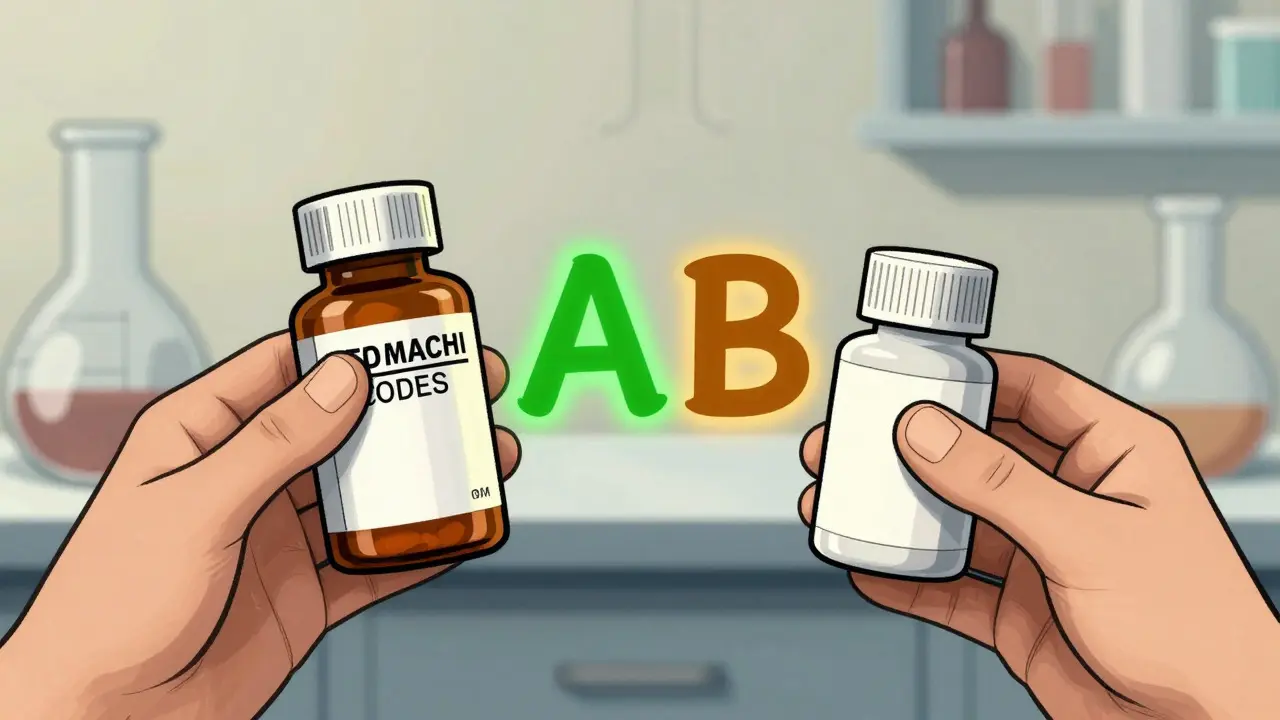
The core of the system is a simple two-letter code. The first letter tells you the big picture: is this drug therapeutically equivalent to the brand-name version?
- 'A' Codes: These are the green lights. An 'A' rating means the FDA considers the generic interchangeable with the brand-name drug. You can expect the same clinical effect and safety profile. This is the vast majority of generics you’ll see in pharmacies today.
- 'B' Codes: These are the red flags or caution signs. A 'B' rating indicates there are unresolved questions about bioequivalence. This doesn’t necessarily mean the drug is bad, but it means the science hasn’t fully proven it performs exactly like the brand-name version in all scenarios. For many 'B' coded drugs, the prescriber must specifically choose that generic; the pharmacist cannot automatically substitute it.
The second letter provides more nuance. For example, an 'AA' code typically refers to immediate-release oral tablets or capsules with no issues. An 'AB' code is interesting-it usually means the product initially had concerns ('B') but later provided additional data proving equivalence, upgrading it to an 'A' status while keeping the historical marker. Then there are specialized codes like 'BC' for extended-release forms or 'BN' for nebulizer products, which often face stricter scrutiny because delivering medication via mist is harder to standardize than swallowing a pill.
Bioequivalence: The Science Behind the Code
What does "therapeutic equivalence" actually require? It’s not just about having the same active ingredient. The FDA requires three things for an 'A' rating:
- Pharmaceutical Equivalence: Same active ingredient, strength, dosage form, and route of administration.
- Bioequivalence: The generic must release the drug into the bloodstream at the same rate and extent as the brand-name Reference Listed Drug (RLD). This is usually proven through blood tests in healthy volunteers.
- Safety and Efficacy: No new safety signals compared to the reference product.
This is where it gets tricky for complex drugs. Simple pills are easy to test. But what about inhalers, eye drops, or patches? The body absorbs these differently, and small formulation changes can have big impacts. This is why 'B' codes persist for these categories. For instance, a generic inhaler might deliver the right amount of medicine, but if the particle size differs slightly, it might not reach the lungs effectively. Until the FDA sees robust data proving otherwise, it stays a 'B'.
State Laws and the Pharmacist’s Role
Here’s a common misconception: The FDA decides if a drug *can* be substituted, but state laws decide if it *must* or *should* be. All 50 states have substitution statutes, but they vary in strictness. Most states, including California and New York, mandate that pharmacists check the current Orange Book before swapping a prescription.
In practice, this means the pharmacist pulls up the electronic record, sees the TE code, and makes a decision. If it’s an 'AA', they swap it, notify you, and save you money. If it’s a 'B', they call the doctor. This legal requirement protects patients from unintended side effects or reduced efficacy. According to a 2021 study in the *Journal of Generic Medicines*, 94.7% of generic prescriptions dispensed involve 'A' rated products, showing how reliable this system has become for the bulk of daily healthcare needs.

Why Do Some Generics Stay 'B'?
You might ask: if the drug works, why keep it as a 'B'? There are a few reasons. First, science takes time. Complex delivery systems require sophisticated studies that take years to complete. Second, there’s economic pressure. Brand-name manufacturers sometimes file citizen petitions with the FDA to challenge a generic’s rating, hoping to delay competition. In 2022 alone, the FDA received over 1,200 such petitions. While most are resolved quickly, they can create temporary uncertainty. Finally, some generics simply haven’t been tested enough yet. The FDA is actively working to reduce the 'B' code backlog, aiming to bring that percentage down from 24% to under 15% by 2027 through initiatives focused on complex generics.
| Code | Meaning | Substitution Status | Typical Examples |
|---|---|---|---|
| AA | Therapeutically equivalent, immediate-release oral | Automatic substitution allowed | Lisinopril, Metformin |
| AB | Initially B-rated, now proven equivalent | Automatic substitution allowed | Certain antibiotic formulations |
| BC | Extended-release dosage form, potential BE issues | Requires prescriber approval | Some pain management ER tablets |
| BN | Aerosol-nebulizer delivery systems | Requires prescriber approval | Asthma inhalers, COPD meds |
| BX | Insufficient data to determine equivalence | No automatic substitution | Newly launched complex generics |
The Bottom Line for Patients and Providers
For patients, the takeaway is simple: trust the process, but stay informed. If your pharmacist substitutes a drug, it’s likely because the FDA has vetted it as safe and effective. However, if you’re taking a narrow therapeutic index drug (like warfarin) or a complex inhaler, ask your doctor if switching brands matters. For providers, the Orange Book is your bible. With digital access now integrated into many Electronic Health Record (EHR) systems, checking the current TE code is faster than ever. The system isn’t perfect-complex drugs still pose challenges-but it has enabled $1.7 trillion in healthcare savings since 1995 without compromising quality. It remains one of the most successful regulatory innovations in pharmaceutical history.
Can I switch between different generic brands of the same drug?
Generally, yes, if both carry an 'A' rating. Since they are both deemed therapeutically equivalent to the brand-name RLD, they should produce the same clinical effect. However, individual sensitivity to inactive ingredients (fillers/dyes) can vary, so consistent use of one manufacturer is often preferred for stability.
What does a 'B' code actually mean for my prescription?
It means the FDA has not yet concluded that the generic is fully interchangeable with the brand-name drug. Your pharmacist likely cannot swap it automatically. You may need to ask your doctor to prescribe that specific generic if you want to try it, or stick with the brand-name version until the code changes.
Where can I check the current TE code for a medication?
You can search the FDA’s online Orange Book database for free. It updates monthly. Many pharmacy software systems also display the code directly in the patient profile, making it easy for pharmacists to verify compliance with state substitution laws.
Are over-the-counter (OTC) drugs assigned TE codes?
No. The FDA does not assign therapeutic equivalency codes to OTC products. The system applies only to multisource prescription drugs approved under Section 505 of the Federal Food, Drug, and Cosmetic Act.
How long does it take for a generic to get an 'A' code?
The average time from ANDA submission to TE code assignment is about 10.3 months for standard products. Complex products, like inhalers or injectables, can take up to 18.7 months or longer due to the need for more extensive bioequivalence testing.