

Have you ever been prescribed antibiotics for a simple infection, only to have your doctor or pharmacist tell you to use condoms as well? You’re not alone. For decades, this advice has been standard practice, creating a widespread belief that almost any antibiotic can make your birth control pills fail. But here is the surprising truth: for the vast majority of people, this warning is based on outdated science and persistent myths.
The idea that antibiotics interfere with hormonal contraception dates back to the 1970s. Early case reports suggested a link, but modern medical research has largely debunked it for common drugs. Today, major health organizations like the Centers for Disease Control and Prevention (CDC) and the American College of Obstetricians and Gynecologists (ACOG) agree that most antibiotics do not reduce the effectiveness of combined hormonal contraceptives. However, there are critical exceptions. Understanding which drugs actually pose a risk-and which don’t-can help you avoid unnecessary anxiety and make informed decisions about your reproductive health.
Why the Myth Persists
To understand why so many people still believe antibiotics kill birth control, we need to look at how the theory started. In the early days of oral contraceptives, researchers hypothesized that broad-spectrum antibiotics might kill the gut bacteria responsible for recycling estrogen. Estrogen is absorbed in the intestines, excreted into bile, and then reabsorbed by bacteria before entering the bloodstream again. If antibiotics wiped out those bacteria, the theory went, estrogen levels would drop, potentially leading to ovulation and pregnancy.
This mechanism sounds logical, but clinical trials have repeatedly failed to prove it works in real life. A systematic review published in the journal Contraception in 2011 analyzed 14 studies involving penicillin-class antibiotics. The results showed that these drugs did not reduce gut bacterial concentrations enough to affect estrogen absorption. Serum estradiol levels remained within normal therapeutic ranges (200-400 pg/mL) throughout treatment. Despite this evidence, the myth stuck. Dr. Eve Espey, past chair of ACOG’s Committee on Gynecologic Practice, noted in a 2020 interview that the persistence of the myth stems from early, non-rigorous case reports rather than solid data.
Furthermore, confusion often arises from user error. When women get sick, they may experience vomiting or diarrhea, which can prevent the pill from being absorbed properly. This isn’t the antibiotic’s fault; it’s the illness itself. Yet, because the two events happen simultaneously, the medication gets blamed. A 1999 article in Contraception reported 16 cases of contraceptive failure among women taking antibiotics, but subsequent analysis revealed that most involved specific enzyme-inducing drugs or missed doses due to sickness.
The Real Culprits: Enzyme Inducers
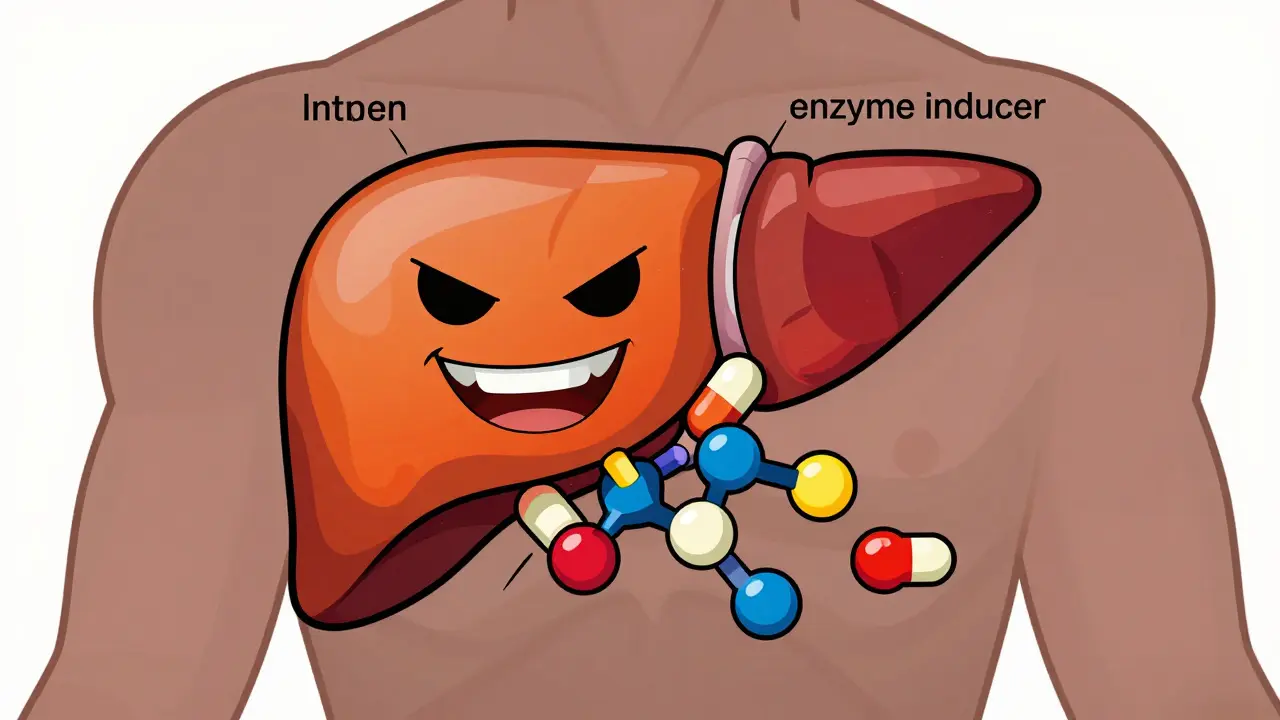
While most antibiotics are safe, there is a small group of medications that genuinely interact with birth control. These are known as enzyme inducers. They work by increasing the activity of cytochrome P450 enzymes in the liver. These enzymes are responsible for breaking down hormones. When their activity spikes, they metabolize ethinyl estradiol and progestin much faster than usual, lowering hormone levels below the threshold needed to suppress ovulation.
| Medication Class | Specific Drugs | Mechanism | Risk Level |
|---|---|---|---|
| Rifamycins | Rifampin, Rifabutin | Increase liver enzyme activity by up to 300% | High (Category 3) |
| Antifungals | Griseofulvin | Accelerates hormone metabolism | High (Category 3) |
| Anticonvulsants | Lamotrigine, Topiramate | Induces hepatic enzymes | Moderate to High |
| Herbal Supplements | St. John’s Wort | Reduces ethinyl estradiol by up to 57% | High |
Rifampin is the most well-known antibiotic that interacts with birth control. Introduced in 1967 for treating tuberculosis, it is a potent enzyme inducer. According to a 2018 study in Pharmacotherapy, rifampin reduces ethinyl estradiol plasma concentrations by 25-50% and progestin concentrations by 14-37%. Because of this significant drop, the CDC classifies rifampin as a Category 3 interaction, meaning the risks usually outweigh the advantages if backup contraception isn't used. You must use a backup method, such as condoms, for 28 days after finishing the course of rifampin.
Rifabutin is another rifamycin antibiotic used primarily for mycobacterial infections. It behaves similarly to rifampin and requires the same precautions. Griseofulvin, an antifungal medication introduced in 1958, also falls into this high-risk category. Although it’s not an antibiotic in the traditional sense, it is often grouped with them in patient discussions. WebMD guidelines recommend using backup contraception for one month after completing griseofulvin treatment.
Common Antibiotics That Are Safe
If you’ve been prescribed amoxicillin, azithromycin, doxycycline, or ciprofloxacin, you can breathe easy. These are the most commonly prescribed antibiotics for conditions like strep throat, urinary tract infections, sinus infections, and acne. Extensive research shows they have no clinically significant impact on contraceptive hormone levels.
- Amoxicillin: Often used for respiratory and ear infections. A 2011 review confirmed it does not lower estrogen levels.
- Azithromycin (Zithromax): Commonly prescribed for bronchitis and pneumonia. No interaction found.
- Doxycycline (Vibramycin): Frequently used for acne and Lyme disease. Studies show stable hormone levels during use.
- Ciprofloxacin (Cipro): Used for UTIs and certain gastrointestinal infections. Safe to combine with birth control.
- Metronidazole (Flagyl): Treats anaerobic bacterial infections and parasitic diseases. No effect on contraception.
The CDC’s 2020 analysis of 35 clinical trials confirmed that non-rifamycin antibiotics do not reduce contraceptive hormone concentrations to sub-therapeutic levels (below 50 pg/mL for ethinyl estradiol). The FDA updated its labeling for all hormonal contraceptives in January 2023 to explicitly state that "other antibiotics do not affect effectiveness," aiming to clear up this long-standing confusion.
Other Medications to Watch
While antibiotics get most of the blame, other types of medications can significantly interfere with birth control. It’s important to be aware of these if you take multiple prescriptions.
Certain antiseizure drugs, such as lamotrigine and topiramate, are enzyme inducers. The American Academy of Neurology’s 2020 guidelines note that lamotrigine at doses ≥300 mg/day and topiramate at doses >200 mg/day can reduce contraceptive efficacy. Similarly, some antiretrovirals used in HIV treatment, particularly efavirenz and nevirapine, pose a risk according to the World Health Organization’s 2019 guidelines.
Don’t overlook herbal supplements. St. John’s wort (Hypericum perforatum) is a popular remedy for mild depression, but it is a powerful enzyme inducer. A 2017 study in Clinical Pharmacology & Therapeutics found it could reduce ethinyl estradiol levels by up to 57%. If you take St. John’s wort, you should definitely use backup contraception.
What Do Doctors Say?
There is a strong consensus among major medical bodies, but you might still hear conflicting advice in the clinic. The CDC’s 2021 US Medical Eligibility Criteria for Contraceptive Use states clearly that "broad-spectrum antibiotics do not reduce the concentration of hormones in combined hormonal contraceptives to a sub-therapeutic level." ACOG supports this, stating in their 2022 Practice Bulletin No. 234 that there is no evidence most antibiotics decrease effectiveness.
However, the American Academy of Family Physicians (AAFP) takes a more conservative stance. In a 2019 publication, they noted that while the absolute risk is small, advising patients to use backup contraception is a "conservative approach" that minimizes anxiety and potential regret. This divergence reflects the difficulty of changing long-held beliefs. Dr. Jen Gunter, an OB/GYN and author, has been vocal about debunking this myth, citing "zero evidence that common antibiotics like amoxicillin affect birth control" in her 2021 book The Menopause Manifesto.
Patient surveys reveal the gap between science and perception. A 2022 Planned Parenthood survey of 1,500 patients found that 62% believed antibiotics reduced birth control effectiveness. Consequently, 43% used backup methods unnecessarily. On social media platforms like Reddit, threads discussing this topic are filled with concern, with many users reporting being advised by pharmacists to use condoms despite taking safe antibiotics.

Practical Steps for Patients
So, what should you do when you pick up a prescription? Here is a simple guide to navigating antibiotic and birth control interactions.
- Check the Name: Is it rifampin, rifabutin, or griseofulvin? If yes, use backup contraception (condoms) for the duration of the treatment and for 28 days afterward.
- Ask Your Pharmacist: Don’t hesitate to ask, "Does this specific medication interact with my birth control?" Pharmacists have access to detailed interaction databases.
- Watch for Side Effects: If you experience severe vomiting or diarrhea while on antibiotics, your pill absorption may be compromised regardless of the drug. In this case, use backup protection until your symptoms resolve and you’ve taken active pills for seven consecutive days.
- Don’t Panic Over Common Drugs: If you’re taking amoxicillin, doxycycline, or azithromycin, you do not need extra protection unless you prefer it for peace of mind.
It’s also worth noting that confusion often arises between similar-sounding drugs. For example, rifaximin (Xifaxan), used for traveler’s diarrhea, does not interact with birth control, unlike rifampin. Always double-check the spelling on your prescription label.
Conclusion
The fear that antibiotics will render your birth control ineffective is largely a relic of the past. While enzyme-inducing drugs like rifampin and griseofulvin pose a real risk, the common antibiotics prescribed for everyday infections do not. By understanding the difference, you can avoid unnecessary stress and rely on accurate medical guidance. Always consult your healthcare provider or pharmacist for personalized advice, but rest assured that for most people, taking amoxicillin or doxycycline won’t compromise their contraception.
Do antibiotics really make birth control pills less effective?
For most common antibiotics like amoxicillin, azithromycin, and doxycycline, no. Extensive research shows they do not lower hormone levels enough to cause contraceptive failure. However, specific enzyme-inducing antibiotics like rifampin and rifabutin do reduce effectiveness and require backup contraception.
Which antibiotics interact with birth control?
The primary antibiotics that interact with birth control are rifampin and rifabutin, which are used to treat tuberculosis and other mycobacterial infections. Griseofulvin, an antifungal, also interacts. These drugs increase liver enzyme activity, speeding up the breakdown of contraceptive hormones.
How long do I need to use backup contraception after taking rifampin?
You should use backup contraception, such as condoms, during the entire course of rifampin treatment and for 28 days after you finish the medication. This ensures that hormone levels remain stable and ovulation is suppressed.
Can vomiting or diarrhea from an infection affect birth control?
Yes. Severe vomiting or diarrhea can prevent your body from absorbing the birth control pill properly, regardless of whether you are taking antibiotics. If this happens, use backup contraception until you have taken active pills for seven consecutive days without issues.
Does St. John's Wort interact with birth control?
Yes, St. John's Wort is a herbal supplement that acts as a potent enzyme inducer. It can significantly reduce ethinyl estradiol levels, making birth control less effective. Users should avoid combining it with hormonal contraceptives or use reliable backup protection.