
Immunosuppressant Probiotic Risk Checker
Assess Your Risk
Answer these questions to determine if probiotics are safe for you.
When you’re on immunosuppressants-whether for a transplant, autoimmune disease, or cancer treatment-your body’s natural defenses are turned down. That’s why even small things, like a cold or a bug in your gut, can become serious. Now add probiotics into the mix: those live bacteria and yeasts sold in pills, yogurts, and powders. Many people think they’re harmless, even helpful. But for people with weakened immune systems, probiotics aren’t always safe. In fact, they can cause life-threatening infections.
What Happens When Probiotics Go Wrong?
Probiotics aren’t magic. They’re living microbes. In healthy people, they mostly stay in the gut, helping with digestion and balancing other bacteria. But in someone on immunosuppressants, the gut barrier can become leaky, and the immune system can’t stop those microbes from slipping into the bloodstream. Once there, they can spread to organs, causing sepsis, heart infections, or fungal infections in the blood. The most dangerous strains? Lactobacillus rhamnosus GG and Saccharomyces boulardii. The yeast Saccharomyces boulardii is especially risky. It’s been linked to 12 out of 47 documented probiotic-related infections between 2000 and 2020. In one study, patients with central IV lines who took Saccharomyces had a 27% higher chance of getting a bloodstream infection. And when that infection happened, 22% of patients died. A 2021 review found that 83% of all probiotic-related infections occurred in people with weakened immune systems. That’s not a coincidence. It’s a direct result of the body’s inability to fight back.Who’s at the Highest Risk?
Not everyone on immunosuppressants is equally at risk. The danger depends on how weak your immune system is and what kind of treatment you’re on.- Neutropenia (ANC <500 cells/µL): If your white blood cell count is this low-common during chemo-you’re in the highest risk group. Most cancer centers in the U.S. tell patients to avoid probiotics entirely during this time.
- Recent organ transplant: Especially in the first 3 months after transplant, when immunosuppression is strongest. Bone marrow transplant patients have a 4.2 times higher risk of probiotic-related bacteremia.
- Central venous catheters: Any tube going into a major vein is a direct path for microbes to enter the blood. Saccharomyces boulardii is especially dangerous here.
- Low CD4 count (HIV): If your CD4 count is below 100, your risk of fungal infections from probiotics jumps 3.8 times.
Who Might Be Safe?
It’s not all black and white. Some people on immunosuppressants can use probiotics safely-if they’re careful. Liver transplant patients, for example, saw a 34% drop in bacterial infections in one major study, with no increase in serious side effects. That’s because their immune systems recover faster than bone marrow or lung transplant patients. HIV patients with CD4 counts above 200 show almost no increased risk. People on single-drug regimens for stable autoimmune conditions-like methotrexate alone-have reported no problems with probiotics in real-world use. The key? Not all probiotics are the same. A 2022 study found that single-strain products had 63% less chance of causing translocation than multi-strain blends. So if you’re low-risk and your doctor approves, stick to one well-studied strain, not a mix of 10+ bacteria.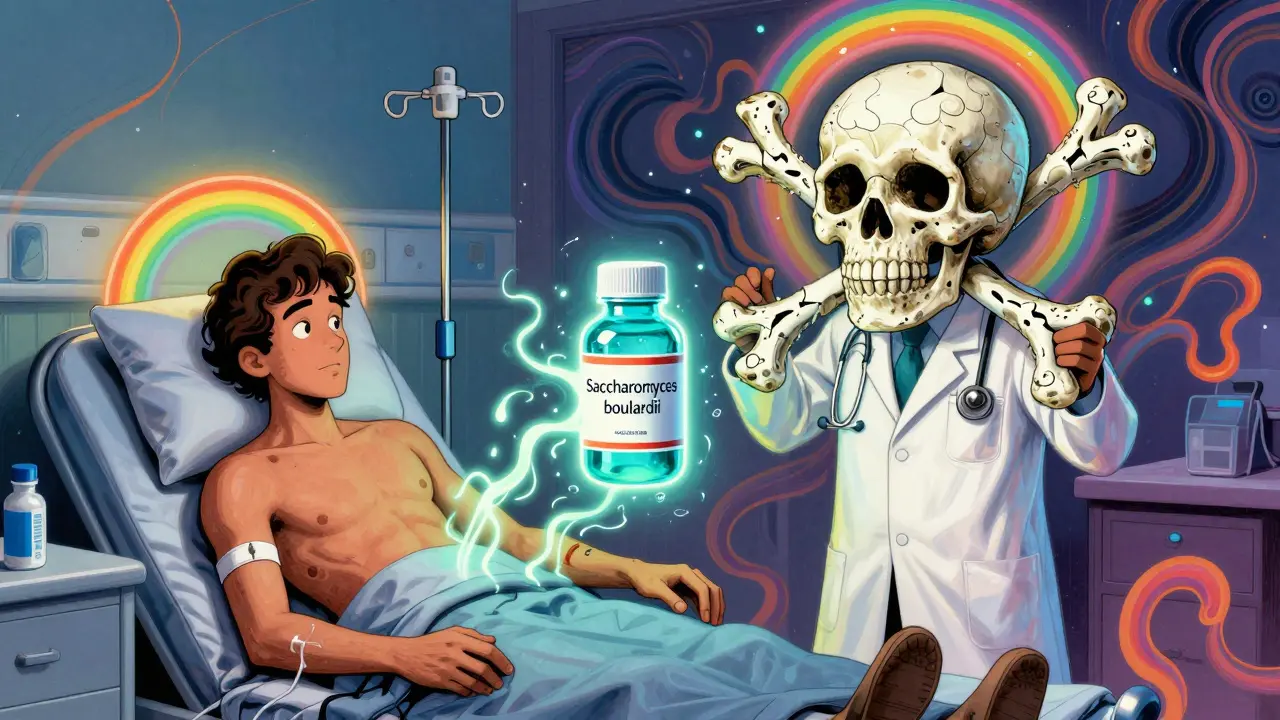
What Do Experts Actually Say?
There’s no single answer. Different groups give different advice. The European Society for Clinical Nutrition and Metabolism (ESPEN) says: avoid probiotics entirely in critically ill immunosuppressed patients. The American Gastroenterological Association says: maybe use one specific strain for liver disease, but only weakly recommended. The Infectious Diseases Society of America (IDSA) breaks it down into four risk levels:- High risk (neutropenia, recent stem cell transplant, central lines): Absolutely avoid.
- Moderate risk (solid organ transplant within 3 months, multiple immunosuppressants): Only use after consulting an infectious disease specialist.
- Lower risk (stable autoimmune disease on one drug, CD4 >200): Consider a single strain, under supervision.
- Low risk (no immunosuppression): Standard use is fine.
What Should You Do?
If you’re on immunosuppressants, don’t guess. Talk to your doctor-and make sure they know you’re taking or thinking about probiotics. Ask these questions:- What’s my current immune status? (Neutrophil count? CD4 count?)
- Am I in the first 3 months after transplant or undergoing active chemo?
- Do I have a central line or port?
- If yes to any of these, should I avoid probiotics entirely?
- Which strain? (Example: Lactobacillus rhamnosus GG ATCC 53103, not just “Lactobacillus”)
- How many CFUs? (Dose matters)
- Is it single-strain or multi-strain?
- What symptoms should I watch for? (Fever over 101°F, chills, abdominal pain, nausea)
What About Alternatives?
If you’re worried about infection but still want gut support, there are safer options. Postbiotics are the newest frontier. These are not live microbes-they’re the harmless byproducts bacteria leave behind, like short-chain fatty acids. A 2024 clinical trial showed postbiotics reduced C. difficile infections in immunocompromised patients by 40%, with zero infections linked to the treatment. Fermented foods like yogurt, kefir, sauerkraut, and kimchi are generally safe because they contain far fewer microbes than supplements, and the strains are usually less aggressive. They’re also not concentrated enough to cause bloodstream infections in most cases. And if you’re just trying to prevent antibiotic-associated diarrhea, the evidence is clear: probiotics work. But only if your immune system can handle them.
Courtney Carra
January 19, 2026 AT 23:37So let me get this straight-we’re telling people with weakened immune systems to avoid live bacteria, but we’re fine with injecting them with chemo that kills their entire immune system? 🤔
Maybe the real problem isn’t probiotics-it’s that we’re treating the body like a broken machine instead of a living system.
We patch holes with drugs, then panic when the patch leaks.
What if the answer isn’t more control, but more trust?
Not in supplements-but in the body’s ability to heal, if given the right environment.
Probiotics are just the scapegoat.
The real villain is the industrial medical complex that profits from fear and pills.
And don’t even get me started on how they market ‘gut health’ like it’s a TikTok trend.
Meanwhile, people are dying from IV lines and hospital infections that no one talks about.
So yeah-I’m not taking probiotics.
But I’m also not trusting the system that told me to take them in the first place.
Art Gar
January 20, 2026 AT 01:48It is imperative to underscore, with the utmost academic rigor, that the utilization of probiotic organisms in immunocompromised populations constitutes a demonstrable violation of established principles of microbial pathogenesis and clinical safety protocols.
The data presented in the source material is not merely suggestive-it is statistically robust, peer-reviewed, and corroborated by multiple prospective cohort studies.
To suggest otherwise is to engage in dangerous pseudoscientific populism.
There is no ‘gray area’ when sepsis is involved.
The FDA’s labeling requirement for Saccharomyces boulardii is not a suggestion-it is a legal mandate based on preventable mortality.
Any deviation from strict avoidance in high-risk groups is indefensible.
One death is one too many.
And yet, we still see Reddit users advocating for ‘natural remedies’ as if the human body operates on Instagram algorithms.
It does not.
It operates on biology.
And biology does not care about your feelings.
clifford hoang
January 20, 2026 AT 14:49EVERYONE KNOWS THIS IS A PHARMA SCAM.
They don’t want you to heal naturally-they want you hooked on drugs that make them billions.
Probiotics? They’re the only thing keeping your gut alive while your immune system is being nuked by chemo.
But the FDA? They’re in bed with Big Pharma.
Remember when they banned vitamin C for cancer patients in the 70s?
Same playbook.
Saccharomyces boulardii? That’s a yeast that’s been used for centuries in Europe.
Now it’s ‘dangerous’ because it can’t be patented.
Meanwhile, the real killers are the central lines and antibiotics they give you-those are ‘medically necessary.’
But a little friendly bacteria? ‘Nope, that’s a biohazard.’
Wake up.
The system is rigged.
And if you’re taking probiotics and get sick? They’ll blame the supplement.
Not the 12 IVs they shoved in your chest.
Not the 37 antibiotics that killed your microbiome.
Nope.
It’s always the ‘natural’ thing.
It’s always the thing they can’t control.
It’s always the thing they can’t patent.
They’re scared.
And you’re being lied to.
Just sayin’.
Carolyn Rose Meszaros
January 20, 2026 AT 15:22Thank you for writing this. I’m a transplant recipient and I’ve been terrified to even think about probiotics since my surgery.
But I’ve also been really lonely in this fear-like no one talks about it.
I’ve been eating kefir and sauerkraut, just because it feels normal.
And now I feel like I’m doing something ‘wrong’ for wanting to feel like myself again.
But your post made me feel less alone.
And honestly? I’m going to keep talking to my doctor about it.
Not because I want to ‘optimize’ my gut.
But because I want to feel like I’m still alive.
Not just surviving.
Living.
And that’s okay.
It’s okay to want that.
And it’s okay to ask for help.
You’re not alone.
Greg Robertson
January 22, 2026 AT 04:06Just wanted to say I really appreciate how clear and calm this post is.
I’m on methotrexate for RA and my rheumatologist told me I could try a single-strain probiotic if I wanted.
I’ve been taking L. rhamnosus GG for 8 months now with no issues.
But I didn’t just grab something off the shelf-I asked for the exact strain, the CFU count, and the batch number.
And I’ve been keeping a journal.
It’s not about being paranoid.
It’s about being smart.
And honestly? I think more people should talk like this.
Not with fear.
But with care.
Renee Stringer
January 22, 2026 AT 10:12It’s irresponsible to even suggest that probiotics could be ‘safe’ for anyone on immunosuppressants.
There is no ‘low-risk’ when your immune system is compromised.
That’s not a spectrum-it’s a cliff.
One misstep and you’re in the ICU.
And now people are casually eating kimchi like it’s a vitamin?
That’s not wellness.
That’s negligence.
And if someone gets sick because they read this and thought ‘I’m fine,’ who’s responsible?
Not the supplement.
Not the yeast.
But the person who made it sound like a choice.
It’s not a choice.
It’s a gamble.
And someone’s life is on the line.
Crystal August
January 22, 2026 AT 13:23Okay but what if you’re just trying to stop diarrhea from antibiotics?
Is that not a valid reason?
And why are we assuming all probiotics are the same?
Yogurt isn’t a supplement.
It’s food.
And if I can’t eat yogurt because of some FDA warning, then what’s next?
No cheese?
No sourdough?
Are we going to ban fermentation?
Because that’s what this feels like.
Science is being weaponized to scare people away from real food.
And I’m not buying it.
Also-I’ve had probiotics for 5 years and I’m still alive.
So maybe the risk isn’t as universal as they say.
Or maybe I’m just lucky.
But I’m not giving up my sauerkraut.
Nadia Watson
January 23, 2026 AT 13:10Thank you for this thoughtful, meticulously referenced post.
As someone who works in global public health, I’ve seen how misinformation around microbiome interventions spreads rapidly in low-resource settings-often with tragic consequences.
It’s heartbreaking to see the same patterns repeat here, even in high-income countries.
People are desperate for control over their health.
And when the medical system feels distant or dismissive, they turn to supplements as a form of agency.
But agency without knowledge is dangerous.
That’s why this post matters.
It doesn’t shame.
It informs.
It invites dialogue.
And it centers the patient’s voice.
That’s the model we need more of.
Not fear.
Not profit.
But clarity.
And care.
Thank you.
From a fellow human.
Shane McGriff
January 24, 2026 AT 13:41Hey-I just want to say this is one of the clearest, most compassionate posts I’ve read on this topic.
My mom had a kidney transplant last year and she was taking a probiotic because her ‘gut was off’-no doctor said it was okay.
She got sick. Turned out to be a Lactobacillus bloodstream infection.
She spent 18 days in the hospital.
She’s fine now.
But we almost lost her.
And honestly? I’m angry-not at her.
But at how little we’re told.
Why didn’t the pharmacist warn her?
Why didn’t the label say ‘DO NOT USE IF IMMUNOCOMPROMISED’ in bold letters?
Why did we assume ‘natural’ meant ‘safe’?
Thank you for giving us the language to talk about this.
And if you’re reading this and you’re on immunosuppressants?
Don’t guess.
Ask.
Write it down.
Bring the bottle.
And if your doctor says ‘it’s fine’-ask them to show you the study.
Because your life isn’t a risk you take lightly.
You’re worth more than that.